
Tools
-
Speed Up Model Training with torch.compile & Grad Accumulation
Read Full Article: Speed Up Model Training with torch.compile & Grad Accumulation Training deep transformer language models can be accelerated using two main techniques: torch.compile() and gradient accumulation. With the introduction of PyTorch 2.0, torch.compile() allows for the compilation of models, optimizing them for better performance by creating a computation graph. This compiled model shares the same tensors as the original model, but it is crucial to ensure the model is error-free before compiling, as debugging becomes more challenging. Gradient accumulation, on the other hand, is a method to simulate a larger batch size by accumulating gradients over multiple forward passes, reducing the number of backward passes and optimizer updates needed. This approach is particularly useful in memory-constrained environments, as it allows for efficient training without requiring additional memory. Adjustments to the learning rate schedule are necessary when using gradient accumulation to ensure proper training dynamics. These techniques are important for improving the efficiency and speed of training large models, which can be a significant bottleneck in machine learning workflows.
-
Training Models on Multiple GPUs with Data Parallelism
Read Full Article: Training Models on Multiple GPUs with Data Parallelism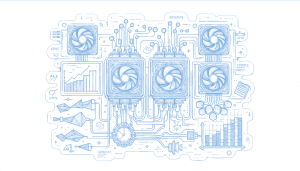 Training a model on multiple GPUs using data parallelism involves distributing data across various GPUs to enhance computational efficiency and speed. The process begins with defining a model configuration, such as the Llama model, which includes hyperparameters like vocabulary size, sequence length, and number of layers. The model utilizes components like rotary position encoding and grouped-query attention to process input data. A distributed data parallel (DDP) setup is employed to manage multiple GPUs, ensuring each GPU processes a portion of the data. The training loop involves loading data, creating attention masks, computing loss, and updating model weights using optimizers and learning rate schedulers. This approach significantly boosts training performance and is essential for handling large-scale datasets and complex models in machine learning. This matters because it enables efficient training of large models, which is crucial for advancements in AI and machine learning applications.
-
Testing Octaspace Cloud GPU Performance & Pricing
Read Full Article: Testing Octaspace Cloud GPU Performance & Pricing Octaspace Cloud GPU offers a compelling option for those in need of reliable GPU resources for tasks like PyTorch training and Stable Diffusion fine-tuning. The platform supports RTX 4090 and A100 instances, with a user-friendly setup process that includes easy integration of custom Docker images. Performance on the A100 instance is comparable to that of Lambda, with stable disk I/O and no unexpected slowdowns. Notably, Octaspace is consistently more affordable than competitors like RunPod and Lambda while providing similar performance. However, the platform only accepts cryptocurrency payments and has a limited number of locations. For users without local GPU access, Octaspace presents a cost-effective and reliable alternative. This matters because it provides an affordable and efficient solution for intensive computational tasks, which can be crucial for developers and researchers working with machine learning and AI models.
-
Building Self-Organizing Zettelkasten Knowledge Graphs
Read Full Article: Building Self-Organizing Zettelkasten Knowledge Graphs Building a self-organizing Zettelkasten knowledge graph with sleep-consolidation mechanisms represents a significant leap in Agentic AI, mimicking the human brain's ability to organize and consolidate information. By using Google's Gemini, the system autonomously decomposes inputs into atomic facts, semantically links them, and consolidates these into higher-order insights, akin to how the brain processes and stores memories. This approach allows the agent to actively understand and adapt to evolving project contexts, addressing the issue of fragmented context in long-running AI interactions. The implementation includes robust error handling for API constraints, ensuring smooth operation even under heavy processing loads. This matters because it demonstrates the potential for creating more intelligent, autonomous agents that can manage complex information dynamically, paving the way for advanced AI applications.
-
DevDay 2025: Empowering Developers with New Tools
Read Full Article: DevDay 2025: Empowering Developers with New Tools The recent DevDay 2025 event showcased a groundbreaking suite of tools and models designed to empower developers in building and scaling applications more efficiently. Key launches include the AgentKit Apps SDK, which streamlines the creation of intelligent agents, and Sora 2, an advanced API that promises enhanced performance. Additionally, the introduction of GPT-5 Pro and Codex in the API represents a significant leap forward in AI capabilities, offering developers more robust resources for coding and application development. Developers are encouraged to engage with the team through an AMA (Ask Me Anything) session, where they can inquire about the new releases and gain deeper insights into their functionalities. The team, consisting of experts like Dmitry Pimenov, Alexander Embiricos, and others, is available to answer questions and provide further clarification on the new tools. This interactive session serves as an opportunity for developers to explore how these innovations can be integrated into their projects and workflows. For those who missed the live announcements, replays are available online, allowing developers to catch up on the latest developments at their convenience. The event underscores a pivotal moment for the developer community, as these new tools and models are poised to significantly enhance the speed and reliability of application development. This matters because it accelerates innovation and efficiency in the tech industry, empowering developers to create more sophisticated and scalable solutions.
-
Top 7 Open Source OCR Models
Read Full Article: Top 7 Open Source OCR Models Optical Character Recognition (OCR) models are evolving rapidly, offering advanced capabilities that surpass traditional text extraction methods. Modern open-source OCR models can transform documents, tables, diagrams, and multilingual text into highly accurate digital copies. These models are not only more efficient but also provide enhanced accuracy, making them suitable for a variety of applications, from parsing PDFs to processing multilingual documents. The latest models offer features like adaptive content-aware processing, reinforcement learning optimization, and scalable toolkit support, which are critical for handling complex document layouts and large-scale processing tasks. Among the top OCR models, olmOCR-2-7B-1025 stands out for its high accuracy in document OCR, particularly for scientific and technical PDFs, while PaddleOCR v5 excels in multilingual parsing across 109 languages. OCRFlux-3B offers markdown-accurate parsing with advanced cross-page table and paragraph merging, optimized for consumer GPUs. MiniCPM-V 4.5 provides state-of-the-art multimodal OCR, supporting video understanding and mobile device deployment. InternVL 2.5-4B is designed for resource-limited environments, offering efficient OCR with multimodal reasoning. Granite Vision 3.3 2b focuses on visual document understanding, including experimental features like image segmentation and doctags generation. Lastly, TrOCR Large Printed is specialized for clean printed-text OCR, leveraging transformer-based architecture for high-quality text extraction. The advancements in OCR technology are significant as they enable more efficient and accurate document processing across various industries. These models support a wide range of applications, from enterprise document extraction to mobile and edge OCR tasks, enhancing the ability to digitize and analyze complex documents efficiently. This matters because it empowers businesses and individuals to automate and improve the accuracy of data extraction, leading to better decision-making and streamlined workflows.
-
Sketch to HTML with Qwen3-VL
Read Full Article: Sketch to HTML with Qwen3-VL Qwen3-VL is showcased as a powerful tool for developing a sketch-to-HTML application, highlighting its practical application in creating real-world solutions. The process involves using Qwen3-VL to convert hand-drawn sketches into functional HTML code, demonstrating the model's capability to bridge the gap between design and development. This approach not only streamlines the workflow for designers and developers but also exemplifies how advanced machine learning models can be harnessed to automate and enhance creative processes. Understanding and implementing such technology can significantly improve efficiency in web development projects, making it a valuable asset for both individual developers and teams.
-
Step-by-Step EDA: Raw Data to Visual Insights
Read Full Article: Step-by-Step EDA: Raw Data to Visual Insights A comprehensive Exploratory Data Analysis (EDA) notebook has been developed, focusing on the process of transforming raw data into meaningful visual insights using Python. The notebook covers essential EDA techniques such as handling missing values and outliers, which are crucial for preparing data for analysis. By addressing these common data issues, users can ensure that their analysis is based on accurate and complete datasets, leading to more reliable conclusions. Feature correlation heatmaps are also included, which help in identifying relationships between different variables within a dataset. These visual tools allow users to quickly spot patterns and correlations that might not be immediately apparent through raw data alone. The notebook utilizes popular Python libraries such as matplotlib and seaborn to create interactive visualizations, making it easier for users to explore and understand complex datasets visually. The EDA notebook uses the Fifa 19 dataset to demonstrate these techniques, offering key insights into the data while maintaining clean and well-documented code. This approach ensures that even beginners can follow along and apply these methods to their own datasets. By sharing this resource, the author invites feedback and encourages learning and collaboration within the data science community. This matters because effective EDA is foundational to data-driven decision-making and can significantly enhance the quality of insights derived from data.
-
Training a Model for Code Edit Predictions
Read Full Article: Training a Model for Code Edit Predictions Developing a coding agent like NES, designed to predict the next change needed in a code file, is a complex task that requires understanding how developers write and edit code. The model considers the entire file and recent edit history to predict where and what the next change should be. Capturing real developer intent is challenging due to the messy nature of real commits, which often include unrelated changes and skip incremental steps. To train the edit model effectively, special edit tokens were used to define editable regions, cursor positions, and intended edits, allowing the model to predict the next code edit within a specified region. Data sources like CommitPackFT and Zeta were utilized, and the dataset was normalized into a unified format with filtering to remove non-sequential edits. The choice of base model for fine-tuning was crucial, with Gemini 2.5 Flash Lite selected for its ease of use and operational efficiency. This managed model avoids the overhead of running an open-source model and uses LoRA for lightweight fine-tuning, ensuring the model remains stable and cost-effective. Flash Lite enhances user experience by providing faster responses and lower compute costs, enabling frequent improvements without significant downtime or version drift. Evaluation of the edit model was conducted using the LLM-as-a-Judge metric, which assesses the semantic correctness and logical consistency of predicted edits. This approach is more aligned with human judgment than simple token-level comparisons, allowing for scalable and sensitive evaluation processes. To make the Next Edit Suggestions responsive, the model receives more than just the current file snapshot at inference time; it also includes the user's recent edit history and additional semantic context. This comprehensive input helps the model understand user intent and predict the next edit accurately. This matters because it enhances coding efficiency and accuracy, offering developers a more intuitive and reliable tool for code editing.
-
Building a Small VIT with Streamlit
Read Full Article: Building a Small VIT with Streamlit Streamlit is a popular framework for creating data applications with ease, and its capabilities are being explored through a project involving small Vision Transformers (VITs). The project involves performing a grid search on custom-built VITs to identify the most effective configuration for real-time digit classification. By leveraging Streamlit, the project not only facilitates the classification process but also provides a platform to visualize attention maps, which are crucial for understanding how the model focuses on different parts of the input data. The use of VITs in this context is significant as they represent a modern approach to handling image data, often outperforming traditional convolutional neural networks in various tasks. The project demonstrates how VITs can be effectively implemented from scratch and highlights the flexibility of Streamlit in deploying machine learning models. This exploration serves as a practical example for those looking to understand the integration of advanced machine learning techniques with user-friendly application frameworks. Sharing the code and application through platforms like GitHub and Streamlit allows others to replicate and learn from the project, fostering a collaborative learning environment. This is particularly useful for individuals new to Streamlit or those interested in experimenting with VITs, providing them with a tangible example to build upon. The project not only showcases the potential of Streamlit in machine learning applications but also encourages others to explore and innovate within the field. This matters because it highlights the accessibility and power of modern tools in democratizing machine learning development.