
AI & Technology Updates
-
AI’s Impact on Healthcare Transformation
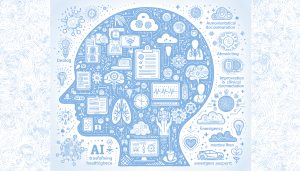 AI is set to transform healthcare by automating clinical documentation, improving diagnostic accuracy, and personalizing patient care. It can significantly reduce administrative burdens by streamlining tasks such as charting and billing, while also enhancing operational efficiency in areas like supply chain management and emergency planning. Additionally, AI offers potential in mental health support by making it more accessible and affordable. These advancements are expected to lead to overall improvements in healthcare outcomes and efficiency, showcasing the promising future of AI in the medical field. Why this matters: AI's integration into healthcare can lead to more efficient, accurate, and personalized patient care, ultimately improving health outcomes and reducing costs.
-
Synthetic Data Boosts Financial Document Parsing
 Researchers have tackled the Privacy Paradox in Financial Document Understanding (FDU) by developing synthetic data generators to train models without using real client data. They created DocuLite, a framework with InvoicePy and TemplatePy, to generate complex synthetic OCR text and HTML-based invoice templates. These synthetic datasets were used to train models like OpenChat-3.5 and InternVL-2, resulting in significant improvements in F1 scores compared to models trained on conventional public datasets. This approach suggests that investing in synthetic data generation can be more effective for building document parsers in sensitive domains like finance and healthcare. This matters because it provides a privacy-compliant method to improve machine learning models for financial document processing.
-
Grafted Titans: Enhancing LLMs with Neural Memory
 An experiment with Test-Time Training (TTT) aimed to replicate Google's "Titans" architecture by grafting a trainable memory module onto a frozen open-weight model, Qwen-2.5-0.5B, using consumer-grade hardware. This new architecture, called "Grafted Titans," appends memory embeddings to the input layer through a trainable cross-attention gating mechanism, allowing the memory to update while the base model remains static. In tests using the BABILong benchmark, the Grafted Titans model achieved 44.7% accuracy, outperforming the vanilla Qwen model's 34.0% accuracy by acting as a denoising filter. However, the model faces limitations such as signal dilution and susceptibility to input poisoning, and further research is needed to address these issues. This matters because it explores innovative ways to enhance neural network performance without extensive computational resources, potentially democratizing access to advanced AI capabilities.
-
Introducing Falcon H1R 7B: A Reasoning Powerhouse
 Falcon-H1R-7B is a reasoning-specialized model developed from Falcon-H1-7B-Base, utilizing cold-start supervised fine-tuning with extensive reasoning traces and enhanced by scaling reinforcement learning with GRPO. This model excels in multiple benchmark evaluations, showcasing its capabilities in mathematics, programming, instruction following, and general logic tasks. Its advanced training techniques and application of reinforcement learning make it a powerful tool for complex problem-solving. This matters because it represents a significant advancement in AI's ability to perform reasoning tasks, potentially transforming fields that rely heavily on logical analysis and decision-making.
-
ChatGPT Outshines Others in Finding Obscure Films
 In a personal account, the author shares their experience using various language learning models (LLMs) to identify an obscure film based on a vague description. Despite trying multiple platforms like Gemini, Claude, Grok, DeepSeek, and Llama, only ChatGPT successfully identified the film. The author emphasizes the importance of personal testing and warns against blindly trusting corporate claims, highlighting the practical integration of ChatGPT with iOS as a significant advantage. This matters because it underscores the varying effectiveness of AI tools in real-world applications and the importance of user experience in technology adoption.