
AI & Technology Updates
-
Practical Agentic Coding with Google Jules
 Google Jules is an autonomous agentic coding assistant developed by Google DeepMind, designed to integrate with existing code repositories and autonomously perform development tasks. It operates asynchronously in the background using a cloud virtual machine, allowing developers to focus on other tasks while it handles complex coding operations. Jules analyzes entire codebases, drafts plans, executes modifications, tests changes, and submits pull requests for review. It supports tasks like code refactoring, bug fixing, and generating unit tests, and provides audio summaries of recent commits. Interaction options include a command-line interface and an API for deeper customization and integration with tools like Slack or Jira. While Jules excels in certain tasks, developers must review its plans and changes to ensure alignment with project standards. As agentic coding tools like Jules evolve, they offer significant potential to enhance coding workflows, making it crucial for developers to explore and adapt to these technologies. Why this matters: Understanding and leveraging agentic coding tools like Google Jules can significantly enhance development efficiency and adaptability, positioning developers to better meet the demands of evolving tech landscapes.
-
Efficient Model Training with Mixed Precision
 Training large language models is a memory-intensive task, primarily due to the size of the models and the length of the data sequences they process. Techniques like mixed precision and gradient checkpointing can help alleviate memory constraints. Mixed precision involves using lower-precision floating-point numbers, such as float16 or bfloat16, which save memory and can speed up training on compatible hardware. PyTorch's automatic mixed precision (AMP) feature simplifies this process by automatically selecting the appropriate precision for different operations, while a GradScaler manages gradient scaling to prevent issues like vanishing gradients. Gradient checkpointing further reduces memory usage by discarding some intermediate results during the forward pass and recomputing them during the backward pass, trading off computational time for memory savings. These techniques are crucial for training models efficiently in memory-constrained environments, allowing for larger batch sizes and more complex models without requiring additional hardware resources. This matters because optimizing memory usage in model training enables more efficient use of resources, allowing for the development of larger and more powerful models without the need for expensive hardware upgrades.
-
Speed Up Model Training with torch.compile & Grad Accumulation
 Training deep transformer language models can be accelerated using two main techniques: torch.compile() and gradient accumulation. With the introduction of PyTorch 2.0, torch.compile() allows for the compilation of models, optimizing them for better performance by creating a computation graph. This compiled model shares the same tensors as the original model, but it is crucial to ensure the model is error-free before compiling, as debugging becomes more challenging. Gradient accumulation, on the other hand, is a method to simulate a larger batch size by accumulating gradients over multiple forward passes, reducing the number of backward passes and optimizer updates needed. This approach is particularly useful in memory-constrained environments, as it allows for efficient training without requiring additional memory. Adjustments to the learning rate schedule are necessary when using gradient accumulation to ensure proper training dynamics. These techniques are important for improving the efficiency and speed of training large models, which can be a significant bottleneck in machine learning workflows.
-
Training Models on Multiple GPUs with Data Parallelism
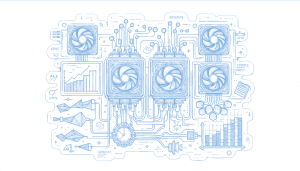 Training a model on multiple GPUs using data parallelism involves distributing data across various GPUs to enhance computational efficiency and speed. The process begins with defining a model configuration, such as the Llama model, which includes hyperparameters like vocabulary size, sequence length, and number of layers. The model utilizes components like rotary position encoding and grouped-query attention to process input data. A distributed data parallel (DDP) setup is employed to manage multiple GPUs, ensuring each GPU processes a portion of the data. The training loop involves loading data, creating attention masks, computing loss, and updating model weights using optimizers and learning rate schedulers. This approach significantly boosts training performance and is essential for handling large-scale datasets and complex models in machine learning. This matters because it enables efficient training of large models, which is crucial for advancements in AI and machine learning applications.
-
HP ZBook 8 G1i Review: Affordable Yet Unimpressive
 The HP ZBook 8 G1i is a portable workstation that aims to deliver high performance for demanding tasks like video editing and CAD work, traditionally at a high cost. However, it surprises with a significant discount, reducing its price to the range of a standard laptop. Despite its powerful specs, such as 64 GB of RAM and a 1-terabyte SSD, the choice of a mid-range Intel Core Ultra 7 265H CPU and an outdated Nvidia GeForce RTX 500 Ada Generation GPU raises questions about its suitability for cutting-edge tasks. The design is utilitarian, with a thick and heavy build, wide bezels, and a functional but uninspired keyboard and trackpad. While the 2560 x 1600 pixel display is adequate, it lacks the wow factor expected from a high-end workstation. This matters because it highlights the trade-offs between cost, design, and performance in mobile workstations, challenging the notion that high price always equates to top-tier capability.