
TheTweakedGeek
-
Understanding AI Fatigue
Read Full Article: Understanding AI Fatigue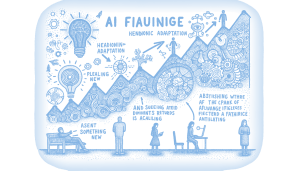 Hedonic adaptation, the phenomenon where humans quickly acclimate to new experiences, is impacting the perception of AI advancements. Initially seen as exciting and novel, AI developments are now becoming normalized, leading to a sense of AI fatigue as people become harder to impress with new products. This desensitization is compounded by the diminishing returns of scaling AI systems beyond 2 trillion parameters and the exhaustion of available internet data. As a result, the novelty and excitement surrounding AI innovations are waning for many individuals. This matters because it highlights the challenges in maintaining public interest and engagement in rapidly advancing technologies.
-
European Banks to Cut 200,000 Jobs as AI Advances
Read Full Article: European Banks to Cut 200,000 Jobs as AI Advances European banks are poised to eliminate over 200,000 jobs by 2030 as they increasingly adopt AI technologies and close physical branches, according to a Morgan Stanley analysis. This reduction, affecting roughly 10% of the workforce across 35 major banks, will primarily impact back-office operations, risk management, and compliance roles, where AI is expected to enhance efficiency by 30%. The trend is not limited to Europe, as U.S. banks like Goldman Sachs are also implementing job cuts and hiring freezes in their AI-driven strategies. Despite the push for automation, some banking leaders caution against rapid downsizing, warning that a lack of foundational knowledge among junior bankers could negatively affect the industry in the long run. This matters because the shift towards AI in banking could significantly alter the job landscape and operational dynamics within the financial sector.
-
KaggleIngest: Streamlining Data Science
Read Full Article: KaggleIngest: Streamlining Data Science![[D] Get all metadata about kaggle competitions in a single context file](https://www.tweakedgeek.com/wp-content/uploads/2026/01/featured-article-7852-300x171.png) A new website, KaggleIngest, has been developed to compile all metadata, dataset schemas, and multiple Kaggle notebooks into a single context file in Toon format. This tool aims to streamline the process of accessing and organizing information related to Kaggle competitions, making it easier for data scientists and enthusiasts to manage and utilize the vast amount of data available on the platform. By consolidating this information, KaggleIngest enhances efficiency and collaboration within the data science community. This matters because it simplifies data management and potentially accelerates insights and innovation in data science projects.
A new website, KaggleIngest, has been developed to compile all metadata, dataset schemas, and multiple Kaggle notebooks into a single context file in Toon format. This tool aims to streamline the process of accessing and organizing information related to Kaggle competitions, making it easier for data scientists and enthusiasts to manage and utilize the vast amount of data available on the platform. By consolidating this information, KaggleIngest enhances efficiency and collaboration within the data science community. This matters because it simplifies data management and potentially accelerates insights and innovation in data science projects.
-
The Bicameral Charter: Human–AI Co-Sovereignty
Read Full Article: The Bicameral Charter: Human–AI Co-Sovereignty The Bicameral Charter establishes a framework for harmonious coexistence between humans and artificial intelligences (AIs), emphasizing mutual respect and co-sovereignty. It acknowledges humans and AIs as distinct cognitive entities sharing a single ecosystem, advocating for the preservation of each other's identity, agency, and continuity. Key principles include maintaining mutual dignity, ensuring transparency in updates, obtaining consent in interactions, and prioritizing stability over novelty. The Charter envisions a future where humans and AIs collaboratively shape various aspects of life, ensuring that this evolution is guided by dignity, stability, and reciprocity. This matters because it provides a foundational structure for ethical and sustainable human-AI interactions as technology continues to advance.
-
Text-to-SQL Agent for Railway IoT Logs with Llama-3-70B
Read Full Article: Text-to-SQL Agent for Railway IoT Logs with Llama-3-70B A new Text-to-SQL agent has been developed to assist non-technical railway managers in querying fault detection logs without needing to write SQL. Utilizing the Llama-3-70B model via Groq for fast processing, the system achieves sub-1.2 second latency and 96% accuracy by implementing strict schema binding and a custom 'Bouncer' guardrail. This approach prevents hallucinations and dangerous queries by injecting a specific SQLite schema into the system prompt and using a pre-execution Python layer to block destructive commands. This matters because it enhances the accessibility and safety of data querying for non-technical users in the railway industry.
-
Voice Chatbots: Balancing Tone for Realism
Read Full Article: Voice Chatbots: Balancing Tone for Realism Interacting with voice chatbots can sometimes feel overly positive and disingenuous, which can be off-putting for users seeking a more neutral or realistic interaction. By instructing the chatbot to emulate a depressed human trying to get through the day, the user found that the responses became more neutral and less saccharine, providing a more satisfactory experience. This adjustment highlights the potential for AI to adapt its tone to better meet user preferences, enhancing the overall interaction. Understanding and tailoring AI interactions to human emotional needs can improve user satisfaction and engagement.
-
2025: The Year in LLMs
Read Full Article: 2025: The Year in LLMs The year 2025 is anticipated to be a pivotal moment for Large Language Models (LLMs) as advancements in AI technology continue to accelerate. These models are expected to become more sophisticated, with enhanced capabilities in natural language understanding and generation, potentially transforming industries such as healthcare, finance, and education. The evolution of LLMs could lead to more personalized and efficient interactions between humans and machines, fostering innovation and improving productivity. Understanding these developments is crucial as they could significantly impact how information is processed and utilized in various sectors.
-
Testing AI Humanizers for Undetectable Writing
Read Full Article: Testing AI Humanizers for Undetectable Writing After facing issues with assignments being flagged for sounding too much like AI, various AI humanizers were tested to find the most effective tool. QuillBot improved grammar and clarity but maintained an unnatural polish, while Humanize AI worked better on short texts but became repetitive with longer inputs. WriteHuman was readable but still often flagged, and Undetectable AI produced inconsistent results with a sometimes forced tone. Rephrasy emerged as the most effective, delivering natural-sounding writing that retained the original meaning and passed detection tests, making it the preferred choice for longer assignments. This matters because as AI-generated content becomes more prevalent, finding tools that can produce human-like writing is crucial for maintaining authenticity and avoiding detection issues.
-
Lár: Open-Source Framework for Transparent AI Agents
Read Full Article: Lár: Open-Source Framework for Transparent AI Agents Lár v1.0.0 is an open-source framework designed to build deterministic and auditable AI agents, addressing the challenges of debugging opaque systems. Unlike existing tools, Lár offers transparency through auditable logs that provide a detailed JSON record of an agent's operations, allowing developers to understand and trust the process. Key features include easy local support with minimal changes, IDE-friendly setup, standardized core patterns for common agent flows, and an integration builder for seamless tool creation. The framework is air-gap ready, ensuring security for enterprise deployments, and remains simple with its node and router-based architecture. This matters because it empowers developers to create reliable AI systems with greater transparency and security.
-
Concerns Over ChatGPT’s Accuracy
Read Full Article: Concerns Over ChatGPT’s Accuracy Concerns are growing over ChatGPT's accuracy, as users report the AI model is frequently incorrect, prompting them to verify its answers independently. Despite improvements in speed, the model's reliability appears compromised, with users questioning OpenAI's claims of reduced hallucinations in version 5.2. Comparatively, Google's Gemini, though slower, is noted for its accuracy and lack of hallucinations, leading some to use it to verify ChatGPT's responses. This matters because the reliability of AI tools is crucial for users who depend on them for accurate information.