
AI advancements
-
AI Revolutionizing Nobel-Level Discoveries
Read Full Article: AI Revolutionizing Nobel-Level Discoveries IQ is a key factor strongly correlating with Nobel-level scientific discoveries, with Nobel laureates typically having an IQ of 150. Currently, only a small percentage of scientists possess such high IQs, but this is set to change as AI IQs are rapidly advancing. By mid-2026, AI models are expected to reach an IQ of 150, equaling human Nobel laureates, and by 2027, they could surpass even the most brilliant human minds like Einstein and Newton. This exponential increase in AI intelligence will allow for an unprecedented number of Nobel-level discoveries across various fields, potentially revolutionizing scientific, medical, and technological advancements. This matters because it could lead to a transformative era in human knowledge and problem-solving capabilities, driven by super intelligent AI.
-
Optimizing Small Language Model Architectures
Read Full Article: Optimizing Small Language Model Architectures Llama AI technology has made notable progress in 2025, particularly with the introduction of Llama 3.3 8B, which features Instruct Retrieval-Augmented Generation (RAG). This advancement focuses on optimizing AI infrastructure and managing costs effectively, paving the way for future developments in small language models. The community continues to engage and share resources, fostering a collaborative environment for further innovation. Understanding these developments is crucial as they represent the future direction of AI technology and its practical applications.
-
LoongFlow vs Google AlphaEvolve: AI Advancements
Read Full Article: LoongFlow vs Google AlphaEvolve: AI Advancements LoongFlow, a new AI technology, is being compared favorably to Google's AlphaEvolve due to its innovative features and advancements. In 2025, Llama AI technology has made notable progress, particularly with the release of Llama 3.3, which includes an 8B Instruct Retrieval-Augmented Generation (RAG) model. This development highlights the growing capabilities and efficiency of AI infrastructures, while also addressing cost concerns and future potential. The AI community is actively engaging with these advancements, sharing resources and discussions on various platforms, including dedicated subreddits. Understanding these breakthroughs is crucial as they shape the future landscape of AI technology and its applications.
-
Understanding AI Fatigue
Read Full Article: Understanding AI Fatigue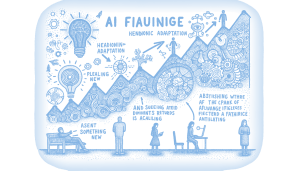 Hedonic adaptation, the phenomenon where humans quickly acclimate to new experiences, is impacting the perception of AI advancements. Initially seen as exciting and novel, AI developments are now becoming normalized, leading to a sense of AI fatigue as people become harder to impress with new products. This desensitization is compounded by the diminishing returns of scaling AI systems beyond 2 trillion parameters and the exhaustion of available internet data. As a result, the novelty and excitement surrounding AI innovations are waning for many individuals. This matters because it highlights the challenges in maintaining public interest and engagement in rapidly advancing technologies.
-
Local AI Agent: Automating Daily News with GPT-OSS 20B
Read Full Article: Local AI Agent: Automating Daily News with GPT-OSS 20B Automating a "Daily Instagram News" pipeline is now possible with GPT-OSS 20B running locally, eliminating the need for subscriptions or API fees. This setup utilizes a single prompt to perform tasks such as web scraping, Google searches, and local file I/O, effectively creating a professional news briefing from Instagram trends and broader context data. The process ensures privacy, as data remains local, and is cost-effective since it operates without token costs or rate limits. Open-source models like GPT-OSS 20B demonstrate the capability to act as autonomous personal assistants, highlighting the advancements in AI technology. Why this matters: This approach showcases the potential of open-source AI models to perform complex tasks independently while maintaining privacy and reducing costs.
-
Fine-Tuning Qwen3-VL for HTML Code Generation
Read Full Article: Fine-Tuning Qwen3-VL for HTML Code Generation![[Article] Fine-Tuning Qwen3-VL](https://www.tweakedgeek.com/wp-content/uploads/2026/01/featured-article-7894-300x171.png) Fine-tuning the Qwen3-VL 2B model involves training it with a long context of 20,000 tokens to effectively convert screenshots and sketches of web pages into HTML code. This process enhances the model's ability to understand and interpret complex visual layouts, enabling more accurate HTML code generation from visual inputs. Such advancements in AI models are crucial for automating web development tasks, potentially reducing the time and effort required for manual coding. This matters because it represents a significant step towards more efficient and intelligent web design automation.
Fine-tuning the Qwen3-VL 2B model involves training it with a long context of 20,000 tokens to effectively convert screenshots and sketches of web pages into HTML code. This process enhances the model's ability to understand and interpret complex visual layouts, enabling more accurate HTML code generation from visual inputs. Such advancements in AI models are crucial for automating web development tasks, potentially reducing the time and effort required for manual coding. This matters because it represents a significant step towards more efficient and intelligent web design automation.
-
Automating ML Explainer Videos with AI
Read Full Article: Automating ML Explainer Videos with AI A software engineer successfully automated the creation of machine learning explainer videos, focusing on LLM inference optimizations, using Claude Code and Opus 4.5. Despite having no prior video creation experience, the engineer developed a system that automatically generates video content, including the script, narration, audio effects, and background music, in just three days. The engineer did the voiceover manually due to the text-to-speech output being too robotic, but the rest of the process was automated. This achievement demonstrates the potential of AI to significantly accelerate and simplify complex content creation tasks.
-
Solar-Open-100B-GGUF: A Leap in AI Model Design
Read Full Article: Solar-Open-100B-GGUF: A Leap in AI Model Design Solar Open is a groundbreaking 102 billion-parameter Mixture-of-Experts (MoE) model, developed from the ground up with a training dataset comprising 19.7 trillion tokens. Despite its massive size, it efficiently utilizes only 12 billion active parameters during inference, optimizing performance while managing computational resources. This innovation in AI model design highlights the potential for more efficient and scalable machine learning systems, which can lead to advancements in various applications, from natural language processing to complex data analysis. Understanding and improving AI efficiency is crucial for sustainable technological growth and innovation.
-
Solar Open Model: Llama AI Advancements
Read Full Article: Solar Open Model: Llama AI Advancements The Solar Open model by HelloKS, proposed in Pull Request #18511, introduces a new advancement in Llama AI technology. This model is part of the ongoing developments in 2025, including Llama 3.3 and 8B Instruct Retrieval-Augmented Generation (RAG). These advancements aim to enhance AI infrastructure and reduce associated costs, paving the way for future developments in the field. Engaging with community resources and discussions, such as relevant subreddits, can provide further insights into these innovations. This matters because it highlights the continuous evolution and potential cost-efficiency of AI technologies, impacting various industries and research areas.
-
The State Of LLMs 2025: Progress and Predictions
Read Full Article: The State Of LLMs 2025: Progress and Predictions By 2025, Large Language Models (LLMs) are expected to have made significant advancements, particularly in their ability to understand context and generate more nuanced responses. However, challenges such as ethical concerns, data privacy, and the environmental impact of training these models remain pressing issues. Predictions suggest that LLMs will become more integrated into everyday applications, enhancing personal and professional tasks, while ongoing research will focus on improving their efficiency and reducing biases. Understanding these developments is crucial as LLMs increasingly influence various aspects of technology and society.