
data parallelism
-
Distributed FFT in TensorFlow v2
Read Full Article: Distributed FFT in TensorFlow v2 The recent integration of Distributed Fast Fourier Transform (FFT) in TensorFlow v2, through the DTensor API, allows for efficient computation of Fourier Transforms on large datasets that exceed the memory capacity of a single device. This advancement is particularly beneficial for image-like datasets, enabling synchronous distributed computing and enhancing performance by utilizing multiple devices. The implementation retains the original FFT API interface, requiring only a sharded tensor as input, and demonstrates significant data processing capabilities, albeit with some tradeoffs in speed due to communication overhead. Future improvements are anticipated, including algorithm optimization and communication tweaks, to further enhance performance. This matters because it enables more efficient processing of large-scale data in machine learning applications, expanding the capabilities of TensorFlow.
-
Training Models on Multiple GPUs with Data Parallelism
Read Full Article: Training Models on Multiple GPUs with Data Parallelism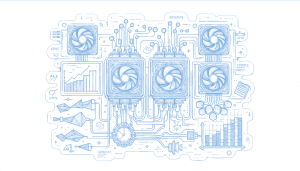 Training a model on multiple GPUs using data parallelism involves distributing data across various GPUs to enhance computational efficiency and speed. The process begins with defining a model configuration, such as the Llama model, which includes hyperparameters like vocabulary size, sequence length, and number of layers. The model utilizes components like rotary position encoding and grouped-query attention to process input data. A distributed data parallel (DDP) setup is employed to manage multiple GPUs, ensuring each GPU processes a portion of the data. The training loop involves loading data, creating attention masks, computing loss, and updating model weights using optimizers and learning rate schedulers. This approach significantly boosts training performance and is essential for handling large-scale datasets and complex models in machine learning. This matters because it enables efficient training of large models, which is crucial for advancements in AI and machine learning applications.