
machine learning
-
3 Smart Ways to Encode Categorical Features
Read Full Article: 3 Smart Ways to Encode Categorical Features Encoding categorical features into numerical values is crucial for machine learning models to process data effectively. Three reliable techniques are ordinal encoding, one-hot encoding, and target (mean) encoding. Ordinal encoding is suitable for categories with a natural order, like education levels, where the rank is preserved in numerical form. One-hot encoding is ideal for nominal data without inherent order, such as colors or countries, by creating binary columns for each category, avoiding false hierarchies. However, it can lead to high dimensionality with features having many unique values. Target encoding, useful for high-cardinality features, replaces categories with the mean of the target variable, compressing many categories into a single predictive feature. This method requires caution to prevent target leakage, which can be mitigated through cross-validation or smoothing techniques. Choosing the appropriate encoding method depends on the data's nature and the number of unique categories, ensuring the model's accuracy and efficiency. This matters because proper encoding of categorical features is essential for building accurate and efficient machine learning models, directly impacting their predictive performance.
-
Training Models on Multiple GPUs with Data Parallelism
Read Full Article: Training Models on Multiple GPUs with Data Parallelism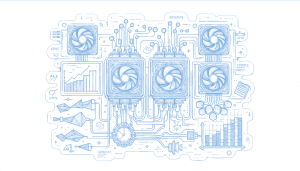 Training a model on multiple GPUs using data parallelism involves distributing data across various GPUs to enhance computational efficiency and speed. The process begins with defining a model configuration, such as the Llama model, which includes hyperparameters like vocabulary size, sequence length, and number of layers. The model utilizes components like rotary position encoding and grouped-query attention to process input data. A distributed data parallel (DDP) setup is employed to manage multiple GPUs, ensuring each GPU processes a portion of the data. The training loop involves loading data, creating attention masks, computing loss, and updating model weights using optimizers and learning rate schedulers. This approach significantly boosts training performance and is essential for handling large-scale datasets and complex models in machine learning. This matters because it enables efficient training of large models, which is crucial for advancements in AI and machine learning applications.
-
Sketch to HTML with Qwen3-VL
Read Full Article: Sketch to HTML with Qwen3-VL Qwen3-VL is showcased as a powerful tool for developing a sketch-to-HTML application, highlighting its practical application in creating real-world solutions. The process involves using Qwen3-VL to convert hand-drawn sketches into functional HTML code, demonstrating the model's capability to bridge the gap between design and development. This approach not only streamlines the workflow for designers and developers but also exemplifies how advanced machine learning models can be harnessed to automate and enhance creative processes. Understanding and implementing such technology can significantly improve efficiency in web development projects, making it a valuable asset for both individual developers and teams.
-
Pre-Transformer NLP Research Insights
Read Full Article: Pre-Transformer NLP Research Insights Python remains the dominant programming language for machine learning due to its extensive libraries and user-friendly nature. However, other languages are employed for specific purposes, particularly when performance or platform-specific needs arise. C++ is often used for performance-critical parts of machine learning, while Julia, although less widely adopted, is recognized for its capabilities in this field. R is primarily utilized for statistical analysis and data visualization but also supports machine learning tasks. Go, known for its compiled native code and garbage collection, offers good performance as a high-level language. Swift, typically used for iOS and macOS development, is applicable to machine learning due to its compilation to machine code. Kotlin, preferred over Java for Android development, supports machine learning inference on mobile devices. Java, with tools like GraalVM, can be compiled natively, making it suitable for performance-sensitive applications, including machine learning inference. Rust is favored for its performance and memory safety, making it a strong candidate for high-performance computing tasks in machine learning. Dart and Vala also compile to machine code for various architectures, offering versatility in machine learning applications. While Python's popularity and versatility make it the go-to language for machine learning, familiarity with other languages such as C++, Julia, R, Go, Swift, Kotlin, Java, Rust, Dart, and Vala can provide additional tools for addressing specific performance or platform requirements. A solid understanding of programming fundamentals and AI principles remains crucial, regardless of the language used. This matters because diversifying language skills can enhance problem-solving capabilities and optimize machine learning solutions across different environments and applications.
-
Building a Small VIT with Streamlit
Read Full Article: Building a Small VIT with Streamlit Streamlit is a popular framework for creating data applications with ease, and its capabilities are being explored through a project involving small Vision Transformers (VITs). The project involves performing a grid search on custom-built VITs to identify the most effective configuration for real-time digit classification. By leveraging Streamlit, the project not only facilitates the classification process but also provides a platform to visualize attention maps, which are crucial for understanding how the model focuses on different parts of the input data. The use of VITs in this context is significant as they represent a modern approach to handling image data, often outperforming traditional convolutional neural networks in various tasks. The project demonstrates how VITs can be effectively implemented from scratch and highlights the flexibility of Streamlit in deploying machine learning models. This exploration serves as a practical example for those looking to understand the integration of advanced machine learning techniques with user-friendly application frameworks. Sharing the code and application through platforms like GitHub and Streamlit allows others to replicate and learn from the project, fostering a collaborative learning environment. This is particularly useful for individuals new to Streamlit or those interested in experimenting with VITs, providing them with a tangible example to build upon. The project not only showcases the potential of Streamlit in machine learning applications but also encourages others to explore and innovate within the field. This matters because it highlights the accessibility and power of modern tools in democratizing machine learning development.
-
AGI Insights by OpenAI Co-founder Ilya Sutskever
Read Full Article: AGI Insights by OpenAI Co-founder Ilya Sutskever Python remains the dominant programming language in the field of machine learning due to its extensive libraries and ease of use, making it the go-to choice for many developers. However, when performance or platform-specific needs arise, other languages such as C++, Julia, and R are also utilized. C++ is particularly favored for performance-critical parts of machine learning, while Julia, though not as widely adopted, is appreciated by some for its capabilities. R is primarily used for statistical analysis and data visualization but also supports machine learning tasks. Beyond these, several high-level languages offer unique advantages for machine learning applications. Go, with its garbage collection and reflection, provides good performance and is compiled to native code. Swift, commonly used for iOS and macOS development, can also be applied to machine learning. Kotlin, preferred over Java for Android development, supports ML inference on mobile devices, while Java, when compiled natively with tools like GraalVM, is suitable for performance-sensitive applications. Rust is praised for its performance and memory safety, making it a strong choice for high-performance computing tasks in machine learning. Additional languages like Dart, which compiles to machine code for various architectures, and Vala, a general-purpose language that compiles to native code, also contribute to the diverse ecosystem of programming languages used in machine learning. While Python remains the most popular and versatile, understanding other languages like C++, Julia, R, Go, Swift, Kotlin, Java, Rust, Dart, and Vala can enhance a developer's toolkit for specific performance or platform needs. Mastery of programming fundamentals and AI principles is crucial, regardless of the language chosen, ensuring adaptability and effectiveness in the evolving field of machine learning. This matters because choosing the right programming language can significantly impact the performance and efficiency of machine learning applications, catering to specific needs and optimizing resources.
-
StructOpt: Stability Layer for Optimizers
Read Full Article: StructOpt: Stability Layer for Optimizers StructOpt is introduced as a structural layer that enhances the stability of existing optimizers such as SGD and Adam, rather than replacing them. It modulates the effective step scale based on an internal structural signal, S(t), which responds to instability in the optimization process. This approach aims to stabilize the optimization trajectory in challenging landscapes where traditional methods may diverge or exhibit large oscillations. The effectiveness of StructOpt is demonstrated through two stress tests. The first involves a controlled oscillatory landscape where vanilla SGD diverges and Adam shows significant step oscillations. StructOpt successfully stabilizes the trajectory by dynamically adjusting the step size without requiring explicit tuning. The second test involves a regime shift where the loss landscape changes abruptly. Here, the structural signal S(t) acts like a damping term, reacting to instability spikes and maintaining bounded optimization. StructOpt is presented as a stability layer that can be composed on top of existing optimization methods, rather than competing with them. The signal S(t) is shown to correlate with instability rather than gradient magnitude, suggesting its potential as a general mechanism for improving stability. The approach is optimizer-agnostic and invites feedback on its applicability and potential failure modes. The code is designed for inspection rather than performance, encouraging further exploration and validation. This matters because enhancing the stability of optimization processes can lead to more reliable and robust outcomes in machine learning and other computational fields.
-
Open-source BardGPT Model Seeks Contributors
Read Full Article: Open-source BardGPT Model Seeks Contributors BardGPT is an open-source, educational, and research-friendly GPT-style model that has been developed with a focus on simplicity and accessibility. It is a decoder-only Transformer model trained entirely from scratch using the Tiny Shakespeare dataset. The project provides a clean architectural framework, comprehensive training scripts, and checkpoints for both the best validation and fully-trained models. Additionally, BardGPT supports character-level sampling and includes implementations of attention mechanisms, embeddings, and feed-forward networks from the ground up. The creator of BardGPT is seeking contributors to enhance and expand the project. Opportunities for contribution include adding new datasets to broaden the model's training capabilities, extending the architecture to improve its performance and functionality, and refining sampling and training tools. There is also a call for building visualizations to better understand model operations and improving the documentation to make the project more accessible to new users and developers. For those interested in Transformers, machine learning training, or contributing to open-source models, BardGPT offers a collaborative platform to engage with cutting-edge AI technology. The project not only serves as a learning tool but also as an opportunity to contribute to the development and refinement of Transformer models. This matters as it fosters community involvement and innovation in the field of artificial intelligence, making advanced technologies more accessible and customizable for educational and research purposes.
-
Enterprise AI Agents: 5 Years of Evolution
Read Full Article: Enterprise AI Agents: 5 Years of Evolution Over the past five years, enterprise AI agents have undergone significant evolution, transforming from simple task-specific tools to sophisticated systems capable of handling complex operations. These AI agents are now integral to business processes, enhancing decision-making, automating routine tasks, and providing insights that were previously difficult to obtain. The development of natural language processing and machine learning algorithms has been pivotal, enabling AI agents to understand and respond to human language more effectively. AI agents have also become more adaptable and scalable, allowing businesses to deploy them across various departments and functions. This adaptability is largely due to advancements in cloud computing and data storage, which provide the necessary infrastructure for AI systems to operate efficiently. As a result, companies can now leverage AI to optimize supply chains, improve customer service, and drive innovation, leading to increased competitiveness and productivity. The evolution of enterprise AI agents matters because it represents a shift in how businesses operate, offering opportunities for growth and efficiency that were not possible before. As AI technology continues to advance, it is expected to further integrate into business strategies, potentially reshaping industries and creating new economic opportunities. Understanding these developments is crucial for businesses looking to stay ahead in a rapidly changing technological landscape.
-
SPARQL-LLM: Natural Language to Knowledge Graph Queries
Read Full Article: SPARQL-LLM: Natural Language to Knowledge Graph Queries SPARQL-LLM is a novel approach that leverages large language models (LLMs) to translate natural language queries into executable SPARQL queries for knowledge graphs. This method addresses the challenge of interacting with complex data structures using everyday language, making it more accessible for users who may not be familiar with the intricacies of SPARQL or knowledge graph schemas. By using LLMs, SPARQL-LLM can understand and process the nuances of human language, providing a more intuitive interface for querying knowledge graphs. The approach involves training the language model on a dataset that pairs natural language questions with their corresponding SPARQL queries. This enables the model to learn the patterns and structures necessary to generate accurate and efficient queries. The ultimate goal is to bridge the gap between human language and machine-readable data, allowing users to extract valuable insights from knowledge graphs without needing specialized technical skills. SPARQL-LLM represents a significant advancement in making data more accessible and usable, particularly for those who are not data scientists or engineers. By simplifying the process of querying complex databases, it empowers a broader audience to leverage the wealth of information contained within knowledge graphs. This matters because it democratizes access to data-driven insights, fostering innovation and informed decision-making across various fields.