
GPU training
-
LLM-Pruning Collection: JAX Repo for LLM Compression
Read Full Article: LLM-Pruning Collection: JAX Repo for LLM CompressionZlab Princeton researchers have developed the LLM-Pruning Collection, a JAX-based repository that consolidates major pruning algorithms for large language models into a single, reproducible framework. This collection aims to simplify the comparison of block level, layer level, and weight level pruning methods under a consistent training and evaluation setup on both GPUs and TPUs. It includes implementations of various pruning methods such as Minitron, ShortGPT, Wanda, SparseGPT, Magnitude, Sheared LLaMA, and LLM-Pruner, each designed to optimize model performance by removing redundant or less important components. The repository also integrates advanced training and evaluation tools, providing a platform for engineers to verify results against established baselines. This matters because it streamlines the process of enhancing large language models, making them more efficient and accessible for practical applications.
-
Training Models on Multiple GPUs with Data Parallelism
Read Full Article: Training Models on Multiple GPUs with Data Parallelism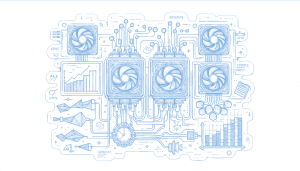 Training a model on multiple GPUs using data parallelism involves distributing data across various GPUs to enhance computational efficiency and speed. The process begins with defining a model configuration, such as the Llama model, which includes hyperparameters like vocabulary size, sequence length, and number of layers. The model utilizes components like rotary position encoding and grouped-query attention to process input data. A distributed data parallel (DDP) setup is employed to manage multiple GPUs, ensuring each GPU processes a portion of the data. The training loop involves loading data, creating attention masks, computing loss, and updating model weights using optimizers and learning rate schedulers. This approach significantly boosts training performance and is essential for handling large-scale datasets and complex models in machine learning. This matters because it enables efficient training of large models, which is crucial for advancements in AI and machine learning applications.