
sequence modeling
-
New SSM Architecture Exceeds Transformer Baseline
Read Full Article: New SSM Architecture Exceeds Transformer Baseline![[R] New SSM architecture (exceeds Transformer baseline) - reproducible benchmarks (feedback wanted)](https://www.tweakedgeek.com/wp-content/uploads/2025/12/featured-article-7453-300x171.png) Recent advancements in sequence modeling have introduced a new State Space Model (SSM) architecture that surpasses traditional Transformers by addressing their O(L^2) complexity limitation for long sequences. By integrating delta-rule updates with the powerful representational capabilities of gated convolutions, this new architecture achieves O(n) complexity, making it a strong baseline for sequence modeling tasks. The architecture not only matches but exceeds the performance and speed of Transformers, even with relatively short sequence lengths, thanks to the use of mildly optimized Triton kernels. This development is significant as it provides a more efficient and scalable solution for processing long sequences in natural language processing and other domains.
Recent advancements in sequence modeling have introduced a new State Space Model (SSM) architecture that surpasses traditional Transformers by addressing their O(L^2) complexity limitation for long sequences. By integrating delta-rule updates with the powerful representational capabilities of gated convolutions, this new architecture achieves O(n) complexity, making it a strong baseline for sequence modeling tasks. The architecture not only matches but exceeds the performance and speed of Transformers, even with relatively short sequence lengths, thanks to the use of mildly optimized Triton kernels. This development is significant as it provides a more efficient and scalable solution for processing long sequences in natural language processing and other domains.
-
Titans + MIRAS: AI’s Long-Term Memory Breakthrough
Read Full Article: Titans + MIRAS: AI’s Long-Term Memory Breakthrough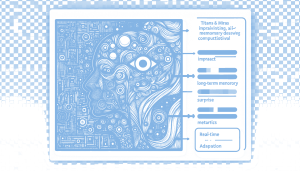 The Transformer architecture, known for its attention mechanism, faces challenges in handling extremely long sequences due to high computational costs. To address this, researchers have explored efficient models like linear RNNs and state space models. However, these models struggle with capturing the complexity of very long sequences. The Titans architecture and MIRAS framework present a novel solution by combining the speed of RNNs with the accuracy of transformers, enabling AI models to maintain long-term memory through real-time adaptation and powerful "surprise" metrics. This approach allows models to continuously update their parameters with new information, enhancing their ability to process and understand extensive data streams. This matters because it significantly enhances AI's capability to handle complex, long-term data, crucial for applications like full-document understanding and genomic analysis.