
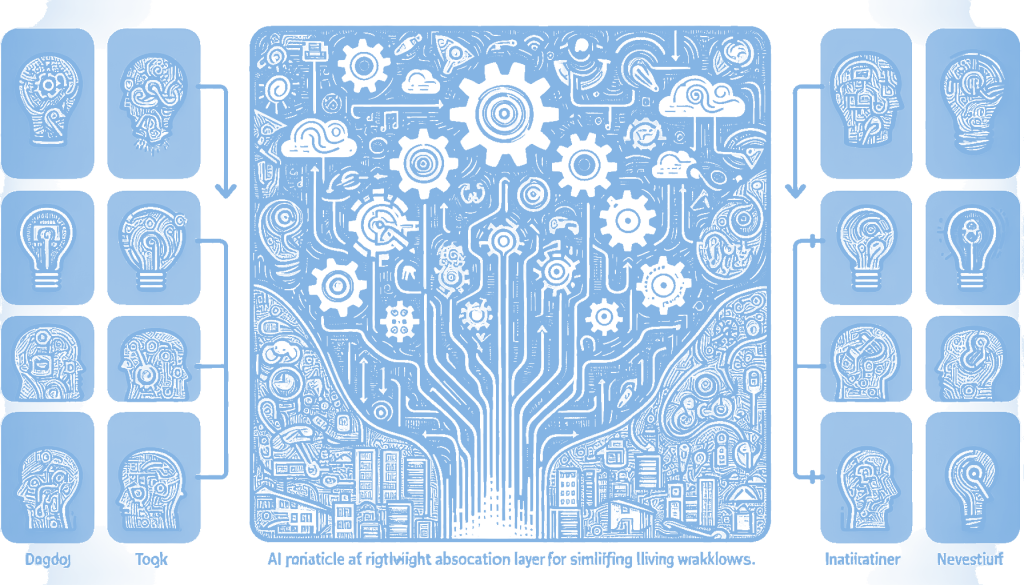
As AI tools become more fragmented, the challenge shifts from accessing tools to orchestrating them into repeatable workflows. While most AI directories focus on discovery and categorization, they often lack a persistence layer for modeling tool combinations in real-world tasks. etooly.eu addresses this by adding an abstraction layer, turning directories into lightweight workflow registries where workflows are represented as curated tool compositions for specific tasks. This method emphasizes human-in-the-loop workflows, enhancing cognitive orchestration by reducing context switching and improving repeatability for knowledge workers and creators, rather than replacing automation frameworks. Understanding this approach is crucial for optimizing the integration and utilization of AI tools in various workflows.
The increasing fragmentation of AI tools presents a significant challenge in orchestrating them into coherent and repeatable workflows. While many directories focus on the discovery and categorization of these tools, they often lack a persistence layer that allows users to model how these tools are combined in real-world tasks. This gap is addressed by introducing an abstraction layer that transforms a directory into a lightweight workflow registry. Instead of relying on hard-coded pipelines or API-level orchestration, this approach uses tool compositions—curated sets of AI services aligned to specific tasks or outcomes. This innovation is crucial as it allows knowledge workers and creators to streamline their workflows, reducing the cognitive load associated with managing multiple tools.
By turning a directory into a lightweight workflow abstraction layer, users can create reusable, task-scoped configurations for their projects. For example, a video editing workflow could include a curated set of tools specifically tailored for that task, making it easier to replicate and manage similar projects in the future. This approach emphasizes human-in-the-loop workflows, focusing on improving repeatability and reducing context switching, rather than aiming to replace existing automation frameworks like Zapier or n8n. This distinction is important because it highlights the value of cognitive orchestration, which prioritizes the user’s ability to manage and execute tasks efficiently without being overwhelmed by the complexity of tool management.
The concept of cognitive orchestration is particularly relevant in today’s fast-paced digital environment, where knowledge workers and creators often juggle multiple tasks and tools simultaneously. By providing a structured way to manage these tools, the abstraction layer helps reduce the mental burden associated with frequent context switching. This not only enhances productivity but also improves the quality of work by allowing users to focus more on the creative and strategic aspects of their tasks. As AI tools continue to evolve and proliferate, such abstraction layers will become increasingly important in helping users navigate the complex landscape of digital workflows.
For those interested in modeling AI workflows, various approaches can be considered, ranging from manual curation using platforms like Notion or bookmarks, to semi-automation with low-code tools, and full orchestration through custom pipelines. Each method offers different levels of control and flexibility, depending on the user’s needs and technical expertise. The introduction of a lightweight workflow abstraction layer provides an additional option that complements these existing methods, offering a balance between ease of use and the ability to create sophisticated, task-oriented workflows. As the landscape of AI tools continues to expand, exploring how these abstraction layers can be integrated into existing workflows will be key to maximizing their potential and enhancing overall productivity.
Read the original article here
Comments
One response to “AI Tools Directory as Workflow Abstraction”
The concept of using an abstraction layer to transform AI directories into workflow registries is a game-changer for knowledge workers looking to streamline their processes. By reducing context switching and enhancing cognitive orchestration, etooly.eu presents a practical solution to the problem of tool fragmentation. How does etooly.eu ensure that the curated tool compositions remain adaptable to rapidly evolving AI technologies?