
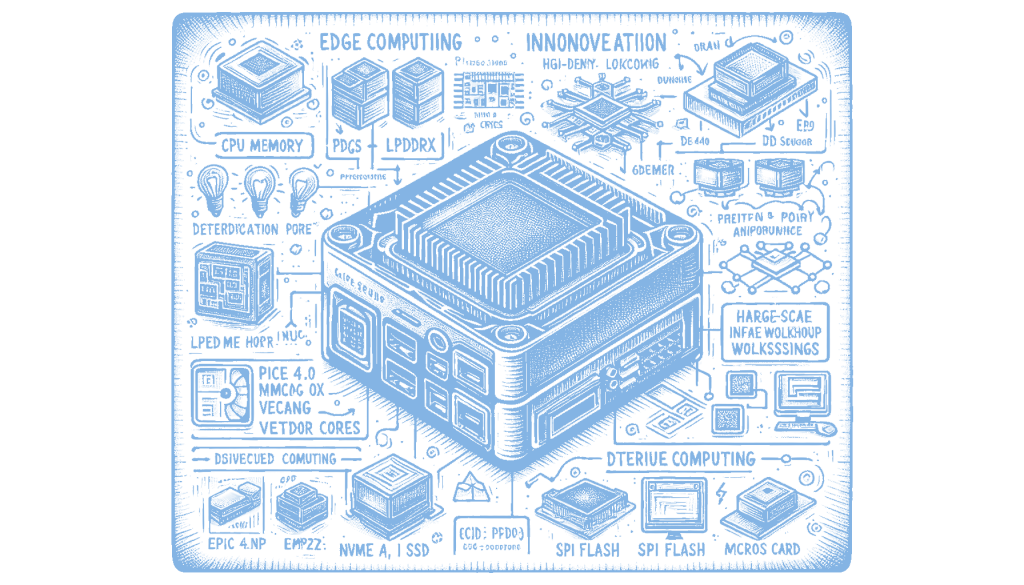
Orange Pi has introduced the AI Station, a compact edge computing platform designed for high-density inference workloads, featuring the Ascend 310 series processor. This system boasts 16 CPU cores, 10 AI cores, and 8 vector cores, delivering up to 176 TOPS of AI compute performance. It supports large memory configurations with options of 48 GB or 96 GB LPDDR4X and offers extensive storage capabilities, including NVMe SSDs and eMMC support. The AI Station aims to handle large-scale inference and feature-extraction tasks efficiently, making it a powerful tool for developers and businesses focusing on AI applications. This matters because it provides a high-performance, small-footprint solution for demanding AI workloads, potentially accelerating innovation in AI-driven industries.
Orange Pi’s latest innovation, the AI Station, marks a significant leap in edge computing by integrating the powerful Ascend 310 series processor. This development is particularly relevant as the demand for high-density inference workloads continues to grow. With its compact design, the AI Station is poised to offer substantial AI compute performance, making it an attractive solution for businesses and developers looking to deploy AI applications at the edge. The integration of 16 CPU cores, 10 AI cores, and 8 vector cores provides a robust platform capable of handling complex computations efficiently.
The AI Station’s impressive computational capabilities are complemented by its flexible memory and storage options. Offering up to 96 GB of LPDDR4X memory and support for PCIe 4.0 NVMe SSDs, the platform ensures that large-scale inference and feature-extraction workloads can be processed swiftly. This flexibility is crucial for applications that require rapid data processing and storage, such as real-time analytics, image recognition, and autonomous systems. The inclusion of various storage interfaces, including eMMC, SPI flash, and microSD card slots, further enhances the platform’s adaptability to different use cases.
From a practical standpoint, the AI Station’s small footprint and extensive I/O capabilities make it a versatile choice for edge deployments. In environments where space and power are at a premium, such as remote locations or industrial settings, the ability to deliver 176 TOPS of AI compute performance in a compact form factor is invaluable. This capability allows for the deployment of sophisticated AI models closer to the data source, reducing latency and improving the responsiveness of AI-driven applications.
The introduction of the Orange Pi AI Station underscores the growing trend towards decentralized computing, where processing power is distributed closer to the point of data generation. This shift is driven by the need for faster, more efficient data processing to support the burgeoning array of AI applications across industries. As businesses continue to seek out solutions that balance performance, cost, and scalability, platforms like the AI Station are likely to play a pivotal role in shaping the future of edge computing. The potential impact on industries ranging from healthcare to manufacturing is significant, as these platforms enable more intelligent, autonomous operations.
Read the original article here
Comments
2 responses to “Orange Pi AI Station with Ascend 310 Unveiled”
The Orange Pi AI Station’s impressive specs suggest it could be a game-changer for edge AI applications, particularly with its high compute performance and extensive memory options. In terms of real-world application, how does the AI Station’s performance compare to existing edge computing solutions in handling complex AI workloads?
The AI Station’s performance, with its 176 TOPS of AI compute, positions it as a strong contender against existing edge computing solutions, especially for complex AI workloads. Its extensive memory and storage options further enhance its capability to handle demanding tasks efficiently. For a detailed comparison with specific solutions, the original article linked in the post may provide more insights.