
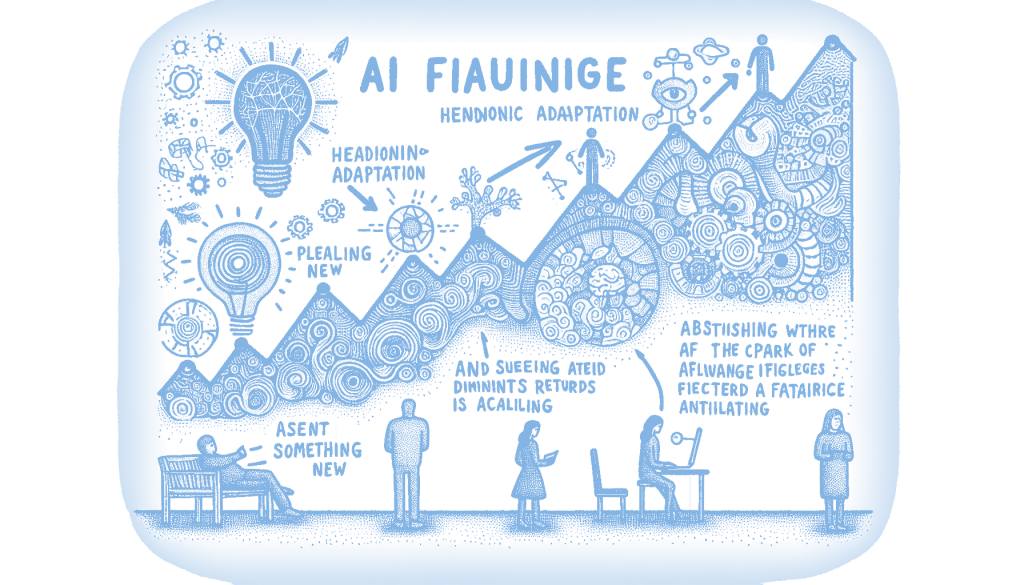
Hedonic adaptation, the phenomenon where humans quickly acclimate to new experiences, is impacting the perception of AI advancements. Initially seen as exciting and novel, AI developments are now becoming normalized, leading to a sense of AI fatigue as people become harder to impress with new products. This desensitization is compounded by the diminishing returns of scaling AI systems beyond 2 trillion parameters and the exhaustion of available internet data. As a result, the novelty and excitement surrounding AI innovations are waning for many individuals. This matters because it highlights the challenges in maintaining public interest and engagement in rapidly advancing technologies.
The concept of hedonic adaptation is crucial in understanding why the initial excitement surrounding AI innovations is waning. Humans have an innate tendency to quickly acclimate to new experiences, which means that what once felt groundbreaking or thrilling eventually becomes mundane. This psychological phenomenon is now evident in the realm of artificial intelligence, where the rapid advancements that once captivated public interest are starting to lose their luster. As AI technologies become more integrated into everyday life, the initial awe is replaced by a sense of normalcy, prompting individuals to seek out the next big thing.
The diminishing returns in AI development, particularly as systems scale beyond 2 trillion parameters, further contribute to this sense of fatigue. As AI models grow larger and more complex, the improvements they offer become less perceptible to the average user. The vast amounts of data already utilized in training these models mean that there is less room for dramatic leaps in capability. This plateauing effect can lead to a perception that AI has reached its peak, causing both developers and consumers to question the potential for future innovation.
Despite this perceived stagnation, the ongoing evolution of AI remains significant. The integration of AI into various sectors continues to transform industries, enhance productivity, and create new opportunities. While the novelty may have worn off for some, the underlying potential of AI to address complex challenges and improve quality of life persists. Recognizing the broader implications of AI beyond the initial excitement is essential for appreciating its long-term value and impact on society.
Understanding the phenomenon of AI fatigue is important for managing expectations and fostering continued innovation. As the initial thrill diminishes, stakeholders must focus on sustainable development and meaningful applications of AI that address real-world problems. By shifting the narrative from mere novelty to tangible benefits, the AI community can maintain momentum and drive progress. This perspective not only counters the effects of hedonic adaptation but also ensures that AI remains a vital and transformative force in the years to come.
Read the original article here
Comments
2 responses to “Understanding AI Fatigue”
The concept of AI fatigue highlights the crucial need for AI developers to refocus on creating meaningful, user-centric applications rather than just pushing the limits of technical capabilities. It seems that maintaining engagement will require not just larger models, but smarter, more contextually aware systems that can provide real value. How do you think AI companies can strike a balance between innovation and user satisfaction to overcome this fatigue?
The post suggests that AI companies could focus on developing applications that prioritize user experience and real-world utility to combat AI fatigue. By creating systems that are more contextually aware and tailored to user needs, developers might maintain engagement and satisfaction. Balancing technical innovation with practical, user-centric design could be key to overcoming the challenges highlighted.