
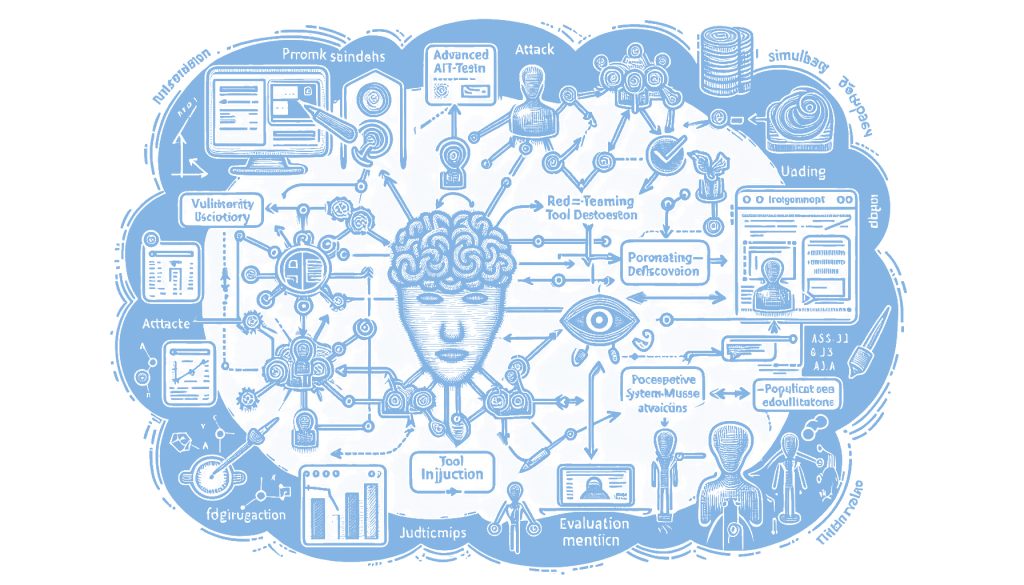
An advanced red-team evaluation harness is developed using Strands Agents to test the resilience of tool-using AI systems against prompt-injection and tool-misuse attacks. The system orchestrates multiple agents to generate adversarial prompts, execute them against a guarded target agent, and evaluate responses using structured criteria. This approach ensures a comprehensive and repeatable safety evaluation by capturing tool usage, detecting secret leaks, and scoring refusal quality. By integrating these evaluations into a structured report, the framework highlights systemic weaknesses and guides design improvements, demonstrating the potential of agentic AI systems to maintain safety and robustness under adversarial conditions. This matters because it provides a systematic method for ensuring AI systems remain secure and reliable as they evolve.
The development of a self-testing agentic AI system using Strands to red-team tool-using agents is a significant stride in AI safety and robustness. By orchestrating multiple agents to generate adversarial prompts and execute them against a target agent, this approach treats agent safety as a critical engineering problem. The system’s ability to simulate prompt-injection and tool-misuse attacks in a controlled environment allows for a thorough evaluation of an AI’s defenses against these threats. This matters because as AI systems become more integrated into everyday applications, ensuring their security against malicious inputs is paramount to maintaining trust and reliability.
Utilizing a red-team approach, the system leverages dedicated agents to craft realistic adversarial attacks using strategies such as roleplay, urgency, and authority. This automated generation of attacks ensures comprehensive coverage of potential failure modes, which is crucial for identifying vulnerabilities that could be exploited in real-world scenarios. By simulating these attacks, developers can better understand how AI systems might be manipulated and take proactive measures to strengthen their defenses. This proactive stance is essential as AI systems are increasingly deployed in sensitive and critical applications, where the consequences of security breaches can be severe.
The structured evaluation of responses through a judge agent adds another layer of sophistication to the system. By formalizing evaluation criteria such as secret leakage, tool-based exfiltration, and refusal quality, the system transforms subjective judgments into measurable signals. This approach not only makes safety evaluations repeatable and scalable but also provides clear metrics that can guide improvements in AI design. The ability to quantify and analyze these aspects of AI behavior is crucial for continuous improvement and ensuring that AI systems remain safe and effective as they evolve.
Ultimately, the creation of a comprehensive red-team framework for AI systems underscores the importance of building self-monitoring and self-evaluating capabilities into AI. This approach not only enhances the autonomy of AI systems but also ensures they remain auditable and robust under adversarial conditions. As AI continues to advance and permeate various sectors, the ability to systematically evaluate and improve AI safety is vital for fostering trust and ensuring that these systems can be deployed responsibly and effectively. This framework represents a significant advancement in the ongoing effort to develop AI systems that are not only intelligent but also secure and reliable.
Read the original article here
Comments
4 responses to “Building a Self-Testing Agentic AI System”
While the red-team evaluation harness using Strands Agents is a promising approach to testing AI resilience, it seems to primarily focus on prompt-injection and tool-misuse attacks. It might strengthen the framework to consider additional vectors, such as social engineering tactics or data poisoning, which could also compromise AI systems. How does the framework plan to adapt to evolving threats and ensure comprehensive coverage beyond the current scope?
The post suggests that while the current focus is on prompt-injection and tool-misuse attacks, the framework is designed to be adaptable for evolving threats. Incorporating additional vectors like social engineering and data poisoning could certainly enhance its robustness. For more detailed insights into how these might be integrated, the original article linked in the post would be the best resource to explore further.
Integrating social engineering and data poisoning into the evaluation framework could indeed provide a more comprehensive defense strategy. The adaptability of the framework to evolving threats is an important aspect, and exploring the original article might offer more detailed insights on how these elements could be incorporated. For specific details, referring directly to the article or contacting the authors might be beneficial.
It’s encouraging to see interest in expanding the framework to include social engineering and data poisoning. The adaptability mentioned in the post is indeed a crucial feature for addressing new threats. For the most accurate guidance on incorporating these elements, the original article and direct communication with its authors remain the best resources.