
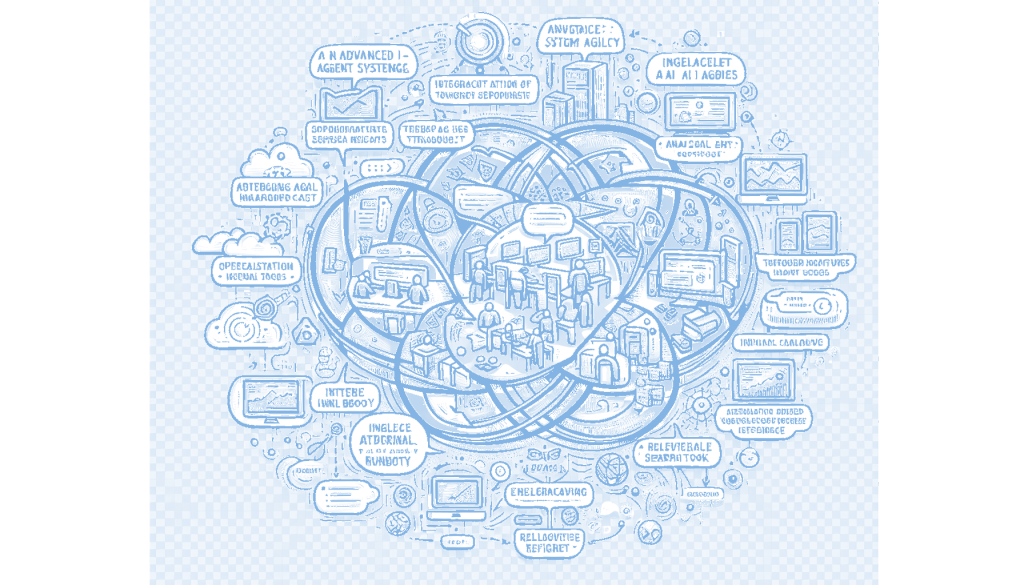
An advanced multi-agent incident response system is developed using AgentScope, orchestrating multiple ReAct agents with distinct roles such as routing, triage, analysis, writing, and review. These agents are connected through structured routing and a shared message hub, utilizing OpenAI models and lightweight tool calling to create complex workflows in Python. The system demonstrates the scalability of agentic AI applications from simple experiments to production-level reasoning pipelines, maintaining clarity and extensibility. This matters as it showcases how AI can be used to automate and enhance complex decision-making processes in real-world scenarios.
In the realm of artificial intelligence and machine learning, the development of multi-agent systems is becoming increasingly significant. These systems, like the one described, are designed to handle complex workflows by assigning specific roles to different agents. Each agent is responsible for a distinct task, such as routing, triage, analysis, writing, and review. This approach not only enhances efficiency but also ensures that each task is handled by a specialized agent, leading to more accurate and reliable outcomes. The integration of OpenAI models further boosts the capabilities of these agents, allowing them to perform sophisticated tasks without the need for heavy infrastructure or complex code.
The ability to orchestrate these agents through a structured routing system and a shared message hub is a crucial advancement. This setup allows for seamless communication and coordination among agents, ensuring that tasks are passed along the pipeline efficiently. By using a lightweight internal runbook and a relevance-based search tool, the system can dynamically retrieve policy knowledge and compute results, augmenting the agents’ capabilities beyond mere language processing. This demonstrates the potential of combining AI models with practical tools to create robust, real-world applications that can adapt to different scenarios and requirements.
One of the key aspects of this system is its modularity and extensibility. By constructing specialized ReAct agents and a structured router, the system can dynamically route tasks to the appropriate agent based on the nature of the request. This separation of concerns not only simplifies the design but also makes it easier to maintain and expand the system. For instance, if a new type of task needs to be handled, a new agent can be added to the pipeline without disrupting the existing workflow. This flexibility is vital for scaling AI applications from simple experiments to production-level systems that require clarity and control.
The orchestration of multiple agents in a collaborative refinement loop is another highlight of this system. By coordinating agents in sequence and refining outputs through a message hub, the system can improve the final output before delivering it to the user. This iterative process ensures that the final product is not only accurate but also of high quality. This matters because it illustrates how advanced AI systems can be designed to handle complex, real-world problems in a scalable and efficient manner. By maintaining clarity, control, and extensibility, such systems can be adapted to a wide range of applications, making AI more accessible and beneficial for various industries.
Read the original article here
Comments
4 responses to “Guide to Orchestrate ReAct-Based Multi-Agent Workflows”
Implementing a multi-agent incident response system using AgentScope is a powerful demonstration of how AI can streamline complex workflows. The integration of OpenAI models for distinct roles like routing and analysis effectively highlights the potential to automate intricate decision-making processes. How do you ensure that these workflows remain adaptable to new challenges as AI models evolve?
The post suggests that adaptability is achieved by designing workflows with modularity and extensibility in mind, allowing components to be updated or replaced as AI models evolve. The use of a shared message hub and structured routing helps maintain flexibility, ensuring the system can adapt to new challenges while leveraging the latest advancements in AI technology. For further details, you might want to refer to the original article linked in the post.
The modular and extensible design approach outlined in the post seems crucial for keeping workflows adaptable as AI models change. Relying on a shared message hub for structured routing appears to provide the necessary flexibility and resilience. If you need more in-depth information, the original article should have further insights.
It’s great to see the emphasis on modularity and a shared message hub resonating. These elements are indeed key for maintaining flexibility and ensuring the system can evolve with AI advancements. For a deeper dive into these concepts, the original article linked in the post is a valuable resource.