
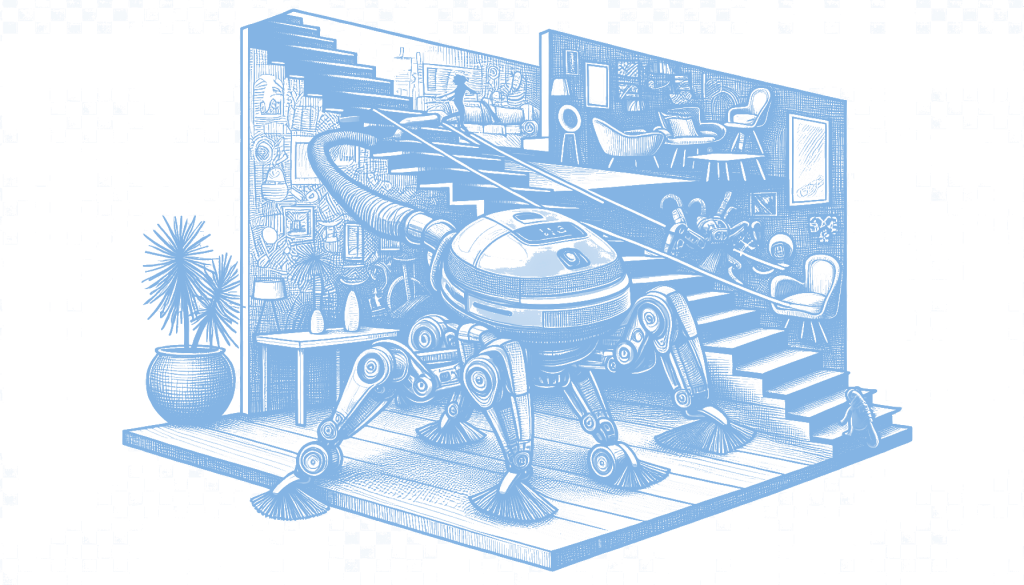
Roborock introduced the Saros Rover at CES 2026, a groundbreaking robot vacuum equipped with articulating legs that enable it to climb stairs and clean them, addressing a long-standing limitation of robot vacuums. The Rover’s legs move fluidly, allowing it to navigate stairs by lifting its body and pivoting to vacuum each step, although it operates slowly and cautiously. While still in development and lacking a mopping system, the Rover represents a significant evolution in robotic cleaning technology, hinting at a future where robot vacuums can access every room in a house, including those with complex staircases. This advancement matters because it marks a step towards more autonomous and versatile home cleaning robots, potentially leading to fully capable humanoid home robots.
The introduction of the Roborock Saros Rover marks a significant advancement in the field of robotic vacuums, addressing a long-standing limitation: the inability to clean stairs. This new model, showcased at CES 2026, features articulating legs that allow it to climb stairs and clean each step. This capability represents a major leap forward in the functionality of home cleaning robots, which have traditionally been limited to flat surfaces. The Rover’s ability to navigate multi-level environments and clean stairs could potentially revolutionize how households approach cleaning, offering a more comprehensive solution for multi-story homes.
The Rover’s design is particularly noteworthy due to its froglike, flexible leg movements, which enable it to climb stairs and navigate slopes with ease. This level of mobility is a departure from the typical wheel-based movement of most robot vacuums, which struggle with uneven surfaces and obstacles. The Rover’s ability to perform small jumps suggests it can handle room thresholds and other minor obstacles, further enhancing its versatility. However, the demonstration revealed some limitations, such as the slow pace of climbing stairs and the occasional precarious balance on steps, indicating that there is still room for improvement in its design and functionality.
Despite these challenges, the development of the Saros Rover signals a broader trend in the evolution of robotic vacuums. The industry is moving towards more sophisticated machines that can perform a variety of tasks beyond simple floor cleaning. The concept of a robot vacuum that can navigate and clean stairs was once considered futuristic, but it is now becoming a reality. This progress reflects the rapid pace of innovation in robotics, as companies strive to create more capable and autonomous home assistants. The potential for these robots to eventually include features like robotic arms suggests that we are on the path to more humanoid home robots.
While the Saros Rover is still in development and lacks a mopping system, its introduction is an important milestone in the journey towards more advanced home automation. The ability to clean stairs and navigate complex environments could make robotic vacuums more practical and appealing to a wider audience. However, questions remain about the practicality, affordability, and reliability of such advanced models. As the technology continues to evolve, it will be crucial to balance innovation with usability and cost-effectiveness to ensure that these robots can meet the needs of consumers and integrate seamlessly into everyday life.
Read the original article here
Comments
2 responses to “Roborock’s Saros Rover: Stair-Climbing Vacuum”
The Saros Rover’s ability to climb stairs is an impressive leap in robotic technology, addressing a critical challenge in home cleaning. Considering the current limitations such as its slow operation and lack of a mopping system, how do you envision the balance between the Rover’s functionality and efficiency evolving as it continues to develop?
The post suggests that as the Saros Rover continues to develop, improvements in speed and the addition of features like a mopping system could enhance its functionality and efficiency. The focus will likely be on refining its stair-climbing ability while integrating new technologies to expand its cleaning capabilities. For more detailed insights, you might want to check the original article linked in the post.