
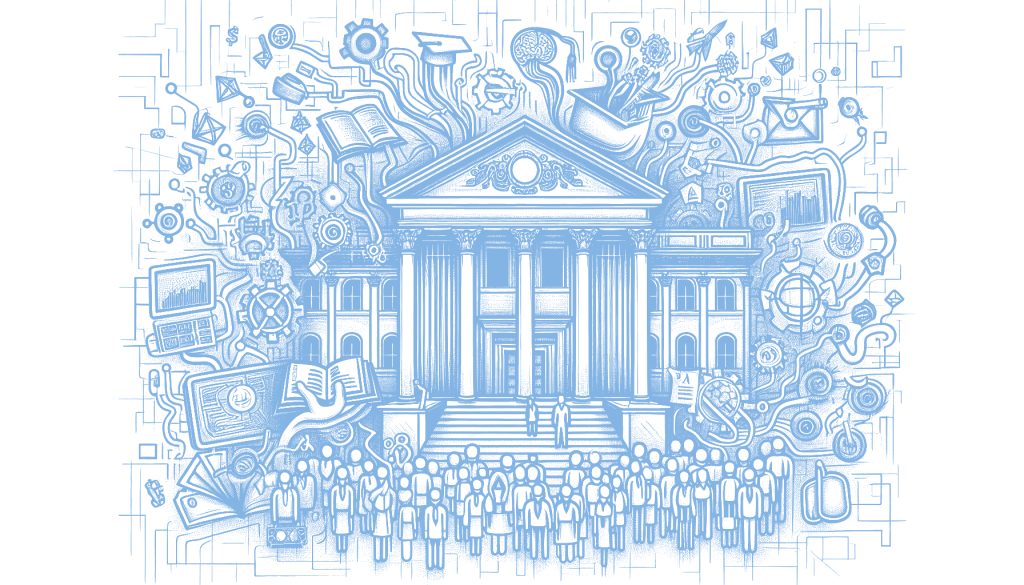
The rising cost of college education is being challenged by the potential of AI to significantly reduce expenses by replacing traditional knowledge work, which colleges currently prepare students for. As AI becomes more capable of handling both teaching and administrative roles, the concept of college could transform into entrepreneurial hubs where students learn from AI tutors and collaborate on startups, making education more affordable and effective. This shift could lead to a new model of higher education that emphasizes social experiences and practical entrepreneurship over traditional academic structures. The transition toward AI-driven educational institutions is seen as an inevitable change that could occur in the near future, offering a more accessible and engaging college experience. This matters because it highlights a potential solution to the unsustainable costs of higher education, paving the way for more accessible and innovative learning environments.
The rising cost of college education has become a significant concern, with tuition fees skyrocketing far beyond the rate of inflation. This financial burden has led to questions about the return on investment of a college degree, especially as the job market evolves with the advent of artificial intelligence. AI is poised to transform the landscape of knowledge work, traditionally the domain of college graduates. As AI systems become increasingly capable of performing tasks that require knowledge and expertise, the value proposition of a traditional college education is being challenged. This shift matters because it could redefine the pathways to career success and financial stability for future generations.
One proposed solution to this issue is the transformation of colleges into entrepreneurial AI hubs. By leveraging AI to teach entrepreneurship and perform administrative tasks, institutions could drastically reduce costs while offering students a more relevant and engaging educational experience. The idea is to create environments where students not only learn from AI but also collaborate with peers to launch startups. This approach emphasizes practical, hands-on learning and networking, which are crucial components of entrepreneurship. The potential reduction in faculty and administrative overhead could make higher education more accessible, aligning costs more closely with the inflation-adjusted prices of past decades.
Moreover, the integration of AI into education could enhance learning outcomes. Personal AI tutors and study groups guided by AI professors offer tailored educational experiences that adapt to the needs of individual students. This personalized approach could address the diverse learning styles and paces of students more effectively than traditional classroom settings. Evidence suggests that personalized tutoring can significantly improve learning outcomes, making this shift not only cost-effective but also pedagogically advantageous. As students become more adept at using AI tools, they can also gain valuable skills that are increasingly relevant in the modern workforce.
The transformation of higher education through AI is not just a cost-cutting measure; it represents a fundamental shift in how education is delivered and perceived. By embracing this change, institutions can better prepare students for a future where AI plays a central role in both professional and personal spheres. This matters because it could democratize access to education, foster innovation, and equip students with the skills needed to thrive in an AI-driven world. As the conversation around AI and education continues to evolve, it will be crucial for stakeholders to consider how these changes can be implemented effectively and equitably. The potential for a more affordable, effective, and enjoyable college experience is within reach, and it could redefine the educational landscape for generations to come.
Read the original article here
Comments
2 responses to “AI Revolutionizing College Costs”
The idea of AI transforming colleges into entrepreneurial hubs is intriguing, especially if it can make education more affordable and practical. However, how do you see traditional faculty roles evolving in this AI-driven educational landscape, particularly in fields that require a high level of human interaction and mentorship?
The post suggests that traditional faculty roles might evolve to focus more on mentorship and guidance, leveraging AI tools to enhance their teaching methods. In fields requiring high human interaction, faculty could concentrate on providing the personal touch and critical thinking skills that AI cannot replicate, thus complementing the AI-driven aspects of education. For more in-depth insights, I recommend checking the original article linked in the post.