
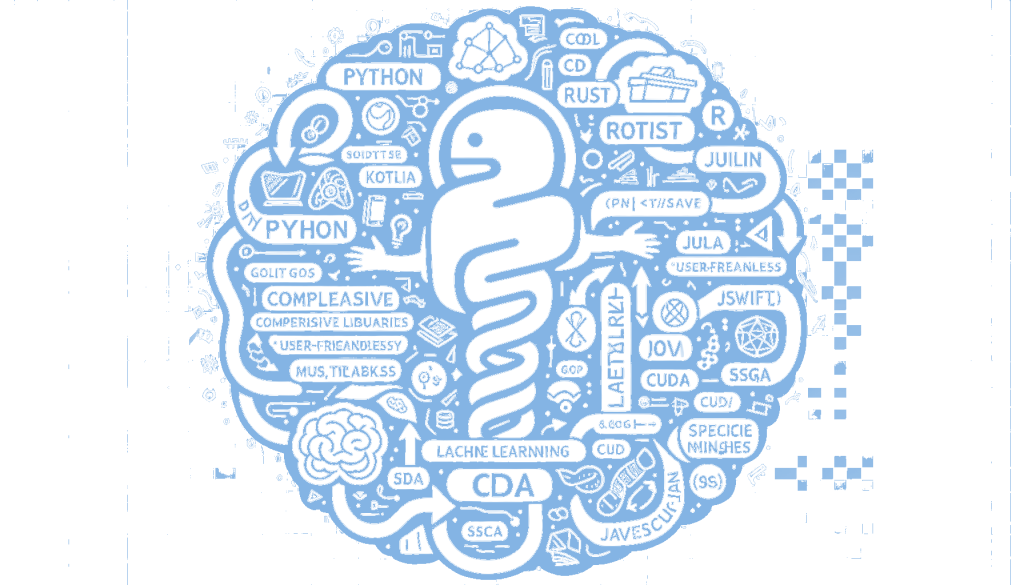
Python remains the dominant language for machine learning due to its comprehensive libraries, user-friendly nature, and adaptability. For tasks requiring high performance, C++ and Rust are favored, with C++ being notable for inference and optimizations, while Rust is chosen for its safety features. Julia is recognized for its performance capabilities, though its adoption rate is slower. Other languages like Kotlin, Java, and C# are used for platform-specific applications, while Go, Swift, and Dart are preferred for their ability to compile to native code. R and SQL serve roles in statistical analysis and data management, respectively, and CUDA is employed for GPU programming to boost machine learning tasks. JavaScript is frequently used in full-stack projects involving web-based machine learning interfaces. Understanding the strengths and applications of various programming languages is essential for optimizing machine learning and AI development.
Python’s dominance in the realm of machine learning and AI is largely attributed to its extensive libraries, ease of use, and versatility. Libraries like TensorFlow, PyTorch, and Scikit-learn provide robust frameworks that simplify the development of complex models, making Python an ideal choice for both beginners and experts. Its readability and the vast community support further enhance its appeal, ensuring that developers can efficiently troubleshoot and optimize their code. This matters because the choice of programming language can significantly impact the development speed and the performance of machine learning applications.
For tasks where performance is paramount, languages like C++ and Rust are often preferred. C++ is renowned for its speed, making it suitable for inference and low-level optimizations where execution time is critical. Rust, on the other hand, offers similar performance benefits but adds a layer of safety features that help prevent common programming errors, such as memory leaks and data races. These languages are crucial for applications where computational efficiency and reliability are non-negotiable, such as real-time data processing or embedded systems.
Languages like Julia, Kotlin, Java, and C# also find their niches in the machine learning landscape. Julia is noted for its performance, particularly in numerical computing, though its adoption is not as widespread. Kotlin, Java, and C# are often used for machine learning applications on specific platforms, such as Android, due to their ability to compile to native code, which enhances performance. The choice of these languages often depends on the specific requirements of the project, such as platform compatibility and the need for native performance.
Other languages like Go, Swift, Dart, R, SQL, CUDA, and JavaScript serve specialized roles in the machine learning ecosystem. Go, Swift, and Dart are high-level languages that compile to native code, making them suitable for applications where performance is a priority. R is extensively used for statistical analysis and data science, which frequently overlap with machine learning tasks, while SQL is indispensable for data management. CUDA, often used with C++, is essential for GPU programming to accelerate machine learning computations. JavaScript is a popular choice for integrating machine learning into web applications, providing a seamless user experience. Understanding these languages and their roles is crucial for developers to make informed decisions based on the specific needs of their projects. This diversity in language options ensures that developers can choose the best tools for their particular use case, optimizing both development efficiency and application performance.
Read the original article here
Comments
2 responses to “Language Modeling: Training Dynamics”
While the post effectively highlights the strengths of various programming languages in machine learning, it could benefit from a deeper exploration of how emerging languages like Julia are being integrated into existing ecosystems despite their slower adoption rates. Additionally, discussing the role of language interoperability, particularly in environments where multiple languages must work together, would provide a more comprehensive view. How do you foresee the evolution of language interoperability impacting the future landscape of machine learning development?
The post suggests that while Julia’s performance capabilities are promising, its slower adoption is a challenge. Language interoperability is indeed crucial, especially as diverse toolchains become more common in machine learning. The evolution of interoperability could significantly streamline workflows, allowing for more seamless integration of various languages and leveraging their unique strengths in a unified ecosystem.