
Deep Dives
-
Flash Attention in Triton: V1 and V2
Read Full Article: Flash Attention in Triton: V1 and V2 Python remains the dominant language for machine learning due to its extensive libraries and ease of use, but other languages are also employed for specific performance or platform requirements. C++ is favored for performance-critical tasks, while Julia, though less common, is another option. R is used for statistical analysis and data visualization, and Go offers good performance with its high-level features. Swift and Kotlin are popular for iOS/macOS and Android development, respectively, with ML applications. Java, with tools like GraalVM, is suitable for performance-sensitive tasks, and Rust is valued for its memory safety. Dart and Vala are also mentioned for their ability to compile to native code. Understanding these languages alongside Python can enhance a developer's toolkit for various machine learning needs. This matters because leveraging the right programming language can optimize machine learning applications for performance and platform-specific requirements.
-
Project-Based Learning in Machine Learning
Read Full Article: Project-Based Learning in Machine Learning Project-based learning in machine learning involves building projects from scratch, starting with foundational concepts like linear regression and progressing to more complex tasks such as constructing large language models (LLMs). This hands-on approach facilitates deeper understanding and practical skills development by allowing learners to apply theoretical knowledge to real-world problems. Regular updates and shared repositories can enhance learning by providing continuous feedback and fostering a collaborative learning environment. This matters because it bridges the gap between theory and practice, equipping learners with the skills needed to tackle real-world machine learning challenges effectively.
-
5 Agentic Coding Tips & Tricks
Read Full Article: 5 Agentic Coding Tips & Tricks Agentic coding becomes effective when it consistently delivers correct updates, passes tests, and maintains a reliable record. To achieve this, it's crucial to guide code agents with a structured workflow that emphasizes clarity, evidence, and containment. Key strategies include using a repo map to prevent broad refactors by helping agents understand the codebase's structure, enforcing a diff budget to keep changes manageable, and converting requirements into executable acceptance tests to provide clear targets. Additionally, incorporating a "rubber duck" step can reveal hidden assumptions, and requiring run recipes ensures the agent's output is reproducible and verifiable. These practices enhance the agent's precision and reliability, transforming it from a flashy tool into a dependable contributor to the development process. This matters because it enables more efficient and error-free coding, ultimately leading to higher quality software development.
-
Adapting RoPE for Long Contexts
Read Full Article: Adapting RoPE for Long Contexts Rotary Position Embeddings (RoPE) are a method for encoding token positions in sequences, offering an advantage over traditional sinusoidal embeddings by focusing on relative rather than absolute positions. To adapt RoPE for longer context lengths, as seen in models like Llama 3.1, a scaling strategy is employed that modifies the frequency components. This involves applying a scaling factor to improve long-range stability at low frequencies while maintaining high-frequency information for local context. The technique allows models to handle both short and long contexts effectively by reallocating the RoPE scaling budget, ensuring that the model can capture dependencies within a wide range of token distances. This approach is crucial for enhancing the performance of language models on tasks requiring understanding of long sequences, which is increasingly important in natural language processing applications.
-
Pretraining Llama Model on Local GPU
Read Full Article: Pretraining Llama Model on Local GPU Pretraining a Llama model on a local GPU involves setting up a comprehensive pipeline using PyTorch and Hugging Face libraries. The process starts with loading a tokenizer and a dataset, followed by defining the model architecture through a series of classes, such as LlamaConfig, RotaryPositionEncoding, and LlamaAttention, among others. The Llama model is built using transformer layers with rotary position embeddings and grouped-query attention mechanisms. The training setup includes defining hyperparameters like learning rate, batch size, and sequence length, along with creating data loaders, optimizers, and learning rate schedulers. The training loop involves computing attention masks, applying the model to input data, calculating loss using cross-entropy, and updating model weights with gradient clipping. Checkpoints are saved periodically to resume training if interrupted, and the final model is saved upon completion. This matters because it provides a detailed guide for developers to pretrain large language models efficiently on local hardware, making advanced AI capabilities more accessible.
-
3 Smart Ways to Encode Categorical Features
Read Full Article: 3 Smart Ways to Encode Categorical Features Encoding categorical features into numerical values is crucial for machine learning models to process data effectively. Three reliable techniques are ordinal encoding, one-hot encoding, and target (mean) encoding. Ordinal encoding is suitable for categories with a natural order, like education levels, where the rank is preserved in numerical form. One-hot encoding is ideal for nominal data without inherent order, such as colors or countries, by creating binary columns for each category, avoiding false hierarchies. However, it can lead to high dimensionality with features having many unique values. Target encoding, useful for high-cardinality features, replaces categories with the mean of the target variable, compressing many categories into a single predictive feature. This method requires caution to prevent target leakage, which can be mitigated through cross-validation or smoothing techniques. Choosing the appropriate encoding method depends on the data's nature and the number of unique categories, ensuring the model's accuracy and efficiency. This matters because proper encoding of categorical features is essential for building accurate and efficient machine learning models, directly impacting their predictive performance.
-
Evaluating Perplexity on Language Models
Read Full Article: Evaluating Perplexity on Language Models Perplexity is a crucial metric for evaluating language models, as it measures how well a model predicts a sequence of text by assessing its uncertainty about the next token. Defined mathematically as the inverse of the geometric mean of the token probabilities, perplexity provides insight into a model's predictive accuracy, with lower values indicating better performance. The metric is sensitive to vocabulary size, meaning it can vary significantly between models with different architectures. Using the HellaSwag dataset, which includes context and multiple possible endings for each sample, models like GPT-2 and Llama can be evaluated based on their ability to select the correct ending with the lowest perplexity. Larger models generally achieve higher accuracy, as demonstrated by the comparison between the smallest GPT-2 model and Llama 3.2 1B. This matters because understanding perplexity helps in developing more accurate language models that can better mimic human language use.
-
Efficient Model Training with Mixed Precision
Read Full Article: Efficient Model Training with Mixed Precision Training large language models is a memory-intensive task, primarily due to the size of the models and the length of the data sequences they process. Techniques like mixed precision and gradient checkpointing can help alleviate memory constraints. Mixed precision involves using lower-precision floating-point numbers, such as float16 or bfloat16, which save memory and can speed up training on compatible hardware. PyTorch's automatic mixed precision (AMP) feature simplifies this process by automatically selecting the appropriate precision for different operations, while a GradScaler manages gradient scaling to prevent issues like vanishing gradients. Gradient checkpointing further reduces memory usage by discarding some intermediate results during the forward pass and recomputing them during the backward pass, trading off computational time for memory savings. These techniques are crucial for training models efficiently in memory-constrained environments, allowing for larger batch sizes and more complex models without requiring additional hardware resources. This matters because optimizing memory usage in model training enables more efficient use of resources, allowing for the development of larger and more powerful models without the need for expensive hardware upgrades.
-
Speed Up Model Training with torch.compile & Grad Accumulation
Read Full Article: Speed Up Model Training with torch.compile & Grad Accumulation Training deep transformer language models can be accelerated using two main techniques: torch.compile() and gradient accumulation. With the introduction of PyTorch 2.0, torch.compile() allows for the compilation of models, optimizing them for better performance by creating a computation graph. This compiled model shares the same tensors as the original model, but it is crucial to ensure the model is error-free before compiling, as debugging becomes more challenging. Gradient accumulation, on the other hand, is a method to simulate a larger batch size by accumulating gradients over multiple forward passes, reducing the number of backward passes and optimizer updates needed. This approach is particularly useful in memory-constrained environments, as it allows for efficient training without requiring additional memory. Adjustments to the learning rate schedule are necessary when using gradient accumulation to ensure proper training dynamics. These techniques are important for improving the efficiency and speed of training large models, which can be a significant bottleneck in machine learning workflows.
-
Training Models on Multiple GPUs with Data Parallelism
Read Full Article: Training Models on Multiple GPUs with Data Parallelism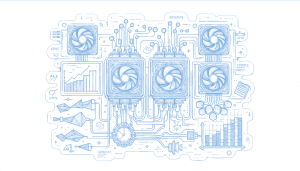 Training a model on multiple GPUs using data parallelism involves distributing data across various GPUs to enhance computational efficiency and speed. The process begins with defining a model configuration, such as the Llama model, which includes hyperparameters like vocabulary size, sequence length, and number of layers. The model utilizes components like rotary position encoding and grouped-query attention to process input data. A distributed data parallel (DDP) setup is employed to manage multiple GPUs, ensuring each GPU processes a portion of the data. The training loop involves loading data, creating attention masks, computing loss, and updating model weights using optimizers and learning rate schedulers. This approach significantly boosts training performance and is essential for handling large-scale datasets and complex models in machine learning. This matters because it enables efficient training of large models, which is crucial for advancements in AI and machine learning applications.