
Learning
-
Comprehensive AI/ML Learning Roadmap
Read Full Article: Comprehensive AI/ML Learning Roadmap A comprehensive AI/ML learning roadmap has been developed to guide learners from beginner to advanced levels using only free resources. This structured path addresses common issues with existing roadmaps, such as being too shallow, overly theoretical, outdated, or fragmented. It begins with foundational knowledge in Python and math, then progresses through core machine learning, deep learning, LLMs, NLP, generative AI, and agentic systems, with each phase including practical projects to reinforce learning. The roadmap is open for feedback to ensure it remains a valuable and accurate tool for anyone serious about learning AI/ML without incurring costs. This matters because it democratizes access to quality AI/ML education, enabling more individuals to develop skills in this rapidly growing field.
-
Interact with Notion Docs Using RAG
Read Full Article: Interact with Notion Docs Using RAG Retrieval-Augmented Generation (RAG) is a powerful method that allows users to interact with their Notion documents through natural language queries. By integrating RAG, users can ask questions and receive responses that are informed by the content of their documents, making information retrieval more intuitive and efficient. This approach leverages a combination of retrieval mechanisms and generative models to provide precise and contextually relevant answers, enhancing the overall user experience. Such advancements in document interaction can significantly streamline workflows and improve productivity by reducing the time spent searching for information.
-
Building Engaged Communities at TechCrunch Disrupt
Read Full Article: Building Engaged Communities at TechCrunch Disrupt Tade Oyerinde and Teddy Solomon shared insights on building lasting communities at TechCrunch Disrupt, drawing from their experiences with Campus and Fizz. Oyerinde's Campus offers flexible online education, including à la carte courses, catering to the growing demand for upskilling, while leveraging financial support from notable investors to prioritize educational innovation over profit. Solomon's Fizz, a social app for college students, has expanded to over 200 campuses and is exploring international growth with a focus on ad-based monetization. Both leaders emphasize the importance of user engagement and satisfaction in sustaining their platforms. This matters because it highlights innovative approaches to education and community building in the digital age, emphasizing user-centric strategies.
-
Choosing the Right Language for ML
Read Full Article: Choosing the Right Language for ML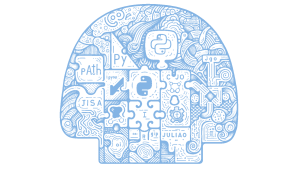 Choosing the right programming language for machine learning can greatly influence efficiency, performance, and resource availability. Python stands out as the most popular choice due to its ease of use, extensive libraries, and strong community support, despite its slower execution speed compared to compiled languages. Other languages like R, Java, C++, Julia, Go, and Rust each offer specific benefits, such as performance, scalability, or ease of integration into existing systems, making them suitable for particular use cases. Ultimately, selecting the best language depends on individual needs, goals, and the specific machine learning tasks at hand. Why this matters: Understanding the strengths and weaknesses of different programming languages helps in selecting the most appropriate one for efficient and effective machine learning projects.
-
Resolving Inconsistencies in Linear Systems
Read Full Article: Resolving Inconsistencies in Linear Systems In the linear equation system Ax=b, inconsistencies can arise when the vector b is not within the column space of A. A common solution is to add a column of 1's to matrix A, which expands the column space by introducing a new direction of reachability, allowing previously unreachable vectors like b to be included in the expanded span. This process doesn't rotate the column space but rather introduces a uniform shift, similar to how adding a constant in y=mx+b shifts the line vertically, transforming the linear system into an affine one. This matters because it provides a method to resolve inconsistencies in linear systems, making them more flexible and applicable to a wider range of problems.
-
AI-Assisted Sculpting for 3D Miniatures
Read Full Article: AI-Assisted Sculpting for 3D Miniatures AI-assisted sculpting workflows are being refined to enhance the creation of 3D miniatures by generating base forms with AI, which are then refined using tools like Blender and ZBrush. The process includes manually cleaning the topology, adding detail with traditional sculpting tools, and exporting print-ready STLs, which are tested on Bambu printers with multi-material setups. A new community, r/AIModelMakers, has been established for individuals interested in AI-enhanced 3D modeling and miniature workflows, offering a space to share experiments and learn from others. This matters as it represents a significant advancement in 3D modeling, making the process more efficient and accessible through AI technology.
-
LoureiroGate: Enforcing Hard Physical Constraints
Read Full Article: LoureiroGate: Enforcing Hard Physical Constraints![[Project] LoureiroGate: A PyTorch library for enforcing Hard Physical Constraints (Differentiable Gating)](https://www.tweakedgeek.com/wp-content/uploads/2025/12/featured-article-7603-300x171.png) Choosing the right programming language for machine learning can greatly affect efficiency, performance, and resource accessibility. Python is the most popular choice due to its ease of use, extensive library ecosystem, and strong community support, making it ideal for beginners and experienced developers alike. Other languages like R, Java, C++, Julia, Go, and Rust offer unique advantages for specific use cases, such as statistical analysis, enterprise integration, or performance-critical tasks. The best language depends on individual needs and the specific requirements of the machine learning project. This matters because selecting the appropriate programming language can significantly streamline machine learning development and enhance the effectiveness of the solutions created.
Choosing the right programming language for machine learning can greatly affect efficiency, performance, and resource accessibility. Python is the most popular choice due to its ease of use, extensive library ecosystem, and strong community support, making it ideal for beginners and experienced developers alike. Other languages like R, Java, C++, Julia, Go, and Rust offer unique advantages for specific use cases, such as statistical analysis, enterprise integration, or performance-critical tasks. The best language depends on individual needs and the specific requirements of the machine learning project. This matters because selecting the appropriate programming language can significantly streamline machine learning development and enhance the effectiveness of the solutions created.
-
10 Must-Know Python Libraries for Data Scientists
Read Full Article: 10 Must-Know Python Libraries for Data Scientists Data scientists often rely on popular Python libraries like NumPy and pandas, but there are many lesser-known libraries that can significantly enhance data science workflows. These libraries are categorized into four key areas: automated exploratory data analysis (EDA) and profiling, large-scale data processing, data quality and validation, and specialized data analysis for domain-specific tasks. For instance, Pandera offers statistical data validation for pandas DataFrames, while Vaex handles large datasets efficiently with a pandas-like API. Other notable libraries include Pyjanitor for clean data workflows, D-Tale for interactive DataFrame visualization, and cuDF for GPU-accelerated operations. Exploring these libraries can help data scientists tackle common challenges more effectively and improve their data processing and analysis capabilities. This matters because utilizing the right tools can drastically enhance productivity and accuracy in data science projects.
-
HOPE Replica Achieves Negative Forgetting on SplitMNIST
Read Full Article: HOPE Replica Achieves Negative Forgetting on SplitMNIST A HOPE replica, inspired by the paper "Nested Learning: The Illusion of Deep Learning Architecture," has achieved negative forgetting on the SplitMNIST task, which is a significant accomplishment in task incremental learning (Task IL). Negative forgetting, also known as positive transfer, implies that the model not only retains previously learned tasks but also improves on them while learning new tasks. This achievement highlights the potential for developing more efficient deep learning models that can better manage and utilize knowledge across multiple tasks. Understanding and implementing such models can lead to advancements in AI that are more adaptable and capable of continuous learning.
-
Dynamic Learning Rate Scheduling
Read Full Article: Dynamic Learning Rate Scheduling Training a machine learning model often requires adjusting the learning rate as the process progresses. Initially, a larger learning rate is beneficial for rapid progress, but as the model nears optimal performance, a smaller learning rate is necessary for fine-tuning and precise adjustments. Without adapting the learning rate, the model may overshoot the optimal point, causing oscillations and preventing further improvement. Implementing a learning rate schedule can significantly enhance model performance, potentially increasing accuracy from 85 percent to 95 percent with the same model and data. This matters because it can lead to more efficient training and better-performing models in machine learning applications.