
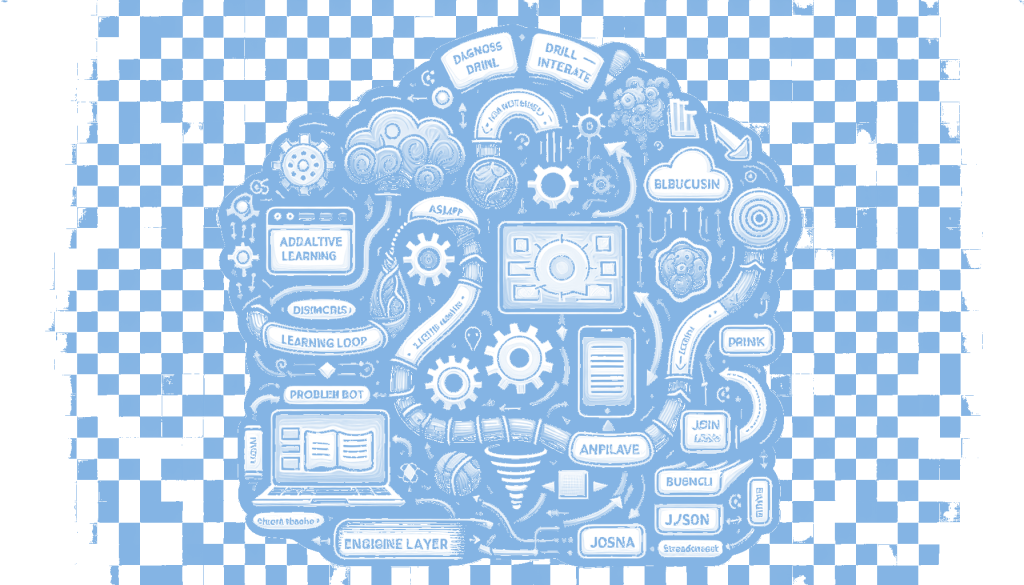
The Adaptive Learning Framework (ALF) is an innovative, open-source tool designed to enhance STEM education through a modular, bilingual, and JSON-driven approach. It operates on a simple adaptive learning loop—Diagnosis, Drill, Integration—to identify misconceptions, provide targeted practice, and confirm mastery. Educators can easily extend ALF by adding new topics through standalone JSON files, which define questions, correct answers, common errors, and drills. The framework’s core is a Python-based adaptive learner that tracks progress through distinct phases, while a minimalistic Streamlit UI supports both English and Dutch. ALF is built to be transparent and accessible, encouraging collaboration and contribution from educators, developers, and researchers, with the aim of making adaptive learning more open and free from corporate constraints. This matters because it democratizes educational tools, allowing for broader access and innovation in learning methodologies.
The development of an open-source Adaptive Learning Framework (ALF) for STEM education is a significant stride in making educational tools more accessible and customizable. ALF is designed to be modular, bilingual, and JSON-driven, which means it can be easily adapted and extended by educators and developers. Its core functionality revolves around a simple adaptive learning loop: Diagnosis, Drill, and Integration. This loop allows the framework to identify misconceptions, provide targeted practice, and verify mastery, all while maintaining transparency and simplicity. The use of JSON modules ensures that anyone can contribute by adding new topics, without the need to alter the underlying engine, making it a truly collaborative and open platform.
The framework’s architecture is built on a few key components that ensure its adaptability and ease of use. The JSON Problem Bank serves as the foundation, where each topic is encapsulated in standalone JSON files, detailing questions, correct answers, common errors, and drill prompts. This design makes it straightforward for educators to expand the framework’s content. The Adaptive Learner, a Python class, acts as a state machine that navigates through the phases of diagnosis, drill, and integration, storing the learner’s history and errors. The Engine Layer orchestrates these components, ensuring seamless operation, while the Streamlit UI offers a minimalistic and bilingual interface, supporting both English and Dutch.
The motivation behind creating ALF stems from a desire to promote clarity, transparency, and evolution in educational systems. The developer’s experience across education, tech, and the military highlighted the need for systems that are easy to understand and adapt. By documenting the entire development process with photos and structure diagrams, the creator emphasizes the intentionality and care that went into building ALF. This transparency not only aids in understanding the framework but also builds trust in its functionality and purpose. The visual documentation serves as a testament to the framework’s growth and maturity, inviting others to explore and contribute to its development.
Sharing ALF as an open-source project underscores the belief that adaptive learning should not be confined within corporate boundaries. By making it accessible and modifiable, the framework encourages collaboration among educators, developers, and researchers. This openness fosters innovation and allows for the continuous improvement of educational tools. The hope is that ALF will inspire new ideas, spark constructive criticism, and invite curiosity and collaboration from a diverse community. By breaking down barriers to access, ALF aims to democratize adaptive learning and empower educators to tailor educational experiences to better meet the needs of learners worldwide.
Read the original article here