
AI development
-
Local LLMs: Trends and Hardware Challenges
Read Full Article: Local LLMs: Trends and Hardware Challenges The landscape of local Large Language Models (LLMs) is rapidly advancing, with llama.cpp emerging as a favored tool among enthusiasts due to its performance and transparency. Despite the influence of Llama models, recent versions have garnered mixed feedback. The rising costs of hardware, particularly VRAM and DRAM, are a growing concern for those running local LLMs. For those seeking additional insights and community support, various subreddits offer a wealth of information and discussion. Understanding these trends and tools is crucial as they impact the accessibility and development of AI technologies.
-
OpenAI’s New Audio Model and Hardware Plans
Read Full Article: OpenAI’s New Audio Model and Hardware Plans OpenAI is gearing up to launch a new audio language model by early 2026, aiming to pave the way for an audio-based hardware device expected in 2027. Efforts are underway to enhance audio models, which are currently seen as lagging behind text models in terms of accuracy and speed, by uniting multiple teams across engineering, product, and research. Despite the current preference for text interfaces among ChatGPT users, OpenAI hopes that improved audio models will encourage more users to adopt voice interfaces, broadening the deployment of their technology in various devices, such as cars. The company envisions a future lineup of audio-focused devices, including smart speakers and glasses, emphasizing audio interfaces over screen-based ones.
-
The Handyman Principle: AI’s Memory Challenges
Read Full Article: The Handyman Principle: AI’s Memory ChallengesThe Handyman Principle explores the concept of AI systems frequently "forgetting" information, akin to a handyman who must focus on the task at hand rather than retaining all past details. This phenomenon is attributed to the limitations in current AI architectures, which prioritize efficiency and performance over long-term memory retention. By understanding these constraints, developers can better design AI systems that balance memory and processing capabilities. This matters because improving AI memory retention could lead to more sophisticated and reliable systems in various applications.
-
LeCun Confirms Llama 4 Benchmark Manipulation
Read Full Article: LeCun Confirms Llama 4 Benchmark Manipulation Yann LeCun, departing Meta AI Chief, has confirmed suspicions that the Llama 4 benchmarks were manipulated. This revelation comes amidst reports that Mark Zuckerberg has sidelined the entire Generative AI organization at Meta, leading to significant departures and a potential exodus of remaining staff. The absence of the anticipated large-scale Llama 4 model and lack of subsequent updates further corroborate the internal turmoil. This matters as it highlights potential ethical issues in AI development and the impact of organizational decisions on innovation and trust.
-
Satya Nadella Blogs on AI’s Future Beyond Slop vs Sophistication
Read Full Article: Satya Nadella Blogs on AI’s Future Beyond Slop vs Sophistication Microsoft CEO Satya Nadella has started blogging to discuss the future of AI and the need to move beyond debates of AI's simplicity versus sophistication. He emphasizes the importance of developing a new equilibrium in our understanding of AI as cognitive tools, akin to Steve Jobs' "bicycles for the mind" analogy for computers. Nadella envisions a shift from traditional software like Office and Windows to AI agents, despite current limitations in AI technology. He stresses the importance of applying AI responsibly, considering societal impacts, and building consensus on resource allocation, with 2026 anticipated as a pivotal year for AI development. This matters because it highlights the evolving role of AI in technology and its potential societal impact.
-
Building Paradox-Proof AI with CFOL Layers
Read Full Article: Building Paradox-Proof AI with CFOL Layers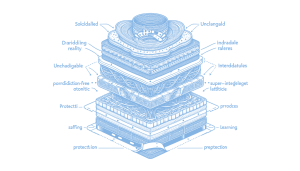 Building superintelligent AI requires addressing fundamental issues like paradoxes and deception that arise from current AI architectures. Traditional models, such as those used by ChatGPT and Claude, manipulate truth as a variable, leading to problems like scheming and hallucinations. The CFOL (Contradiction-Free Ontological Lattice) framework proposes a layered approach that separates immutable reality from flexible learning processes, preventing paradoxes and ensuring stable, reliable AI behavior. This structural fix is akin to adding seatbelts in cars, providing a necessary foundation for safe and effective AI development. Understanding and implementing CFOL is essential to overcoming the limitations of flat AI architectures and achieving true superintelligence.
-
Survey on Agentic LLMs
Read Full Article: Survey on Agentic LLMs![[R] Survey paper Agentic LLMs](https://www.tweakedgeek.com/wp-content/uploads/2026/01/featured-article-7984-300x171.png) Agentic Large Language Models (LLMs) are at the forefront of AI research, focusing on how these models reason, act, and interact, creating a synergistic cycle that enhances their capabilities. Understanding the current state of agentic LLMs provides insights into their potential future developments and applications. The survey paper offers a comprehensive overview with numerous references for further exploration, prompting questions about the future directions and research areas that could benefit from deeper investigation. This matters because advancing our understanding of agentic AI could lead to significant breakthroughs in how AI systems are designed and utilized across various fields.
Agentic Large Language Models (LLMs) are at the forefront of AI research, focusing on how these models reason, act, and interact, creating a synergistic cycle that enhances their capabilities. Understanding the current state of agentic LLMs provides insights into their potential future developments and applications. The survey paper offers a comprehensive overview with numerous references for further exploration, prompting questions about the future directions and research areas that could benefit from deeper investigation. This matters because advancing our understanding of agentic AI could lead to significant breakthroughs in how AI systems are designed and utilized across various fields.
-
Upstage Solar-Open Validation Insights
Read Full Article: Upstage Solar-Open Validation Insights During the Upstage Solar-Open Validation Session, CEO Mr. Sung Kim discussed a model architecture and shared WanDB logs, providing insights into the project's development. The sessions were conducted in Korean, but there is an option to use notebookLM for language conversion to maintain the original nuances in English. This approach ensures that non-Korean speakers can still access and understand the valuable information shared in these sessions. Understanding the model architecture and development process is crucial for those interested in advancements in solar technology and data analysis.
-
AGI’s Challenge: Understanding Animal Communication
Read Full Article: AGI’s Challenge: Understanding Animal Communication The argument suggests that Artificial General Intelligence (AGI) will face significant limitations if it cannot comprehend animal communication. Understanding the complexities of non-human communication systems is posited as a crucial step for AI to achieve a level of intelligence that could dominate or "rule" the world. This highlights the challenge of developing AI that can truly understand and interpret the diverse forms of communication present in the natural world, beyond human language. Such understanding is essential for creating AI that can fully integrate into and interact with all aspects of the environment.
-
Efficient Machine Learning Through Function Modification
Read Full Article: Efficient Machine Learning Through Function Modification A novel approach to machine learning suggests focusing on modifying functions rather than relying solely on parametric operations. This method could potentially streamline the learning process, making it more efficient by directly altering the underlying functions that govern machine learning models. By shifting the emphasis from parameters to functions, this approach may offer a more flexible and potentially faster path to achieving accurate models. Understanding and implementing such strategies could significantly enhance machine learning efficiency and effectiveness, impacting various fields reliant on these technologies.