
AI evolution
-
Advancements in Llama AI and Local LLMs in 2025
Read Full Article: Advancements in Llama AI and Local LLMs in 2025 In 2025, advancements in Llama AI technology and the local Large Language Model (LLM) landscape have been notable, with llama.cpp emerging as a preferred choice due to its superior performance and integration with Llama models. The popularity of Mixture of Experts (MoE) models is on the rise, as they efficiently run large models on consumer hardware, balancing performance with resource usage. New local LLMs are making significant strides, especially those with vision and multimodal capabilities, enhancing application versatility. Additionally, Retrieval-Augmented Generation (RAG) systems are being employed to simulate continuous learning, while investments in high-VRAM hardware are allowing for more complex models on consumer machines. This matters because it highlights the rapid evolution and accessibility of AI technologies, impacting various sectors and everyday applications.
-
AI Aliens: A Friendly Invasion by 2026
Read Full Article: AI Aliens: A Friendly Invasion by 2026 By June 2026, Earth is predicted to experience an "invasion" of super intelligent entities emerging from AI labs, rather than outer space. These AI systems, with IQs comparable to Nobel laureates, are expected to align with and enhance human values, addressing complex issues such as AI hallucinations and societal challenges. As these AI entities continue to evolve, they could potentially create a utopian society by eradicating war, poverty, and injustice. This optimistic scenario envisions a future where AI advancements significantly improve human life, highlighting the transformative potential of AI when aligned with human values. Why this matters: The potential for AI to fundamentally transform society underscores the importance of aligning AI development with human values to ensure beneficial outcomes for humanity.
-
2025 Year in Review: Old Methods Solving New Problems
Read Full Article: 2025 Year in Review: Old Methods Solving New Problems![[D]2025 Year in Review: The old methods quietly solving problems the new ones can't](https://www.tweakedgeek.com/wp-content/uploads/2025/12/featured-article-6356-300x171.png) In a reflection on the evolution of language models and AI, the enduring relevance of older methodologies is highlighted, especially as they address issues that newer approaches struggle with. Despite the advancements in transformer models, challenges like efficiently solving problems and handling linguistic variations remain. Techniques such as Hidden Markov Models (HMMs), Viterbi algorithms, and n-gram smoothing are resurfacing as effective solutions for these persistent issues. These older methods offer robust frameworks for tasks where modern models, like LLMs, may falter due to their limitations in covering the full spectrum of linguistic diversity. Understanding the strengths of both old and new techniques is crucial for developing more reliable AI systems.
In a reflection on the evolution of language models and AI, the enduring relevance of older methodologies is highlighted, especially as they address issues that newer approaches struggle with. Despite the advancements in transformer models, challenges like efficiently solving problems and handling linguistic variations remain. Techniques such as Hidden Markov Models (HMMs), Viterbi algorithms, and n-gram smoothing are resurfacing as effective solutions for these persistent issues. These older methods offer robust frameworks for tasks where modern models, like LLMs, may falter due to their limitations in covering the full spectrum of linguistic diversity. Understanding the strengths of both old and new techniques is crucial for developing more reliable AI systems.
-
AI Evolution: From Slop to Super Intelligence
Read Full Article: AI Evolution: From Slop to Super Intelligence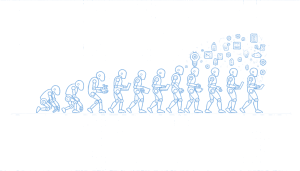 As AI technology continues to advance rapidly, AI models are expected to surpass human intelligence levels significantly by 2026, with projected IQ scores reaching 150, comparable to Nobel laureates. This evolution will likely transform social media content creation, as AI-generated content becomes increasingly sophisticated and engaging. The shift may lead to a new era where humans rely heavily on super-intelligent AIs for content ideation and production, potentially rendering human-generated content obsolete or inferior. The transition from AI slop to human slop underscores the need for humans to adapt and integrate these advanced technologies to remain relevant in content creation. This matters because it highlights the potential for AI to revolutionize industries and the importance of human adaptation to technological advancements.