
machine learning
-
160x Speedup in Nudity Detection with ONNX & PyTorch
Read Full Article: 160x Speedup in Nudity Detection with ONNX & PyTorchAn innovative approach to enhancing the efficiency of a nudity detection pipeline achieved a remarkable 160x speedup by utilizing a "headless" strategy with ONNX and PyTorch. The optimization involved converting the model to an ONNX format, which is more efficient for inference, and removing unnecessary components that do not contribute to the final prediction. This streamlined process not only improves performance but also reduces computational costs, making it more feasible for real-time applications. Such advancements are crucial for deploying AI models in environments where speed and resource efficiency are paramount.
-
Reap Models: Performance vs. Promise
Read Full Article: Reap Models: Performance vs. Promise Reap models, which are intended to be near lossless, have been found to perform significantly worse than smaller, original quantized models. While full-weight models operate with minimal errors, quantized versions might make a few, but reap models reportedly introduce a substantial number of mistakes, up to 10,000. This discrepancy raises questions about the benchmarks used to evaluate these models, as they do not seem to reflect the actual degradation in performance. Understanding the limitations and performance of different model types is crucial for making informed decisions in machine learning applications.
-
When LLMs Are Overkill for Simple Classification
Read Full Article: When LLMs Are Overkill for Simple Classification Large language models (LLMs) can be overkill for simple text classification tasks that require straightforward, deterministic outcomes, such as determining whether a message is a lead or not. The use of LLMs in such scenarios can lead to high costs, slower response times, and non-deterministic outputs, without leveraging user feedback to improve the model. By replacing the LLM with a simpler system using sentence embeddings and an online classifier, the process becomes more efficient, cost-effective, and responsive to user feedback, with the added benefit of complete control over the learning loop. This highlights the importance of choosing the right tool for the task, reserving LLMs for tasks requiring complex reasoning or handling ambiguous language.
-
Choosing Programming Languages for Machine Learning
Read Full Article: Choosing Programming Languages for Machine Learning Choosing the right programming language is crucial for efficiency and performance in machine learning projects. Python is the most popular choice due to its ease of use, extensive libraries, and strong community support, making it ideal for prototyping and developing machine learning models. Other notable languages include R for statistical analysis, Julia for high-performance tasks, C++ for performance-critical applications, Scala for big data processing, Rust for memory safety, and Kotlin for its Java interoperability. Engaging with online communities can provide valuable insights and support for those looking to deepen their understanding of machine learning. This matters because selecting an appropriate programming language can significantly enhance the development process and effectiveness of machine learning solutions.
-
AI Agents for Autonomous Data Analysis
Read Full Article: AI Agents for Autonomous Data Analysis A new Python package has been developed to leverage AI agents for automating the process of data analysis and machine learning model construction. This tool aims to streamline the workflow for data scientists by automatically handling tasks such as data cleaning, feature selection, and model training. By reducing the manual effort involved in these processes, the package allows users to focus more on interpreting results and refining models. This innovation is significant as it can greatly enhance productivity and efficiency in data science projects, making advanced analytics more accessible to a broader audience.
-
Exploring Human Perception with DCGAN and Flower Images
Read Full Article: Exploring Human Perception with DCGAN and Flower Images Training a DCGAN (Deep Convolutional Generative Adversarial Network) on over 2,000 flower images aimed to explore the boundaries of human perception in distinguishing between real and generated images. The project highlights the effectiveness of Python as the primary programming language for machine learning due to its ease of use, rich ecosystem of libraries like TensorFlow and PyTorch, and strong community support. Other languages such as R, Julia, C++, Scala, Rust, and Kotlin also offer unique advantages, particularly in statistical analysis, performance, and big data processing. Understanding the strengths of different programming languages can significantly enhance the development and performance of machine learning models.
-
HuggingFace Model Downloader v2.3.0: Web UI & Faster Scanning
Read Full Article: HuggingFace Model Downloader v2.3.0: Web UI & Faster Scanning The HuggingFace Model Downloader v2.3.0 introduces significant improvements for users downloading models and datasets, including a new web UI that allows for easy management of downloads through a browser. This version supports concurrent connections, smart resume capabilities, and filtering options to download specific quantizations. Notably, it features a one-liner web mode for quick setup and a dramatic increase in repository scanning speed, reducing the time from over five minutes to approximately two seconds. These enhancements make the tool more efficient and user-friendly, particularly for those dealing with large repositories. Why this matters: The updates significantly streamline the process of downloading and managing machine learning models, saving time and simplifying tasks for developers and researchers.
-
Choosing the Right Language for ML
Read Full Article: Choosing the Right Language for ML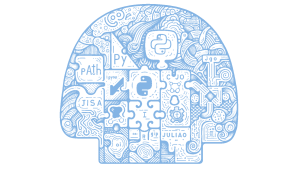 Choosing the right programming language for machine learning can greatly influence efficiency, performance, and resource availability. Python stands out as the most popular choice due to its ease of use, extensive libraries, and strong community support, despite its slower execution speed compared to compiled languages. Other languages like R, Java, C++, Julia, Go, and Rust each offer specific benefits, such as performance, scalability, or ease of integration into existing systems, making them suitable for particular use cases. Ultimately, selecting the best language depends on individual needs, goals, and the specific machine learning tasks at hand. Why this matters: Understanding the strengths and weaknesses of different programming languages helps in selecting the most appropriate one for efficient and effective machine learning projects.
-
Resolving Inconsistencies in Linear Systems
Read Full Article: Resolving Inconsistencies in Linear Systems In the linear equation system Ax=b, inconsistencies can arise when the vector b is not within the column space of A. A common solution is to add a column of 1's to matrix A, which expands the column space by introducing a new direction of reachability, allowing previously unreachable vectors like b to be included in the expanded span. This process doesn't rotate the column space but rather introduces a uniform shift, similar to how adding a constant in y=mx+b shifts the line vertically, transforming the linear system into an affine one. This matters because it provides a method to resolve inconsistencies in linear systems, making them more flexible and applicable to a wider range of problems.
-
AI’s Impact on Healthcare Transformation
Read Full Article: AI’s Impact on Healthcare Transformation AI is set to transform healthcare by enhancing diagnostics, optimizing administrative processes, and improving patient engagement. Key areas where AI can make a significant impact include clinical documentation, imaging, and operational efficiency. Ethical and regulatory considerations are crucial as AI becomes more integrated into healthcare systems. Exploring educational and career paths in AI and healthcare can provide valuable opportunities for those interested in this evolving field. This matters because AI's integration into healthcare has the potential to improve patient outcomes and streamline healthcare operations.