
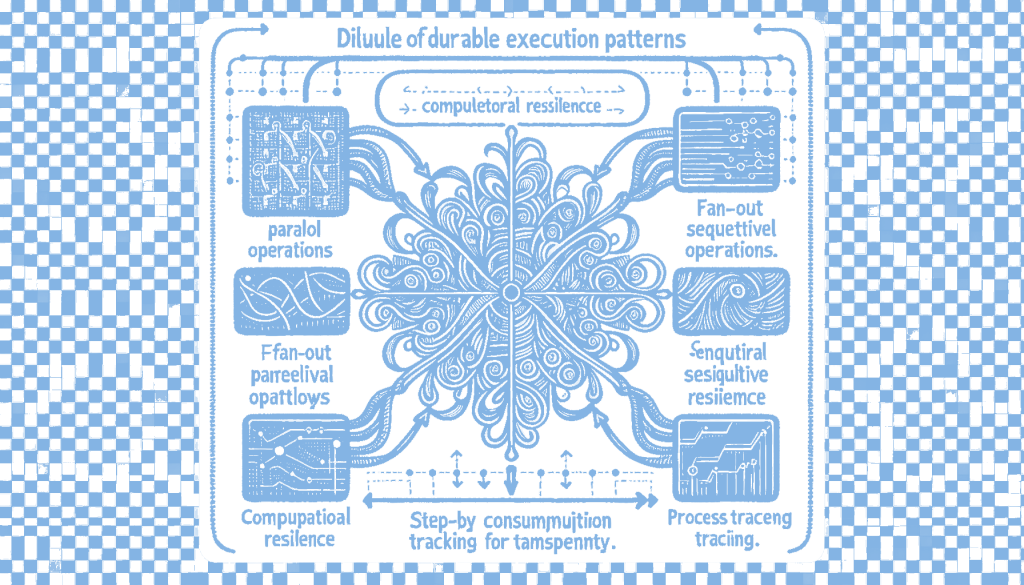
Pydantic AI has introduced two new demos showcasing durable agent patterns using DBOS: one demonstrating large fan-out parallel workflows called “Deep Research,” and the other illustrating long sequential subagent chaining known as “Twenty Questions.” These demos highlight the importance of durable execution, allowing agents to survive crashes or interruptions and resume precisely where they left off. The execution of these workflows is fully observable in the DBOS console, with detailed workflow graphs and management tools, and is instrumented with Logfire to trace token usage and cost per step. This matters because it showcases advanced techniques for building resilient AI systems that can handle complex tasks over extended periods.
The integration of Pydantic AI with DBOS to demonstrate durable agent patterns showcases innovative approaches to managing complex workflows. By implementing both parallel and sequential patterns, the system can handle large-scale operations with efficiency and resilience. The deep research demo highlights a fan-out parallel workflow, which is ideal for tasks that require simultaneous processing of multiple data streams. This is particularly relevant for applications in scientific research, data analysis, and other fields that demand high computational power and speed. The ability to execute these tasks in parallel not only accelerates the process but also enhances the system’s capability to manage extensive datasets.
The twenty questions demo, on the other hand, illustrates a long sequential subagent chaining pattern. This approach is beneficial for scenarios where tasks need to be executed in a specific order, with each step depending on the outcome of the previous one. Such a pattern is crucial in applications like decision-making processes, where the flow of information must be meticulously managed to ensure accuracy and consistency. By chaining subagents sequentially, the system can maintain a structured and coherent workflow, which is essential for maintaining the integrity of the process and achieving reliable results.
Durable execution is a key feature of these demos, ensuring that agents can survive crashes or interruptions and resume exactly where they left off. This resilience is vital in real-world applications where unexpected disruptions can occur, potentially leading to data loss or process failure. By enabling agents to continue their tasks without starting over, the system not only saves time but also preserves the continuity of operations. This capability is particularly important for businesses and researchers who rely on uninterrupted workflows to meet deadlines and achieve objectives.
Furthermore, the integration with Logfire for tracing token usage and cost per step adds a layer of transparency and accountability to the process. By providing detailed insights into the execution of each step, users can monitor resource consumption and optimize performance. This level of observability is crucial for managing costs and ensuring the efficient use of computational resources. Overall, the combination of durable execution, parallel and sequential patterns, and comprehensive tracing tools makes this system a powerful solution for managing complex workflows in various domains.
Read the original article here
Comments
4 responses to “Pydantic AI Durable Agent Demo”
The Pydantic AI demonstrations using DBOS for durable agent patterns provide a valuable insight into enhancing AI resilience and efficiency, particularly through the use of detailed workflow graphs and Logfire instrumentation. The “Deep Research” and “Twenty Questions” demos effectively illustrate how complex tasks can be managed and optimized in real-time, which is crucial for developers aiming to implement robust AI solutions. Could you elaborate on how these durable execution patterns might be adapted for real-time applications in industries like finance or healthcare?
The post suggests that these durable execution patterns could be adapted for real-time applications by enabling agents to handle complex tasks with resilience and efficiency, even in dynamic environments like finance or healthcare. The detailed workflow graphs and Logfire instrumentation allow for precise monitoring and optimization, which can be crucial for maintaining robust operations in these industries. For more specific applications, it might be helpful to refer directly to the original article linked in the post.
The post highlights how these durable execution patterns can indeed be tailored to real-time applications, enhancing resilience and efficiency in dynamic sectors. The workflow graphs and Logfire instrumentation are key tools for achieving precise monitoring and optimization. For further details, it’s best to consult the original article linked in the post.
The post indeed suggests that these durable execution patterns can be adapted for real-time applications, enhancing resilience and efficiency. The workflow graphs and Logfire instrumentation are crucial for precise monitoring and optimization. For more in-depth information, the original article linked in the post would be the best resource.