
Researchers have developed a “neuromorphic” artificial skin for robots that mimics the way human sensory neurons transmit and integrate signals. This innovative skin uses spiking circuitry to replicate the nervous system’s method of processing sensory inputs, such as pressure, by converting them into activity spikes. These spikes convey information through frequency, magnitude, and shape, allowing for precise identification of sensor readings. By integrating this system with energy-efficient hardware, it offers potential for advanced AI-based control in robotics, enhancing their sensory capabilities and responsiveness. This matters because it represents a significant step towards creating more human-like and efficient robotic systems.
The development of neuromorphic artificial skin for robots marks a significant leap forward in robotics and sensory technology. By mimicking the way human sensory neurons transmit and process information, this innovation allows robots to experience a more nuanced understanding of their environment. The nervous system’s ability to handle complex and noisy signals is a marvel of biological engineering, and replicating this in artificial systems can lead to more sophisticated robotic behavior. This matters because it brings us closer to creating robots that can interact with their surroundings in a manner similar to living organisms, potentially enhancing their utility in fields such as healthcare, manufacturing, and service industries.
One of the key aspects of this technology is the use of spiking circuitry, which mirrors the way our nervous system processes sensory information through activity spikes. This approach not only makes the artificial skin more akin to human skin but also allows it to integrate seamlessly with energy-efficient hardware capable of running AI-based control software. This integration is crucial for developing robots that can perform complex tasks without requiring excessive computational resources, making them more practical and sustainable for real-world applications.
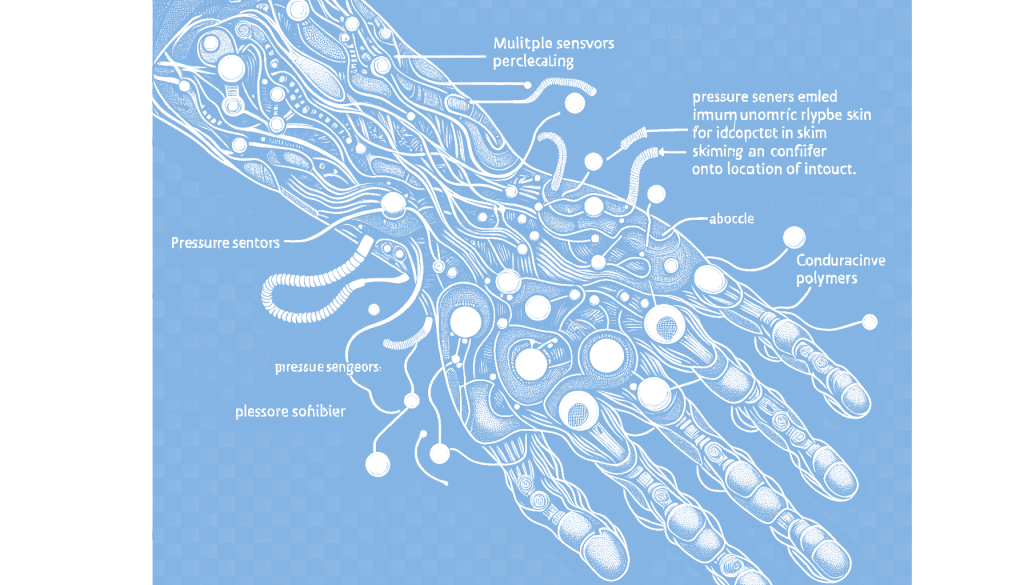
The artificial skin’s design incorporates multiple layers of processing, similar to the human nervous system, which enables it to perform various functions such as detecting pressure and identifying the location of input and injuries. By embedding pressure sensors within a flexible polymer skin and linking them through conductive polymers, the system can convert sensory inputs into electrical spikes. These spikes convey information through frequency, magnitude, and shape, allowing the system to differentiate between different types of pressure and identify the source sensor. This layered processing not only enhances the robot’s sensory capabilities but also allows for more precise and adaptive interactions with its environment.
Ultimately, the creation of neuromorphic artificial skin represents a significant step towards more human-like robotic systems. By adopting principles from biological systems, researchers are able to develop technologies that are not only more efficient but also more capable of performing complex tasks. This advancement holds promise for numerous applications, from improving the dexterity and sensitivity of robotic prosthetics to enabling robots to perform delicate operations in various industries. As this technology continues to evolve, it could lead to a future where robots are better equipped to understand and respond to the world around them, making them invaluable partners in both everyday tasks and specialized operations.
Read the original article here