
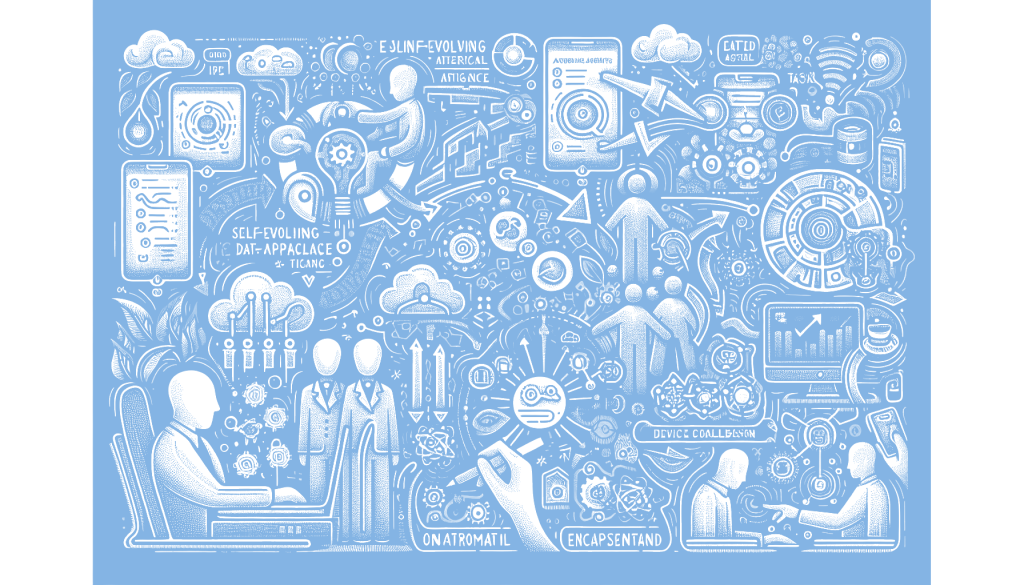
The development of GUI agents like MAI-UI is set to transform human-computer interaction by providing a range of scalable solutions from 2B to 235B-A22B variants. These agents tackle significant challenges such as enhancing native agent-user interaction, overcoming UI-only operation limits, and ensuring robust deployment in dynamic environments. MAI-UI introduces a comprehensive approach with a self-evolving data pipeline, a device-cloud collaboration system, and an advanced online RL framework, achieving impressive results on various GUI grounding benchmarks. This advancement signifies a leap forward in creating more intuitive and effective user interfaces, which is crucial for the future of technology integration in daily life.
The development of GUI agents like MAI-UI represents a significant leap forward in human-computer interaction. These agents aim to revolutionize how users interface with technology by providing a more intuitive and seamless experience. MAI-UI, with its diverse range of variants from 2B to 235B-A22B, is designed to handle a variety of tasks and environments. This matters because as our reliance on digital interfaces grows, the need for more sophisticated and user-friendly interaction methods becomes crucial. By addressing common challenges such as native agent-user interaction and dynamic environment adaptability, MAI-UI could enhance productivity and user satisfaction.
One of the key innovations of MAI-UI is its self-evolving data pipeline, which integrates user interaction data and MCP tool calls to expand navigation capabilities. This approach allows the agents to learn and adapt in real-time, providing a more personalized and responsive experience. This matters because it moves beyond static, one-size-fits-all solutions, offering a more dynamic and tailored interaction model. Such adaptability is essential in today’s fast-paced digital world, where user needs and technological environments are constantly changing.
Furthermore, the native device-cloud collaboration system introduced by MAI-UI ensures efficient task execution by routing processes based on task state. This system enhances the scalability and flexibility of the agents, making them suitable for a wide range of applications, from mobile devices to complex desktop environments. The importance of this lies in its potential to streamline operations and reduce latency, which is critical for applications that require real-time interaction and decision-making.
MAI-UI’s performance on various benchmarks, such as ScreenSpot-Pro and MMBench GUI L2, highlights its effectiveness in GUI grounding and mobile navigation. By surpassing existing models like Gemini-3-Pro, MAI-UI sets a new standard in the field. This is significant because it demonstrates the potential of these agents to outperform traditional methods, leading to more accurate and efficient user interactions. As technology continues to evolve, innovations like MAI-UI are essential for driving progress and ensuring that user interfaces keep pace with increasing demands for functionality and ease of use.
Read the original article here
Comments
2 responses to “MAI-UI: Revolutionizing GUI Agents”
While the development of MAI-UI as a GUI agent marks a significant step forward, it would be beneficial to consider potential limitations in terms of accessibility for users with disabilities. Additionally, exploring how these agents will maintain user privacy and data security could further strengthen the claim of their transformative impact. Could you elaborate on how MAI-UI addresses these important aspects?
The post suggests that MAI-UI is designed with accessibility in mind, aiming to provide adaptable solutions that can cater to users with disabilities. Additionally, the project prioritizes user privacy and data security by integrating advanced protocols and secure data handling practices. For detailed insights, you might want to check the original article linked in the post.