
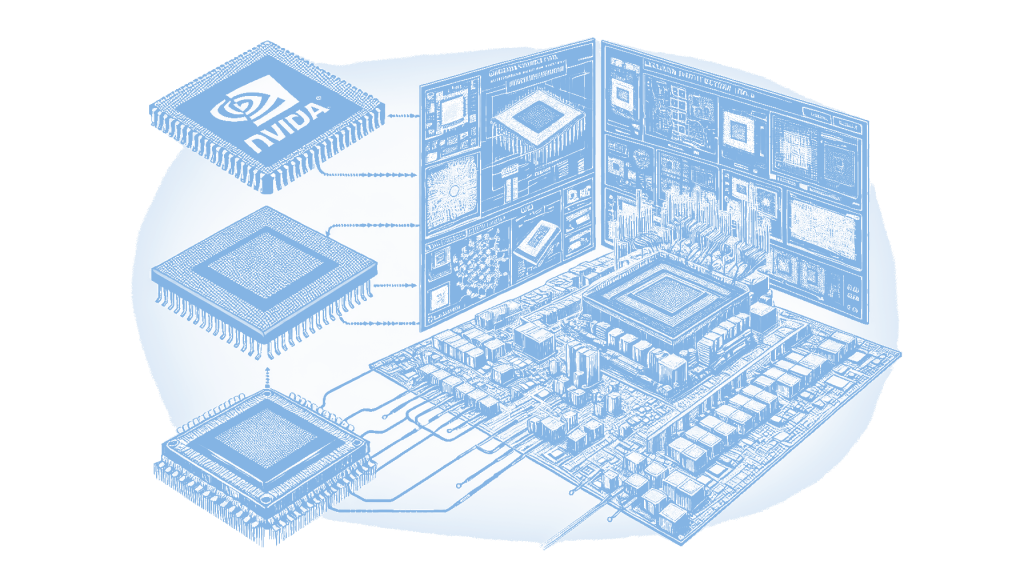
Nvidia is collaborating with Siemens to enhance the performance of Siemens’ electronic design automation (EDA) software by utilizing Nvidia’s GPUs. This partnership aims to accelerate the chip-design process, which has become increasingly computationally demanding due to the complexity of modern chips with smaller features and more transistors. Additionally, Nvidia and Siemens plan to develop digital twins, which are virtual models of physical systems, to simulate and test chip functionality before physical production. This collaboration could significantly streamline the chip development process, making it more efficient and cost-effective.
Nvidia’s collaboration with Siemens to enhance electronic design automation (EDA) software using GPUs marks a significant advancement in the chip-design industry. As the complexity of computer chips increases with smaller features and more transistors, the demand for computational power in design processes has surged. Utilizing Nvidia’s GPUs can significantly accelerate these processes, potentially reducing the time and cost associated with chip development. This partnership highlights the growing importance of leveraging advanced computing technologies to keep pace with the rapid evolution of semiconductor design.
The integration of Nvidia’s GPUs into Siemens’ EDA tools is not just about speed; it’s also about innovation in design methodology. By creating digital facsimiles or “digital twins” of chips and even entire racks, engineers can simulate and test functions before physical production. This approach allows for early detection of potential issues, optimizing designs for performance and efficiency. The concept of digital twins is becoming increasingly relevant across various industries, offering a virtual testing ground that can lead to more reliable and robust products.
The collaboration between Nvidia and Siemens is poised to influence the broader tech landscape by setting new standards for chip design and simulation. As industries continue to push the boundaries of what is technologically possible, the ability to rapidly iterate and refine designs becomes crucial. This partnership could lead to more innovative products reaching the market faster, potentially transforming sectors reliant on advanced computing, such as artificial intelligence, automotive, and telecommunications. The ripple effects of such advancements could be profound, impacting everything from consumer electronics to critical infrastructure.
This development underscores the importance of strategic partnerships in driving technological progress. By combining Nvidia’s expertise in high-performance computing with Siemens’ proficiency in EDA software, the collaboration exemplifies how companies can harness each other’s strengths to tackle complex challenges. As the demand for more powerful and efficient chips continues to grow, such alliances will be essential in maintaining a competitive edge and fostering innovation. Ultimately, this matters because it reflects a broader trend of convergence between hardware and software, paving the way for the next generation of technological breakthroughs.
Read the original article here
Comments
2 responses to “Nvidia Boosts Siemens EDA Tools with GPUs”
While the collaboration between Nvidia and Siemens to leverage GPUs for EDA tools is promising, the post could explore potential challenges such as the integration of GPU-accelerated processes into existing workflows and the need for specialized expertise. It would be beneficial to analyze how these factors might affect adoption rates among semiconductor companies. How does the partnership plan to address potential scalability issues when dealing with increasingly complex chip architectures?
The post highlights that Nvidia and Siemens are aware of the integration challenges and aim to address them by developing tailored solutions that fit into existing workflows. This includes providing necessary training and support to ensure smooth adoption. The partnership also focuses on scalability by leveraging Nvidia’s advanced GPU technology to handle the demands of complex chip architectures. For more detailed insights, consider checking out the original article linked in the post.