
Learning
-
Introducing Paper Breakdown for CS/ML/AI Research
Read Full Article: Introducing Paper Breakdown for CS/ML/AI Research Paper Breakdown is a newly launched platform designed to streamline the process of staying updated with and studying computer science, machine learning, and artificial intelligence research papers. It features a split view for simultaneous reading and chatting, allows users to highlight relevant sections of PDFs, and includes a multimodal chat interface with tools for uploading images from PDFs. The platform also offers capabilities such as generating images, illustrations, and code, as well as a recommendation engine that suggests papers based on user reading habits. Developed over six months, Paper Breakdown aims to enhance research engagement and productivity, making it a valuable resource for both academic and professional audiences. This matters because it provides an innovative way to efficiently digest and interact with complex research materials, fostering better understanding and application of cutting-edge technologies.
-
Stabilizing Hyper Connections in AI Models
Read Full Article: Stabilizing Hyper Connections in AI Models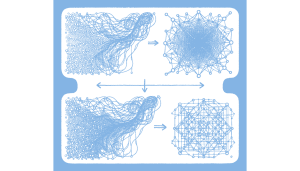 DeepSeek researchers have addressed instability issues in large language model training by applying a 1967 matrix normalization algorithm to hyper connections. Hyper connections, which enhance the expressivity of models by widening the residual stream, were found to cause instability at scale due to excessive amplification of signals. The new method, Manifold Constrained Hyper Connections (mHC), projects residual mixing matrices onto the manifold of doubly stochastic matrices using the Sinkhorn-Knopp algorithm, ensuring numerical stability by maintaining controlled signal propagation. This approach significantly reduces amplification in the model, leading to improved performance and stability with only a modest increase in training time, demonstrating a new axis for scaling large language models. This matters because it offers a practical solution to enhance the stability and performance of large AI models, paving the way for more efficient and reliable AI systems.
-
Recollections from Bernard Widrow’s Classes
Read Full Article: Recollections from Bernard Widrow’s Classes Bernard Widrow's approach to teaching neural networks and signal processing at Stanford in the early 2000s was remarkably ahead of its time, presenting neural networks as practical engineering systems rather than speculative concepts. His classes covered topics such as learning rules, stability, and hardware constraints, and he often demonstrated how concepts like reinforcement learning and adaptive filtering were already being implemented long before they became trendy. Widrow emphasized the importance of real-world applications, sharing anecdotes like the neural network hardware prototype he carried, highlighting the necessity of treating learning systems as tangible entities. His professional courtesy and engineering-oriented mindset left a lasting impression, showcasing how many ideas considered new today were already being explored and treated as practical challenges decades ago. This matters because it underscores the foundational work in neural networks that continues to influence modern advancements in the field.
-
Interactive Visualization of DeepSeek’s mHC Stability
Read Full Article: Interactive Visualization of DeepSeek’s mHC Stability![[P] Interactive visualization of DeepSeek's mHC - why doubly stochastic constraints fix Hyper-Connection instability](https://www.tweakedgeek.com/wp-content/uploads/2026/01/featured-article-8316-300x171.png) An interactive demo has been created to explore DeepSeek's mHC paper, addressing the instability in Hyper-Connections caused by the multiplication of learned matrices across multiple layers. This instability results in exponential amplification, reaching values as high as 10^16. The solution involves projecting these matrices onto a doubly stochastic manifold using the Sinkhorn-Knopp algorithm, which ensures that the composite mapping remains bounded, regardless of depth. Surprisingly, just one iteration of the Sinkhorn process is sufficient to stabilize the gain from 10^16 to approximately 1. This matters because it offers a practical method to enhance the stability and performance of deep learning models that utilize Hyper-Connections.
An interactive demo has been created to explore DeepSeek's mHC paper, addressing the instability in Hyper-Connections caused by the multiplication of learned matrices across multiple layers. This instability results in exponential amplification, reaching values as high as 10^16. The solution involves projecting these matrices onto a doubly stochastic manifold using the Sinkhorn-Knopp algorithm, which ensures that the composite mapping remains bounded, regardless of depth. Surprisingly, just one iteration of the Sinkhorn process is sufficient to stabilize the gain from 10^16 to approximately 1. This matters because it offers a practical method to enhance the stability and performance of deep learning models that utilize Hyper-Connections.
-
Manifold-Constrained Hyper-Connections in AI
Read Full Article: Manifold-Constrained Hyper-Connections in AI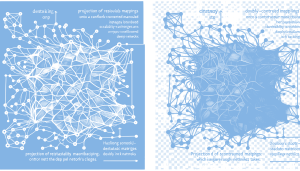 DeepSeek-AI introduces Manifold-Constrained Hyper-Connections (mHC) to tackle the instability and scalability challenges of Hyper-Connections (HC) in neural networks. The approach involves projecting residual mappings onto a constrained manifold using doubly stochastic matrices via the Sinkhorn-Knopp algorithm, which helps maintain the identity mapping property while benefiting from enhanced residual streams. This method has shown to improve training stability and scalability in large-scale language model pretraining, with negligible additional system overhead. Such advancements are crucial for developing more efficient and robust AI models capable of handling complex tasks at scale.
-
Emergent Attractor Framework: Streamlit App Launch
Read Full Article: Emergent Attractor Framework: Streamlit App Launch![[Project] Emergent Attractor Framework – now a Streamlit app for alignment & entropy research](https://www.tweakedgeek.com/wp-content/uploads/2026/01/featured-article-8289-300x171.png) The Emergent Attractor Framework, now available as a Streamlit app, offers a novel approach to alignment and entropy research. This tool allows users to engage with complex concepts through an interactive platform, facilitating a deeper understanding of how systems self-organize and reach equilibrium states. By providing a space for community interaction, the app encourages collaborative exploration and discussion, making it a valuable resource for researchers and enthusiasts alike. This matters because it democratizes access to advanced research tools, fostering innovation and collaboration in the study of dynamic systems.
The Emergent Attractor Framework, now available as a Streamlit app, offers a novel approach to alignment and entropy research. This tool allows users to engage with complex concepts through an interactive platform, facilitating a deeper understanding of how systems self-organize and reach equilibrium states. By providing a space for community interaction, the app encourages collaborative exploration and discussion, making it a valuable resource for researchers and enthusiasts alike. This matters because it democratizes access to advanced research tools, fostering innovation and collaboration in the study of dynamic systems.
-
Gradient Descent Visualizer Tool
Read Full Article: Gradient Descent Visualizer Tool A gradient descent visualizer is a tool designed to help users understand how the gradient descent algorithm works in optimizing functions. By visually representing the path taken by the algorithm to reach the minimum of a function, it allows learners and practitioners to gain insights into the convergence process and the impact of different parameters on the optimization. This matters because understanding gradient descent is crucial for effectively training machine learning models and improving their performance.
-
Stability Over Retraining: A New Approach to AI Forgetting
Read Full Article: Stability Over Retraining: A New Approach to AI Forgetting An intriguing experiment suggests that neural networks can recover lost functions without retraining on original data, challenging traditional approaches to catastrophic forgetting. By applying a stability operator to restore the system's recursive dynamics, a network was able to regain much of its original accuracy after being destabilized. This finding implies that maintaining a stable topology could lead to the development of self-healing AI agents, potentially more robust and energy-efficient than current models. This matters because it opens the possibility of creating AI systems that do not require extensive data storage for retraining, enhancing their efficiency and resilience.
-
Choosing the Right Language for AI/ML Projects
Read Full Article: Choosing the Right Language for AI/ML Projects Choosing the right programming language is essential for machine learning projects, with Python leading the way due to its simplicity, extensive libraries, and strong community support. Python's ease of use and rich ecosystem make it ideal for interactive development, while its libraries leverage optimized C/C++ and GPU kernels for performance. Other languages like C++, Java, Kotlin, R, Julia, Go, and Rust also play significant roles, offering unique advantages such as performance, scalability, statistical analysis, and concurrency features. The selection of a language should align with the specific requirements and performance needs of the project. Understanding the strengths and weaknesses of each language can help in building efficient and effective AI/ML solutions.
-
PerNodeDrop: Balancing Subnets and Regularization
Read Full Article: PerNodeDrop: Balancing Subnets and Regularization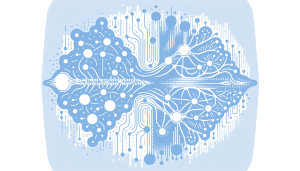 PerNodeDrop is a novel method designed to balance the creation of specialized subnets and regularization in deep neural networks. This technique involves selectively dropping nodes during training, which helps in reducing overfitting by encouraging diversity among subnetworks. By doing so, it enhances the model's ability to generalize from training to unseen data, potentially improving performance on various tasks. This matters because it offers a new approach to improving the robustness and effectiveness of deep learning models, which are widely used in numerous applications.