
Learning
-
AI Model Learns While Reading
Read Full Article: AI Model Learns While Reading A collaborative effort by researchers from Stanford, NVIDIA, and UC Berkeley has led to the development of TTT-E2E, a model that addresses long-context modeling as a continual learning challenge. Unlike traditional approaches that store every token, TTT-E2E continuously trains while reading, efficiently compressing context into its weights. This innovation allows the model to achieve full-attention performance at 128K tokens while maintaining a constant inference cost. Understanding and improving how AI models process extensive contexts can significantly enhance their efficiency and applicability in real-world scenarios.
-
Decision Matrices for Multi-Agent Systems
Read Full Article: Decision Matrices for Multi-Agent Systems Choosing the right decision-making method for multi-agent systems can be challenging due to the lack of a systematic framework. Key considerations include whether trajectory stitching is needed when comparing Behavioral Cloning (BC) to Reinforcement Learning (RL), whether agents receive the same signals when using Copulas, and whether coverage guarantees are important when deciding between Conformal Prediction and Bootstrap methods. Additionally, the choice between Monte Carlo (MC) and Monte Carlo Tree Search (MCTS) depends on whether decisions are sequential or one-shot. Understanding the specific characteristics of a problem is crucial in selecting the most appropriate method, as demonstrated through validation on a public dataset. This matters because it helps optimize decision-making in complex systems, leading to more effective and efficient outcomes.
-
The Handyman Principle: AI’s Memory Challenges
Read Full Article: The Handyman Principle: AI’s Memory ChallengesThe Handyman Principle explores the concept of AI systems frequently "forgetting" information, akin to a handyman who must focus on the task at hand rather than retaining all past details. This phenomenon is attributed to the limitations in current AI architectures, which prioritize efficiency and performance over long-term memory retention. By understanding these constraints, developers can better design AI systems that balance memory and processing capabilities. This matters because improving AI memory retention could lead to more sophisticated and reliable systems in various applications.
-
13 Free AI/ML Quizzes for Learning
Read Full Article: 13 Free AI/ML Quizzes for Learning Over the past year, an AI/ML enthusiast has created 13 free quizzes to aid in learning and testing knowledge in the field of artificial intelligence and machine learning. These quizzes cover a range of topics including Neural Networks Basics, Deep Learning Fundamentals, NLP Introduction, Computer Vision Basics, Linear Regression, Logistic Regression, Decision Trees & Random Forests, and Gradient Descent & Optimization. By sharing these resources, the creator hopes to support others in their learning journey and welcomes any suggestions for improvement. This matters because accessible educational resources can significantly enhance the learning experience and promote knowledge sharing within the AI/ML community.
-
Training a Custom YOLO Model for Posture Detection
Read Full Article: Training a Custom YOLO Model for Posture Detection Embarking on a machine learning journey, a newcomer trained a YOLO classification model to detect poor sitting posture, discovering valuable insights and challenges. While pose estimation initially seemed promising, it failed to deliver results, and the YOLO model struggled with partial side views, highlighting the limitations of pre-trained models. The experience underscored that a lower training loss doesn't guarantee a better model, as evidenced by overfitting when validation accuracy remained unchanged. Utilizing the early stopping parameter proved crucial in optimizing training time, and converting the model from .pt to TensorRT significantly improved inference speed, doubling the frame rate from 15 to 30 FPS. Understanding these nuances is essential for efficient and effective model training in machine learning projects.
-
Understanding Simple Linear Regression
Read Full Article: Understanding Simple Linear Regression Simple Linear Regression (SLR) is a method that determines the best-fitting line through data points by minimizing the least-squares projection error. Unlike the Least Squares Solution (LSS) that selects the closest output vector on a fixed line, SLR involves choosing the line itself, thus defining a space of reachable outputs. This approach involves a search over different possible orientations of the line, comparing projection errors to find the orientation that results in the smallest error. By rotating the line and observing changes in projection distance, SLR effectively identifies the optimal line orientation to model the data. This matters because it provides a foundational understanding of how linear regression models are constructed to best fit data, which is crucial for accurate predictions and analyses.
-
DeepSeek’s mHC: A New Era in AI Architecture
Read Full Article: DeepSeek’s mHC: A New Era in AI Architecture Since the introduction of ResNet in 2015, the Residual Connection has been a fundamental component in deep learning, providing a solution to the vanishing gradient problem. However, its rigid 1:1 input-to-computation ratio limits the model's ability to dynamically balance past and new information. DeepSeek's innovation with Manifold-Constrained Hyper-Connections (mHC) addresses this by allowing models to learn connection weights, offering faster convergence and improved performance. By constraining these weights to be "Double Stochastic," mHC ensures stability and prevents exploding gradients, outperforming traditional methods and reducing training time impact. This advancement challenges long-held assumptions in AI architecture, promoting open-source collaboration for broader technological progress.
-
Understanding Large Language Models
Read Full Article: Understanding Large Language Models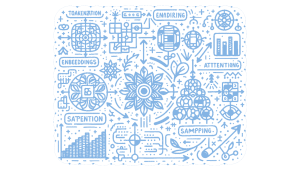 The blog provides a beginner-friendly explanation of how Large Language Models (LLMs) function, focusing on creating a clear mental model of the generation loop. Key concepts such as tokenization, embeddings, attention, probabilities, and sampling are discussed in a high-level and intuitive manner, emphasizing the integration of these components rather than delving into technical specifics. This approach aims to help those working with LLMs or learning about Generative AI to better understand the internals of these models. Understanding LLMs is crucial as they are increasingly used in various applications, impacting fields like natural language processing and AI-driven content creation.
-
Survey on Agentic LLMs
Read Full Article: Survey on Agentic LLMs![[R] Survey paper Agentic LLMs](https://www.tweakedgeek.com/wp-content/uploads/2026/01/featured-article-7984-300x171.png) Agentic Large Language Models (LLMs) are at the forefront of AI research, focusing on how these models reason, act, and interact, creating a synergistic cycle that enhances their capabilities. Understanding the current state of agentic LLMs provides insights into their potential future developments and applications. The survey paper offers a comprehensive overview with numerous references for further exploration, prompting questions about the future directions and research areas that could benefit from deeper investigation. This matters because advancing our understanding of agentic AI could lead to significant breakthroughs in how AI systems are designed and utilized across various fields.
Agentic Large Language Models (LLMs) are at the forefront of AI research, focusing on how these models reason, act, and interact, creating a synergistic cycle that enhances their capabilities. Understanding the current state of agentic LLMs provides insights into their potential future developments and applications. The survey paper offers a comprehensive overview with numerous references for further exploration, prompting questions about the future directions and research areas that could benefit from deeper investigation. This matters because advancing our understanding of agentic AI could lead to significant breakthroughs in how AI systems are designed and utilized across various fields.
-
Open Sourced Loop Attention for Qwen3-0.6B
Read Full Article: Open Sourced Loop Attention for Qwen3-0.6B![[D] Open sourced Loop Attention for Qwen3-0.6B: two-pass global + local attention with a learnable gate (code + weights + training script)](https://www.tweakedgeek.com/wp-content/uploads/2026/01/featured-article-7981-300x171.png) Loop Attention is an innovative approach designed to enhance small language models, specifically Qwen-style models, by implementing a two-pass attention mechanism. It first performs a global attention pass followed by a local sliding window pass, with a learnable gate that blends the two, allowing the model to adaptively focus on either global or local information. This method has shown promising results, reducing validation loss and perplexity compared to baseline models. The open-source release includes the model, attention code, and training scripts, encouraging collaboration and further experimentation. This matters because it offers a new way to improve the efficiency and accuracy of language models, potentially benefiting a wide range of applications.
Loop Attention is an innovative approach designed to enhance small language models, specifically Qwen-style models, by implementing a two-pass attention mechanism. It first performs a global attention pass followed by a local sliding window pass, with a learnable gate that blends the two, allowing the model to adaptively focus on either global or local information. This method has shown promising results, reducing validation loss and perplexity compared to baseline models. The open-source release includes the model, attention code, and training scripts, encouraging collaboration and further experimentation. This matters because it offers a new way to improve the efficiency and accuracy of language models, potentially benefiting a wide range of applications.