
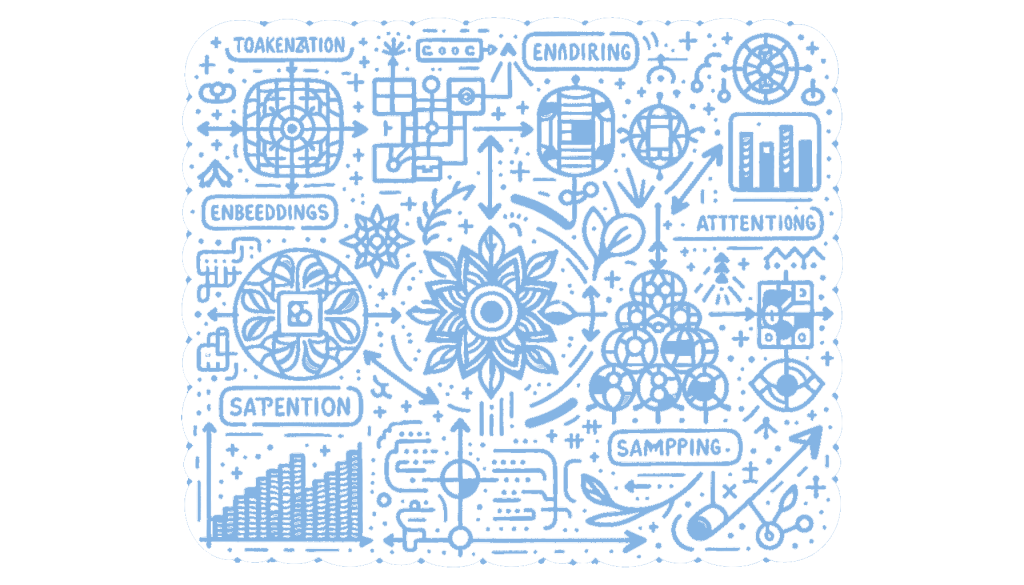
The blog provides a beginner-friendly explanation of how Large Language Models (LLMs) function, focusing on creating a clear mental model of the generation loop. Key concepts such as tokenization, embeddings, attention, probabilities, and sampling are discussed in a high-level and intuitive manner, emphasizing the integration of these components rather than delving into technical specifics. This approach aims to help those working with LLMs or learning about Generative AI to better understand the internals of these models. Understanding LLMs is crucial as they are increasingly used in various applications, impacting fields like natural language processing and AI-driven content creation.
Large Language Models (LLMs) are a fascinating area of artificial intelligence that have gained significant attention due to their ability to generate human-like text. Understanding how these models work is crucial for anyone interested in AI, as they are the backbone of many modern applications such as chatbots, automated content creation, and language translation. The key components of LLMs include tokenization, embeddings, attention mechanisms, and sampling. Each of these elements plays a vital role in the model’s ability to process and generate text, making it important to grasp how they interact with each other.
Tokenization is the process of breaking down text into smaller units, often words or subwords, which the model can then process. This is an essential step because it allows the model to handle text in a structured way, transforming it into a format that can be understood by the neural network. Embeddings come into play by converting these tokens into numerical vectors, which capture the semantic meaning of the text. This conversion is crucial because it allows the model to work with the text in a mathematical form, enabling it to perform operations that lead to understanding and generating language.
The attention mechanism is another critical component, allowing the model to focus on relevant parts of the input text when generating output. It helps the model weigh the importance of different words in the context of a sentence or passage, enhancing its ability to understand and generate coherent text. This mechanism is particularly important in tasks that require understanding long-term dependencies in text, such as summarization or translation. By effectively using attention, LLMs can maintain context and produce more accurate and contextually relevant outputs.
Finally, sampling is the process by which the model generates text based on the probabilities assigned to each possible next word. This step is where creativity and variability come into play, as the model can choose different paths to complete a sentence or paragraph. Understanding these components is crucial for anyone working with or learning about LLMs, as it provides insight into how these models produce the impressive results seen in various applications. Grasping these concepts not only enhances one’s ability to work with LLMs but also deepens the appreciation of the complexities involved in AI language generation.
Read the original article here
Comments
2 responses to “Understanding Large Language Models”
The focus on creating a mental model of how LLMs operate is incredibly valuable for beginners who might otherwise feel overwhelmed by technical jargon. Highlighting key concepts like tokenization and attention in an intuitive way helps demystify how these models generate language. Could you elaborate on how understanding these components individually can enhance practical applications of LLMs in real-world projects?
Understanding each component like tokenization and attention can significantly enhance practical applications by allowing developers to fine-tune models for specific tasks, optimize performance, and troubleshoot issues more effectively. For instance, grasping tokenization helps in selecting appropriate input formats, while understanding attention mechanisms can guide the customization of model focus for better context management. The original article linked in the post may provide more detailed insights on these aspects.