
embeddings
-
API for Local Video Indexing in RAG Setups
Read Full Article: API for Local Video Indexing in RAG Setups An innovative API has been developed to simplify video indexing for those running Retrieval-Augmented Generation (RAG) setups locally, addressing the challenge of effectively indexing video content without relying on cloud services. This API automates the preprocessing of videos by extracting transcripts, sampling frames, performing OCR, and creating embeddings, resulting in clean JSON outputs ready for local vector stores like Milvus or Weaviate. Key features include capturing both speech and visual content, timestamped chunks for easy video reference, and minimal dependencies to ensure lightweight processing. This tool is particularly useful for indexing internal or private videos, running semantic searches over video archives, and building local RAG agents that leverage video content, all while maintaining data privacy and control. Why this matters: This API offers a practical solution for efficiently managing and searching video content locally, enhancing capabilities for those using local LLMs and ensuring data privacy.
-
Understanding Large Language Models
Read Full Article: Understanding Large Language Models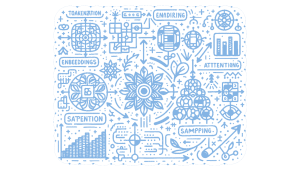 The blog provides a beginner-friendly explanation of how Large Language Models (LLMs) function, focusing on creating a clear mental model of the generation loop. Key concepts such as tokenization, embeddings, attention, probabilities, and sampling are discussed in a high-level and intuitive manner, emphasizing the integration of these components rather than delving into technical specifics. This approach aims to help those working with LLMs or learning about Generative AI to better understand the internals of these models. Understanding LLMs is crucial as they are increasingly used in various applications, impacting fields like natural language processing and AI-driven content creation.
-
EmbeddingAdapters: Translating Model Embeddings
Read Full Article: EmbeddingAdapters: Translating Model Embeddings The Python library EmbeddingAdapters facilitates the translation of embeddings between different model spaces, such as MiniLM and OpenAI, using pre-trained adapters. These adapters are trained on specific domains, allowing them to effectively interpret semantic signals from smaller models into larger dimensional spaces without compromising fidelity. This tool is particularly useful for maintaining existing vector indexes without re-embedding entire datasets, experimenting with different embedding models, and handling provider outages or rate limits. It supports various model pairs and is actively being expanded with more adapters and training sets. This innovation matters as it offers a cost-effective and flexible solution for leveraging multiple embedding models in diverse applications.