
AI & Technology Updates
-
Gumdrop’s Vibe Gap Challenge
 The effectiveness of Gumdrop, a new AI model, is being questioned due to a significant disparity between its voice and text components. While the text model is user-friendly, the voice model lacks the engaging and natural feel necessary for user adoption, resembling an impersonal AI phone service. Bridging this "vibe gap" is crucial for the model's success and widespread acceptance. Addressing this issue matters because user experience is key to the adoption and success of AI technologies in everyday applications.
-
Logitech Fixes macOS Mouse Issues
 Logitech recently addressed an issue affecting macOS users, where their Logitech mice experienced functionality problems due to an expired certificate in the Logi Options Plus app. This problem prevented users from utilizing customized features and caused the app to become stuck in a boot loop. Logitech acknowledged the oversight and released a manual patch to resolve the issue, ensuring that user settings and customizations remain intact. The fix is currently available for recent macOS versions, with support for older versions to follow. This matters as it highlights the importance of maintaining software certificates to prevent disruptions in device functionality.
-
Emergence of Intelligence via Physical Structures
 The hypothesis suggests that the emergence of intelligence is inherently possible within our physical structure and can be designed by leveraging the structural methods of Transformers, particularly their predictive capabilities. The framework posits that intelligence arises from the ability to predict and interact with the environment, using a combination of feature compression and action interference. This involves creating a continuous feature space where agents can tool-ize features, leading to the development of self-boundaries and personalized desires. The ultimate goal is to enable agents to interact with spacetime effectively, forming an internal model that aligns with the universe's essence. This matters because it provides a theoretical foundation for developing artificial general intelligence (AGI) that can adapt to infinite tasks and environments, potentially revolutionizing how machines learn and interact with the world.
-
Falcon-H1R-7B: Compact Model Excels in Reasoning
 The Technology Innovation Institute in Abu Dhabi has introduced Falcon-H1R-7B, a compact 7 billion parameter model that excels in math, coding, and general reasoning tasks, outperforming larger models with up to 47 billion parameters. This model employs a hybrid architecture combining Transformer layers with Mamba2 components, allowing for efficient long-sequence processing with a context window of up to 256,000 tokens. It undergoes a two-stage training process involving supervised fine-tuning and reinforcement learning, which enhances its reasoning capabilities. Falcon-H1R-7B demonstrates impressive performance across various benchmarks, achieving high scores in math and coding tasks, and offers significant improvements in throughput and accuracy through its innovative design. This matters because it showcases how smaller, well-designed models can rival larger ones in performance, offering more efficient solutions for complex reasoning tasks.
-
Exploring Lego’s Innovative Smart Bricks
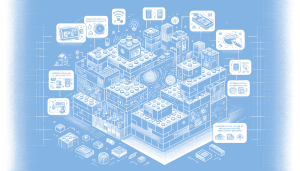 Lego's new Smart Bricks represent a significant innovation, offering a more interactive and imaginative experience than previous Lego computer bricks. Unlike the predictable Lego Mario toys, Smart Bricks use NFC smart tiles to transform into various vehicles or characters, interacting with other smart components in creative ways. For instance, they can simulate lightsaber battles with sound effects or enable characters like Darth Vader to engage in conversations. Despite concerns about battery life and long-term value, these Smart Bricks allow for dynamic play, encouraging both kids and adults to use their imagination while engaging with the sets. This matters because it showcases how traditional toys can evolve with technology to offer richer, more engaging play experiences.