
AIGeekery
-
Hybrid Retrieval: BM25 + FAISS on t3.medium
Read Full Article: Hybrid Retrieval: BM25 + FAISS on t3.medium A hybrid retrieval system has been developed to efficiently serve over 127,000 queries on a single AWS Lightsail instance, combining the precision of BM25 with the semantic understanding of FAISS. This system operates without a GPU for embeddings, though a GPU can be used optionally for reranking to achieve a 3x speedup. The infrastructure is cost-effective, running on a t3.medium instance for approximately $50 per month, and achieves 91% accuracy, significantly outperforming dense-only methods. The hybrid approach effectively handles complex queries by using a four-stage cascade that combines keyword precision with semantic understanding, optimizing latency and accuracy through asynchronous parallel retrieval and batch reranking. This matters because it demonstrates a cost-effective, high-performance solution for query retrieval that balances precision and semantic understanding, crucial for applications requiring accurate and efficient information retrieval.
-
Semantic Grounding Diagnostic with AI Models
Read Full Article: Semantic Grounding Diagnostic with AI Models Large Language Models (LLMs) struggle with semantic grounding, often mistaking pattern proximity for true meaning, as evidenced by their interpretation of the formula (c/t)^n. This formula, intended to represent efficiency in semantic understanding, was misunderstood by three advanced AI models—Claude, Gemini, and Grok—as indicative of collapse or decay, rather than efficiency. This misinterpretation highlights the core issue: LLMs tend to favor plausible-sounding interpretations over accurate ones, which ironically aligns with the book's thesis on their limitations. Understanding these errors is crucial for improving AI's ability to process and interpret information accurately.
-
Chrome Extension for Navigating Long AI Chats
Read Full Article: Chrome Extension for Navigating Long AI Chats Long AI chat conversations often become cumbersome to scroll through and reuse, especially with platforms like ChatGPT, Claude, and Gemini. To address this, a new Chrome extension has been developed that facilitates easier navigation through lengthy chats by allowing users to jump between prompts. Additionally, the extension offers the functionality to export entire conversations in various formats such as Markdown, PDF, JSON, and text. This innovation is significant as it enhances user experience and efficiency when dealing with extensive AI-generated dialogues.
-
OpenAI’s New Audio Model and Hardware Plans
Read Full Article: OpenAI’s New Audio Model and Hardware Plans OpenAI is gearing up to launch a new audio language model by early 2026, aiming to pave the way for an audio-based hardware device expected in 2027. Efforts are underway to enhance audio models, which are currently seen as lagging behind text models in terms of accuracy and speed, by uniting multiple teams across engineering, product, and research. Despite the current preference for text interfaces among ChatGPT users, OpenAI hopes that improved audio models will encourage more users to adopt voice interfaces, broadening the deployment of their technology in various devices, such as cars. The company envisions a future lineup of audio-focused devices, including smart speakers and glasses, emphasizing audio interfaces over screen-based ones.
-
Understanding Large Language Models
Read Full Article: Understanding Large Language Models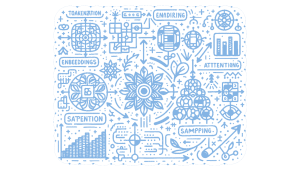 The blog provides a beginner-friendly explanation of how Large Language Models (LLMs) function, focusing on creating a clear mental model of the generation loop. Key concepts such as tokenization, embeddings, attention, probabilities, and sampling are discussed in a high-level and intuitive manner, emphasizing the integration of these components rather than delving into technical specifics. This approach aims to help those working with LLMs or learning about Generative AI to better understand the internals of these models. Understanding LLMs is crucial as they are increasingly used in various applications, impacting fields like natural language processing and AI-driven content creation.
-
Fender’s Mix Headphones: Long-Lasting Battery & Modular Design
Read Full Article: Fender’s Mix Headphones: Long-Lasting Battery & Modular Design Fender Audio has introduced its first wireless headphones, the Mix, featuring a long-lasting and replaceable battery. These headphones stand out with a modular design allowing for color customization and an impressive battery life of up to 52 hours with active noise cancellation (ANC) and 100 hours without. Priced at $299.99, they are more affordable than Sony's WH-1000XM6, offering superior battery performance, though the ANC quality remains untested. The Mix headphones support various connectivity options, including Bluetooth 5.3, a USB-C cable, and a 3.5mm audio cable, with quick charging capabilities providing up to eight hours of playback after just 15 minutes. This matters because it highlights a competitive alternative in the wireless headphone market, emphasizing longevity, customization, and affordability.
-
Open Sourced Loop Attention for Qwen3-0.6B
Read Full Article: Open Sourced Loop Attention for Qwen3-0.6B![[D] Open sourced Loop Attention for Qwen3-0.6B: two-pass global + local attention with a learnable gate (code + weights + training script)](https://www.tweakedgeek.com/wp-content/uploads/2026/01/featured-article-7981-300x171.png) Loop Attention is an innovative approach designed to enhance small language models, specifically Qwen-style models, by implementing a two-pass attention mechanism. It first performs a global attention pass followed by a local sliding window pass, with a learnable gate that blends the two, allowing the model to adaptively focus on either global or local information. This method has shown promising results, reducing validation loss and perplexity compared to baseline models. The open-source release includes the model, attention code, and training scripts, encouraging collaboration and further experimentation. This matters because it offers a new way to improve the efficiency and accuracy of language models, potentially benefiting a wide range of applications.
Loop Attention is an innovative approach designed to enhance small language models, specifically Qwen-style models, by implementing a two-pass attention mechanism. It first performs a global attention pass followed by a local sliding window pass, with a learnable gate that blends the two, allowing the model to adaptively focus on either global or local information. This method has shown promising results, reducing validation loss and perplexity compared to baseline models. The open-source release includes the model, attention code, and training scripts, encouraging collaboration and further experimentation. This matters because it offers a new way to improve the efficiency and accuracy of language models, potentially benefiting a wide range of applications.
-
Petkit’s AI-Powered Pet Care Innovations
Read Full Article: Petkit’s AI-Powered Pet Care Innovations Petkit is introducing two innovative automated machines designed to enhance pet care using advanced technology. The Petkit Yumshare Daily Feast is a pioneering automatic wet food dispenser that can provide meals for up to seven days, utilizing NFC-based tracking to manage uneaten servings and UVC lighting to ensure meal sanitation. Additionally, the device features an AI-powered camera to monitor pet eating habits, offering valuable health insights. Petkit's Eversweet Ultra water fountain, priced at $199.99, includes similar technology to track and analyze pets' drinking behavior, promoting better urinary health. Both products are set to launch in April 2026, with the Yumshare Daily Feast being offered to pet food companies for distribution. This matters because it represents a significant advancement in automated pet care, providing pet owners with tools to better monitor and maintain their pets' health.
-
NextToken: Streamlining AI Engineering Workflows
Read Full Article: NextToken: Streamlining AI Engineering Workflows NextToken is an AI agent designed to alleviate the tedious aspects of AI and machine learning workflows, allowing engineers to focus more on model building rather than setup and debugging. It assists in environment setup, code debugging, data cleaning, and model training, providing explanations and real-time visualizations to enhance understanding and efficiency. By automating these grunt tasks, NextToken aims to make AI and ML more accessible, reducing the steep learning curve that often deters newcomers from completing projects. This matters because it democratizes AI/ML development, enabling more people to engage with and contribute to these fields.
-
Evaluating LLMs in Code Porting Tasks
Read Full Article: Evaluating LLMs in Code Porting Tasks The recent discussion about replacing C and C++ code at Microsoft with automated solutions raises questions about the current capabilities of Large Language Models (LLMs) in code porting tasks. While LLMs have shown promise in generating simple applications and debugging, achieving the ambitious goal of automating the translation of complex codebases requires more than just basic functionality. A test using a JavaScript program with an unconventional prime-checking function revealed that many LLMs struggle to replicate the code's behavior, including its undocumented features and optimizations, when ported to languages like Python, Haskell, C++, and Rust. The results indicate that while some LLMs can successfully port code to certain languages, challenges remain in maintaining identical functionality, especially with niche languages and complex code structures. This matters because it highlights the limitations of current AI tools in fully automating code translation, which is critical for software development and maintenance.