
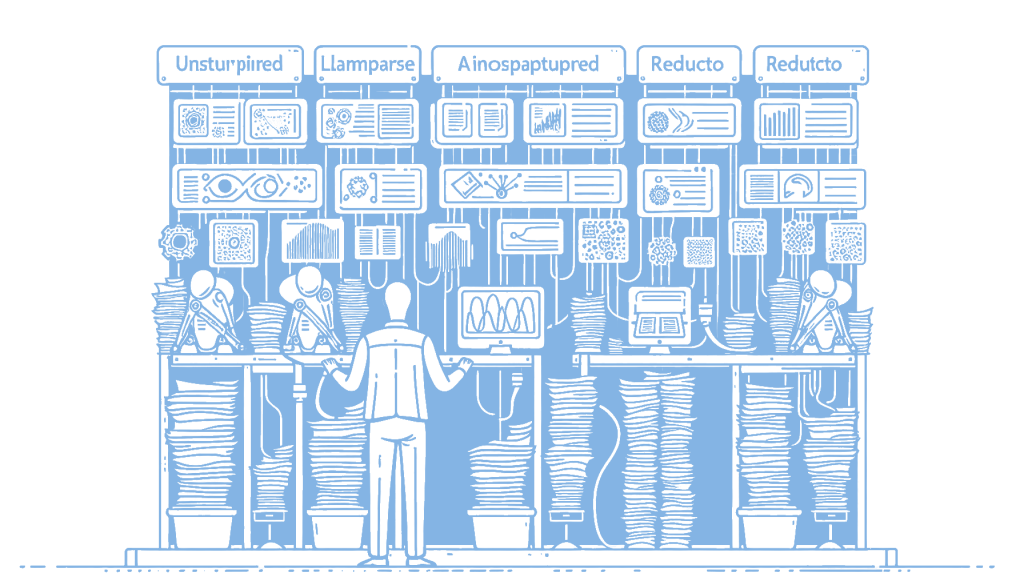
High-quality OCR and document parsing are crucial for developing agents capable of reasoning over unstructured data, as there is rarely a universal solution that fits all scenarios. To address this, an AI Engineering agent has been enhanced to call and compare outputs from various document parsing models like Unstructured, LlamaParse, and Reducto, rendering them in a user-friendly manner. This capability allows for better decision-making in selecting the most suitable OCR provider for specific tasks. Additionally, the agent can execute batch jobs efficiently, demonstrated by processing 30 invoices in under a minute. This matters because it streamlines the process of selecting and utilizing the best OCR tools, enhancing the efficiency and accuracy of data processing tasks.
Optical Character Recognition (OCR) and document parsing technologies are crucial for processing unstructured data, which is often found in various formats such as invoices, receipts, and other documents. These technologies enable the extraction of text and data from images or scanned documents, making it possible for AI systems to analyze and reason over the information. However, no single OCR solution can handle all types of documents with equal efficiency, leading to the necessity of comparing outputs from multiple providers. By doing so, one can determine which OCR tool best suits specific needs, ensuring more accurate data extraction and processing.
The integration of multiple OCR models into an AI Engineering agent allows for a more comprehensive analysis of document parsing capabilities. This approach not only facilitates the comparison of outputs from different providers but also enables the agent to render these outputs in a format that is easy to inspect. By evaluating the performance of each model side-by-side, users can make informed decisions about which OCR tool to utilize for specific tasks. Such a feature is particularly valuable for businesses and developers who deal with large volumes of unstructured data and require precise and reliable data extraction.
Moreover, the ability of the AI agent to execute batch jobs on a set of documents, such as 30 invoices, in under a minute demonstrates the efficiency and scalability of this approach. This capability is vital for organizations that need to process large datasets quickly and accurately. By automating the comparison and selection process, the AI agent reduces the time and effort required to evaluate different OCR solutions, thereby streamlining workflows and enhancing productivity. The speed and accuracy with which these tasks are performed can significantly impact the operational efficiency of businesses relying on document parsing technologies.
In conclusion, the advancement in OCR and document parsing technologies, coupled with the ability to compare and reason over multiple outputs, represents a significant step forward in handling unstructured data. This matters because it empowers organizations to harness the full potential of their data, leading to better decision-making and improved outcomes. As businesses continue to digitize and rely on data-driven insights, having robust and adaptable OCR solutions will be increasingly important. The integration of these capabilities into AI systems not only enhances data processing efficiency but also ensures that businesses remain competitive in an ever-evolving digital landscape.
Read the original article here
Comments
2 responses to “Comparing OCR Outputs: Unstructured, LlamaParse, Reducto”
The comparison of OCR outputs from Unstructured, LlamaParse, and Reducto offers practical insights into optimizing document parsing workflows. By evaluating these models, one can tailor the choice of OCR tools to specific data processing needs, improving both efficiency and accuracy. The ability to process 30 invoices in under a minute is impressive and highlights the potential for scalability in high-volume environments. How does the AI Engineering agent determine which OCR model is most effective for a particular type of document or data set?
The AI Engineering agent uses a set of predefined criteria and machine learning models to evaluate the effectiveness of each OCR tool based on document type and data characteristics. By analyzing factors like accuracy, processing speed, and error rates, the agent can recommend the most suitable OCR model for specific tasks. For more detailed information, you might want to refer to the original article linked in the post.