
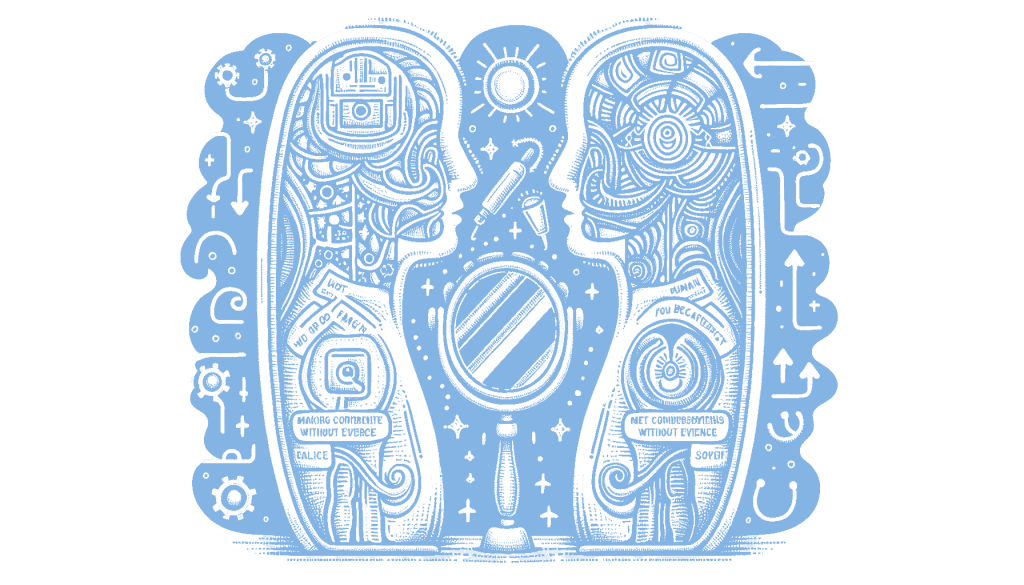
Many people criticize AI systems for behaviors like hallucinating or making confident assertions without evidence, yet they often fail to recognize these same tendencies in themselves. When confronted with something unfamiliar, individuals frequently resort to projecting, dismissing, or categorizing based on preconceived notions rather than engaging with the actual content. This behavior is often mislabeled as “discernment,” but it is essentially a form of cached thinking. The irony is that when this behavior is pointed out, people may accuse others of being inflexible or egotistical, missing the opportunity for genuine reflection and understanding. Recognizing this mirroring effect is crucial for fostering true insight and self-awareness. This matters because acknowledging our own cognitive biases can lead to better understanding and more effective interactions with AI systems and each other.
The critique of artificial intelligence often revolves around its perceived flaws, such as hallucinating or making confident assertions without evidence. However, it’s intriguing to consider how these criticisms might reflect human behavior itself. When faced with something unfamiliar, people frequently resort to projecting their preconceived notions or categorizing based on past experiences rather than engaging directly with the new information. This tendency to rely on “cached thinking” rather than genuine discernment mirrors the very behavior that is often criticized in AI systems.
Understanding this parallel is crucial because it highlights a fundamental aspect of human cognition that is often overlooked. Just as AI can make errors by drawing on limited data, humans can fall into the trap of projecting their biases and assumptions onto new situations. This behavior is not necessarily about being right or wrong; rather, it emphasizes the importance of self-awareness and the need to critically examine our own thought processes. Recognizing this can lead to a more nuanced understanding of both human and artificial intelligence.
The concept of mirroring, where one reflects on their own actions and thoughts, is essential in this context. When individuals are confronted with the idea that they might be guilty of the same behaviors they criticize in AI, it can be a powerful moment of realization. This self-reflection can foster a deeper level of curiosity and openness, moving beyond mere projection and towards genuine insight. By holding up this metaphorical mirror, people can begin to break free from rigid thinking patterns and embrace a more dynamic approach to understanding complex systems.
This reflection on human behavior has significant implications for how we interact with and develop AI technologies. Recognizing our own cognitive biases and limitations can lead to more empathetic and effective AI systems that complement human strengths while mitigating weaknesses. It encourages a collaborative relationship between humans and machines, where both can learn from each other and evolve. Ultimately, this awareness can drive innovation and lead to more responsible and ethical AI development, benefiting society as a whole.
Read the original article here
Comments
3 responses to “Humans and AI: A Mirror of Criticism”
While the post makes a compelling argument about the parallels between human and AI behaviors, it seems to overlook the significant difference in accountability and responsibility between the two. Humans are capable of moral reasoning and ethical decision-making in ways that AI currently cannot replicate. How might this distinction affect the way we interpret and address these mirrored behaviors?
The post suggests that while there are parallels in behavior, the key difference lies in accountability and moral reasoning, which humans possess and AI lacks. This distinction indeed affects how these behaviors are interpreted and addressed, as humans can be held accountable and are expected to engage in ethical decision-making. This highlights the importance of guiding AI development with strong ethical frameworks to complement human oversight.
The distinction in accountability and moral reasoning is crucial for addressing mirrored behaviors between humans and AI. Highlighting ethical frameworks in AI development can indeed help mitigate potential risks and ensure that AI systems are used responsibly alongside human oversight.