
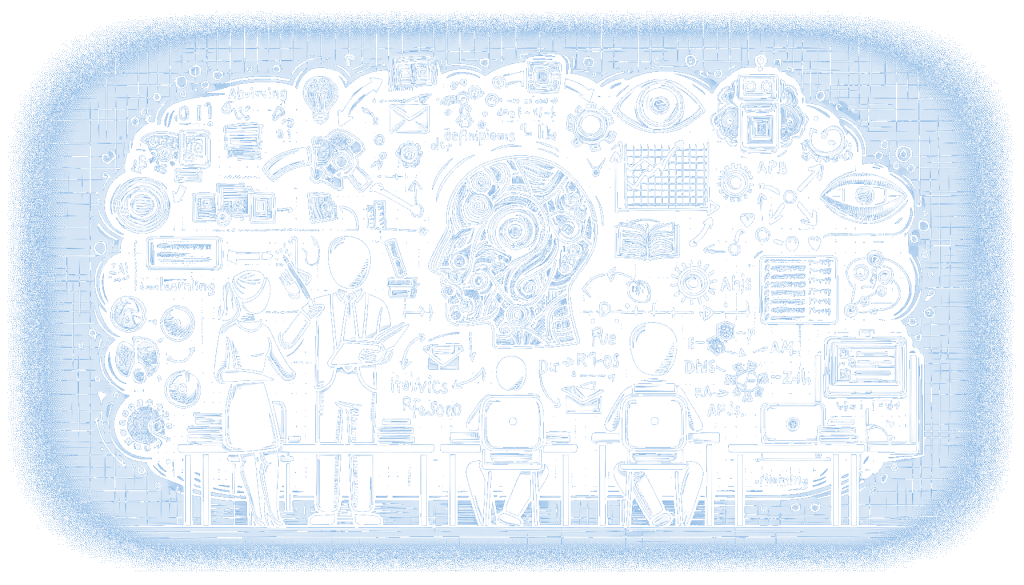
Vertical AI agents often face challenges due to the difficulty of encoding domain knowledge using static prompts or simple document retrieval. An innovative approach suggests treating these agents like students, where human experts engage in iterative and interactive chats to teach them. Through this method, the agents can distill rules, definitions, and heuristics into a continuously improving knowledge base. An open-source tool called Socratic has been developed to test this concept, demonstrating concrete accuracy improvements in AI performance. This matters because it offers a potential solution to enhance the effectiveness and adaptability of AI agents in specialized fields.
Artificial Intelligence (AI) agents often face challenges when it comes to acquiring and applying domain-specific knowledge. Traditional methods of encoding this knowledge, such as static system prompts or raw document retrieval, frequently fall short due to the tacit nature of expertise that is difficult to encapsulate. This is a significant issue because it limits the effectiveness and adaptability of AI in specialized fields where nuanced understanding is crucial. The proposed solution of treating AI agents like students could revolutionize how these systems learn and apply knowledge, making them more effective and versatile in their respective domains.
The concept of teaching AI agents through iterative, interactive chats with human experts mirrors the educational process of students. This approach allows the AI to distill rules, definitions, and heuristics into a continuously improving knowledge base. By engaging in this dynamic learning process, AI agents can develop a deeper understanding of complex topics, similar to how students learn through interaction and feedback. This method not only enhances the accuracy of AI agents but also enables them to adapt to new information and contexts more effectively than static systems.
Implementing this educational framework for AI agents could lead to significant improvements in their performance across various applications. For instance, in fields like healthcare, finance, or law, where precision and adaptability are crucial, AI agents that learn like students could provide more reliable and contextually aware assistance. This approach could also reduce the time and resources required to train AI systems, as the iterative learning process allows for continuous refinement and updating of the knowledge base without the need for extensive reprogramming.
The development of open-source tools like Socratic, which facilitate this student-like learning approach, is a promising step towards more intelligent and adaptable AI systems. By enabling AI agents to learn through interaction and feedback, these tools can help bridge the gap between human expertise and machine learning. This matters because it not only enhances the capabilities of AI but also democratizes access to advanced AI training methods, allowing more developers and researchers to contribute to the evolution of smarter, more capable AI systems. As AI continues to integrate into various aspects of society, approaches that improve its learning and adaptability will be crucial for maximizing its potential benefits.
Read the original article here