
AI architecture
-
Yann LeCun: Intelligence Is About Learning
Read Full Article: Yann LeCun: Intelligence Is About Learning Yann LeCun, a prominent computer scientist, believes intelligence is fundamentally about learning and is working on new AI technologies that could revolutionize industries beyond Meta's interests, such as jet engines and heavy industry. He envisions a "neolab" start-up model that focuses on fundamental research, drawing inspiration from examples like OpenAI's initiatives. LeCun's new AI architecture leverages videos to help models understand the physics of the world, incorporating past experiences and emotional evaluations to improve predictive capabilities. He anticipates the emergence of early versions of this technology within a year, paving the way toward superintelligence and ultimately aiming to increase global intelligence to reduce human suffering and enhance rational decision-making. Why this matters: Advancements in AI technology have the potential to transform industries and improve human decision-making, leading to a more intelligent and less suffering world.
-
The End of the Text Box: AI Signal Bus Revolution
Read Full Article: The End of the Text Box: AI Signal Bus Revolution Python remains the dominant programming language for machine learning due to its extensive libraries and user-friendly nature. However, for performance-critical tasks, languages like C++ and Rust are preferred due to their efficiency and safety features. Julia, although noted for its performance, has not seen widespread adoption. Other languages such as Kotlin, Java, C#, Go, Swift, Dart, R, SQL, CUDA, and JavaScript are used in specific contexts, such as platform-specific applications, statistical analysis, GPU programming, and web interfaces. Understanding the strengths and applications of these languages can help optimize AI and machine learning projects. This matters because choosing the right programming language can significantly impact the efficiency and success of AI applications.
-
FailSafe: Multi-Agent Engine to Stop AI Hallucinations
Read Full Article: FailSafe: Multi-Agent Engine to Stop AI Hallucinations A new verification engine called FailSafe has been developed to address the issues of "Snowball Hallucinations" and Sycophancy in Retrieval-Augmented Generation (RAG) systems. FailSafe employs a multi-layered approach, starting with a statistical heuristic firewall to filter out irrelevant inputs, followed by a decomposition layer using FastCoref and MiniLM to break down complex text into simpler claims. The core of the system is a debate among three agents: The Logician, The Skeptic, and The Researcher, each with distinct roles to ensure rigorous fact-checking and prevent premature consensus. This matters because it aims to enhance the reliability and accuracy of AI-generated information by preventing the propagation of misinformation.
-
AI Safety: Rethinking Protection Layers
Read Full Article: AI Safety: Rethinking Protection Layers![[D] AI safety might fail because we’re protecting the wrong layer](https://www.tweakedgeek.com/wp-content/uploads/2026/01/featured-article-8552-300x171.png) AI safety efforts often focus on aligning the model's internal behavior, but this approach may be insufficient. Instead of relying on AI's "good intentions," real-world engineering practices suggest implementing hard boundaries at the execution level, such as OS permissions and cryptographic keys. By allowing AI models to propose any idea, but requiring irreversible actions to pass through a separate authority layer, unsafe outcomes can be prevented by design. This raises questions about the effectiveness of action-level gating and whether safety investments should prioritize architectural constraints over training and alignment. Understanding and implementing robust safety measures is crucial as AI systems become increasingly complex and integrated into society.
AI safety efforts often focus on aligning the model's internal behavior, but this approach may be insufficient. Instead of relying on AI's "good intentions," real-world engineering practices suggest implementing hard boundaries at the execution level, such as OS permissions and cryptographic keys. By allowing AI models to propose any idea, but requiring irreversible actions to pass through a separate authority layer, unsafe outcomes can be prevented by design. This raises questions about the effectiveness of action-level gating and whether safety investments should prioritize architectural constraints over training and alignment. Understanding and implementing robust safety measures is crucial as AI systems become increasingly complex and integrated into society.
-
Infinitely Scalable Recursive Model (ISRM) Overview
Read Full Article: Infinitely Scalable Recursive Model (ISRM) Overview The Infinitely Scalable Recursive Model (ISRM) is a new architecture developed as an improvement over Samsung's TRM, with the distinction of being fully open source. Although the initial model was trained quickly on a 5090 and is not recommended for use yet, it allows for personal training and execution of the ISRM. The creator utilized AI minimally, primarily for generating the website and documentation, while the core code remains largely free from AI influence. This matters because it offers a new, accessible approach to scalable model architecture, encouraging community involvement and further development.
-
DeepSeek-V3’s ‘Hydra’ Architecture Explained
Read Full Article: DeepSeek-V3’s ‘Hydra’ Architecture Explained![[R] Understanding DeepSeek-V3's "Hydra" Architecture: How mHC prevents signal explosion](https://www.tweakedgeek.com/wp-content/uploads/2026/01/featured-article-8255-300x171.png) DeepSeek-V3 introduces the "Hydra" architecture, which splits the residual stream into multiple parallel streams or Hyper-Connections to prevent features from competing for space in a single vector. Initially, allowing these streams to interact caused signal energy to increase drastically, leading to unstable gradients. The solution involved using the Sinkhorn-Knopp algorithm to enforce energy conservation by ensuring the mixing matrix is doubly stochastic, akin to balancing guests and chairs at a dinner party. To address computational inefficiencies, custom kernels were developed to maintain data in GPU cache, and recomputation strategies were employed to manage memory usage effectively. This matters because it enhances the stability and efficiency of neural networks, allowing for more complex and powerful models.
DeepSeek-V3 introduces the "Hydra" architecture, which splits the residual stream into multiple parallel streams or Hyper-Connections to prevent features from competing for space in a single vector. Initially, allowing these streams to interact caused signal energy to increase drastically, leading to unstable gradients. The solution involved using the Sinkhorn-Knopp algorithm to enforce energy conservation by ensuring the mixing matrix is doubly stochastic, akin to balancing guests and chairs at a dinner party. To address computational inefficiencies, custom kernels were developed to maintain data in GPU cache, and recomputation strategies were employed to manage memory usage effectively. This matters because it enhances the stability and efficiency of neural networks, allowing for more complex and powerful models.
-
GPT-5.1-Codex-Max’s Limitations in Long Tasks
Read Full Article: GPT-5.1-Codex-Max’s Limitations in Long Tasks The METR safety evaluation of GPT-5.1-Codex-Max reveals significant limitations in the AI's ability to handle long-duration tasks autonomously. The model's "50% Time Horizon" is 2 hours and 42 minutes, indicating a 50% chance of failure for tasks that take a human expert this long to complete. To achieve an 80% success rate, the AI is only reliable for tasks equivalent to 30 minutes of human effort, highlighting its lack of endurance. Despite increasing computational resources, performance improvements plateau, and the AI struggles with tasks requiring more than 20 hours, often resulting in catastrophic errors. This matters because it underscores the current limitations of AI in managing complex, long-term projects autonomously.
-
The Handyman Principle: AI’s Memory Challenges
Read Full Article: The Handyman Principle: AI’s Memory ChallengesThe Handyman Principle explores the concept of AI systems frequently "forgetting" information, akin to a handyman who must focus on the task at hand rather than retaining all past details. This phenomenon is attributed to the limitations in current AI architectures, which prioritize efficiency and performance over long-term memory retention. By understanding these constraints, developers can better design AI systems that balance memory and processing capabilities. This matters because improving AI memory retention could lead to more sophisticated and reliable systems in various applications.
-
DeepSeek’s mHC: A New Era in AI Architecture
Read Full Article: DeepSeek’s mHC: A New Era in AI Architecture Since the introduction of ResNet in 2015, the Residual Connection has been a fundamental component in deep learning, providing a solution to the vanishing gradient problem. However, its rigid 1:1 input-to-computation ratio limits the model's ability to dynamically balance past and new information. DeepSeek's innovation with Manifold-Constrained Hyper-Connections (mHC) addresses this by allowing models to learn connection weights, offering faster convergence and improved performance. By constraining these weights to be "Double Stochastic," mHC ensures stability and prevents exploding gradients, outperforming traditional methods and reducing training time impact. This advancement challenges long-held assumptions in AI architecture, promoting open-source collaboration for broader technological progress.
-
Building Paradox-Proof AI with CFOL Layers
Read Full Article: Building Paradox-Proof AI with CFOL Layers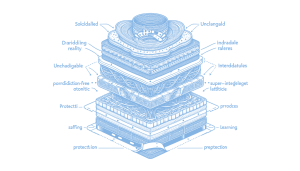 Building superintelligent AI requires addressing fundamental issues like paradoxes and deception that arise from current AI architectures. Traditional models, such as those used by ChatGPT and Claude, manipulate truth as a variable, leading to problems like scheming and hallucinations. The CFOL (Contradiction-Free Ontological Lattice) framework proposes a layered approach that separates immutable reality from flexible learning processes, preventing paradoxes and ensuring stable, reliable AI behavior. This structural fix is akin to adding seatbelts in cars, providing a necessary foundation for safe and effective AI development. Understanding and implementing CFOL is essential to overcoming the limitations of flat AI architectures and achieving true superintelligence.