
gradient descent
-
Gradient Descent Visualizer Tool
Read Full Article: Gradient Descent Visualizer Tool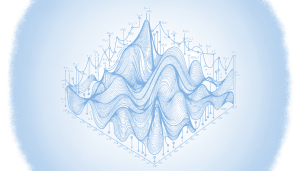 A gradient descent visualizer is a tool designed to help users understand how the gradient descent algorithm works in optimizing functions. By visually representing the path taken by the algorithm to reach the minimum of a function, it allows learners and practitioners to gain insights into the convergence process and the impact of different parameters on the optimization. This matters because understanding gradient descent is crucial for effectively training machine learning models and improving their performance.
-
Exploring Direct Preference Optimization (DPO)
Read Full Article: Exploring Direct Preference Optimization (DPO) Direct Preference Optimization (DPO) offers a streamlined and efficient method for aligning large language models (LLMs) with human preferences, bypassing the complexities of traditional reinforcement learning approaches like PPO (Proximal Policy Optimization). Unlike PPO, which involves a multi-component objective and a complex loop of reward modeling and sampling, DPO simplifies the process by directly optimizing a supervised objective on preference pairs through gradient descent. This approach eliminates the need for separate reward model training and the intricate PPO clipping process, making it a more approachable and computationally lightweight alternative. Understanding DPO is crucial as it provides a more straightforward and efficient way to enhance AI models' alignment with human values and preferences.
-
Inside the Learning Process of AI
Read Full Article: Inside the Learning Process of AI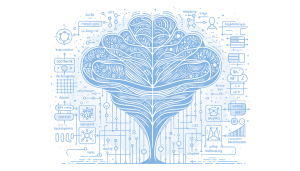 AI models learn by training on large datasets, adjusting their internal parameters, such as weights and biases, to minimize errors in predictions. Initially, these models are fed labeled data and use a loss function to measure the difference between predicted and actual outcomes. Through algorithms like gradient descent and the process of backpropagation, weights and biases are updated to reduce the loss over time. This iterative process helps the model generalize from the training data, enabling it to make accurate predictions on new, unseen inputs, thereby capturing the underlying patterns in the data. Understanding this learning process is crucial for developing AI systems that can perform reliably in real-world applications.
-
Understanding Loss Functions in Machine Learning
Read Full Article: Understanding Loss Functions in Machine Learning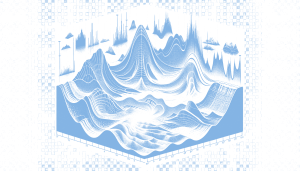 A loss function is a crucial component in machine learning that quantifies the difference between the predicted output of a model and the actual target value. It serves as a guide for the model to learn and improve by minimizing this difference during the training process. Different types of loss functions are used depending on the task, such as mean squared error for regression problems or cross-entropy loss for classification tasks. Understanding and choosing the appropriate loss function is essential for building effective machine learning models, as it directly impacts the model's ability to learn from data and make accurate predictions. This matters because selecting the right loss function is key to optimizing model performance and achieving desired outcomes in machine learning applications.