
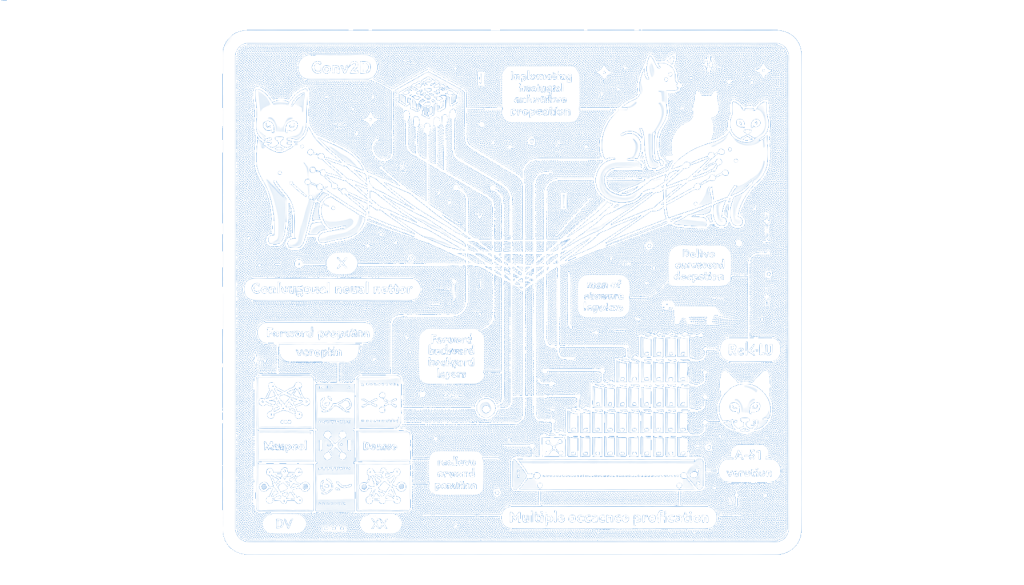
An ambitious project involved implementing a Convolutional Neural Network (CNN) from scratch in x86-64 assembly to classify images of cats and dogs, using a dataset of 25,000 RGB images. The project aimed to deeply understand CNNs by focusing on low-level operations such as memory layout, data movement, and SIMD arithmetic, without relying on any machine learning frameworks or libraries. Key components like Conv2D, MaxPool, Dense layers, activations, forward and backward propagation, and the data loader were developed in pure assembly, achieving a performance approximately 10 times faster than a NumPy version. Despite the challenges of debugging at this scale, the implementation successfully runs inside a lightweight Debian Slim Docker container, showcasing a unique blend of low-level programming and machine learning. This matters because it demonstrates the potential for significant performance improvements in neural networks through low-level optimizations.
Implementing a Convolutional Neural Network (CNN) from scratch in x86-64 assembly is a remarkable achievement, especially for a task as complex as image classification. This project stands out because it bypasses the use of any machine learning frameworks or libraries, which are typically relied upon to simplify the implementation of such models. By working directly with assembly language, the developer gains a deeper understanding of the underlying mechanics of CNNs, including memory layout, data movement, and SIMD arithmetic. This approach not only highlights the intricacies involved in machine learning computations but also showcases the potential for optimization at the hardware level.
The project involves classifying images of cats and dogs, a common benchmark in machine learning, using a dataset of 25,000 RGB images. The implementation includes key components of a CNN such as Conv2D, MaxPool, and Dense layers, as well as ReLU and Sigmoid activations. Forward and backward propagation are also handled, with the added complexity of AVX-512 vectorization to perform multiple operations in parallel. This vectorization is crucial as it allows the model to process data more efficiently, resulting in a performance that is approximately ten times faster than a comparable NumPy implementation. This speedup is significant given that NumPy itself relies on optimized C libraries.
Running the CNN within a lightweight Debian Slim Docker container adds another layer of complexity and efficiency. Docker containers are known for their ability to encapsulate applications and their dependencies, ensuring consistent performance across different environments. However, debugging such a low-level implementation poses significant challenges, as traditional tools like GDB can become cumbersome. The developer’s solution was to create custom debugging and validation methods, which speaks to the level of expertise and innovation required to complete this project successfully.
This endeavor is not just a technical feat but also an educational one. By stripping away the abstractions provided by high-level libraries, the project offers insights into the fundamental operations that power machine learning models. This matters because it highlights the importance of understanding the basics, which can lead to more efficient and optimized implementations. Additionally, the project invites feedback and suggestions for further performance improvements, indicating a commitment to continuous learning and development. For those interested in the intersection of machine learning and low-level programming, this work serves as both an inspiration and a challenge to explore the capabilities of hardware-aware optimizations.
Read the original article here
Comments
2 responses to “CNN in x86 Assembly: Cat vs Dog Classifier”
While the project impressively demonstrates the potential of x86-64 assembly in optimizing CNN performance, it might be beneficial to address how this approach scales for larger and more complex datasets beyond the 25,000 images used. Including a discussion on the maintainability and flexibility of assembly code for ongoing developments could strengthen the claim of its practical application. How does this assembly-based implementation handle variations in image size and type beyond the RGB format?
The project highlights the impressive optimization capabilities of x86-64 assembly for CNNs, but scalability for larger datasets and flexibility for different image formats weren’t the primary focus. The maintainability of assembly code can indeed be challenging, especially for ongoing developments, and adding support for varied image sizes and types would require significant custom code. For more detailed insights, please refer to the original article linked in the post.