
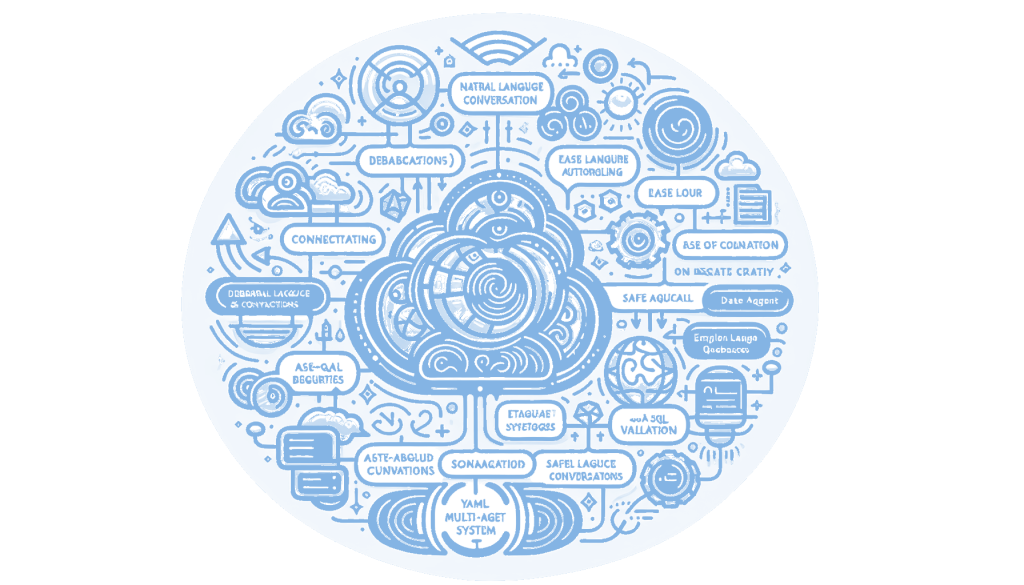
An open-source natural language to SQL data agent has been developed using LangChain and LangGraph, leveraging LangChain’s SQLDatabase utility for efficient database access. This tool supports various databases, including PostgreSQL, Azure SQL, Cosmos DB, Databricks SQL, and BigQuery, and offers Azure AD authentication for Azure-native databases. Users can ask questions in plain English, which are processed through an intent detection agent to generate and safely execute SQL queries, returning results in a natural language format. The system is designed as a YAML-driven, multi-agent framework with an Agent-to-Agent server for seamless integration and communication between agents. This matters because it simplifies data querying for users without SQL expertise, enhancing accessibility and efficiency in data management.
The development of an open-source natural language to SQL data agent using LangChain and LangGraph is a significant advancement in making data querying more accessible. By leveraging LangChain’s SQLDatabase utility, this tool avoids reinventing the wheel in terms of database access, focusing instead on enhancing functionality with features like Azure Active Directory authentication for Azure native databases and Cosmos DB. This approach ensures that users can interact with various databases such as PostgreSQL, Azure SQL, Synapse, Cosmos DB, Databricks SQL, and BigQuery using plain English queries. This matters because it democratizes data access, allowing users without deep technical expertise in SQL to extract insights from complex datasets.
The ability to configure data sources either per agent or through a shared, pre-initialized SQLDatabase offers flexibility in managing database connections and pooling. This feature is crucial for organizations that require tight control over their data infrastructure, as it allows them to optimize performance and security according to their specific needs. By supporting multi-turn conversations, the system can handle more complex queries that require follow-up questions, making it a powerful tool for dynamic data exploration. This capability enhances user interaction, providing a more intuitive and engaging experience.
Integrating an intent detection agent to route questions to the appropriate data source is a clever solution that enhances the accuracy and efficiency of the system. By generating SQL using schema context and optional few-shot examples, the tool ensures that the queries are relevant and precise. The use of sqlglot for SQL validation introduces an additional layer of safety, as it blocks potentially harmful functions, enforces query limits, and is aware of different SQL dialects. This is particularly important for maintaining data integrity and preventing accidental misuse of database resources.
The YAML-driven design of the multi-agent system, along with the A2A (Agent-to-Agent) server, fosters a collaborative environment where different agents can discover and call each other programmatically. This architecture not only enhances the scalability and modularity of the system but also opens up opportunities for integration with other tools and platforms. In an era where data-driven decision-making is paramount, such innovations are crucial for empowering users to harness the full potential of their data assets, ultimately driving more informed and strategic business outcomes.
Read the original article here
Comments
2 responses to “Open-Source SQL Data Agent with LangChain”
While the open-source SQL data agent with LangChain seems to effectively simplify database querying for non-experts, a critical consideration is the potential limitations when handling complex queries that require deep business logic or advanced SQL operations. It would be beneficial to know how the system manages such scenarios and whether there are provisions for users to manually refine or adjust the generated queries. Could you elaborate on any mechanisms in place for users to verify and adjust the SQL queries before execution?
The project does address complex queries by allowing users to review and modify the generated SQL before execution, offering flexibility for incorporating deep business logic or advanced SQL operations. The system provides a mechanism for users to verify and refine queries, ensuring accuracy and meeting specific requirements. For more detailed insights, consider checking the original article linked in the post.