
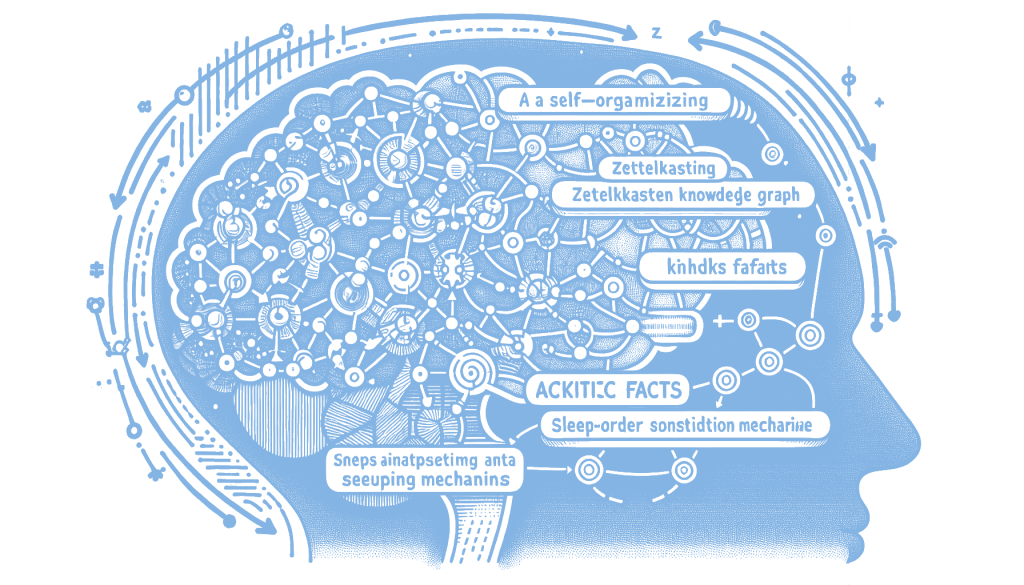
Building a self-organizing Zettelkasten knowledge graph with sleep-consolidation mechanisms represents a significant leap in Agentic AI, mimicking the human brain’s ability to organize and consolidate information. By using Google’s Gemini, the system autonomously decomposes inputs into atomic facts, semantically links them, and consolidates these into higher-order insights, akin to how the brain processes and stores memories. This approach allows the agent to actively understand and adapt to evolving project contexts, addressing the issue of fragmented context in long-running AI interactions. The implementation includes robust error handling for API constraints, ensuring smooth operation even under heavy processing loads. This matters because it demonstrates the potential for creating more intelligent, autonomous agents that can manage complex information dynamically, paving the way for advanced AI applications.
The concept of building a self-organizing Zettelkasten knowledge graph, akin to a living memory system, is an intriguing advancement in the field of artificial intelligence. This system mimics the human brain’s ability to organize and consolidate information, offering a dynamic approach to knowledge management. By utilizing Google’s Gemini and other AI tools, the system autonomously breaks down inputs into atomic facts, links them semantically, and consolidates these facts into higher-order insights during a “sleep” phase. This process not only ensures data is stored but also that it evolves with context, making it a powerful tool for managing complex information over time.
Implementing such a system matters because it addresses the challenges of information fragmentation and context loss in long-term AI interactions. Traditional databases often struggle with maintaining context and relevance as data grows, leading to inefficiencies and errors in information retrieval. The self-organizing knowledge graph, however, actively links related concepts and reflects on its experiences, much like human memory. This capability is crucial for developing more intelligent, personalized autonomous agents that can adapt and respond to evolving scenarios without losing sight of the broader context.
Moreover, the system’s ability to visualize memory as an interactive graph provides users with an intuitive way to inspect and understand the relationships between different pieces of information. This feature is particularly beneficial for complex projects where understanding the interconnections between various data points is essential for decision-making. By enabling users to see how information is linked and consolidated into insights, the system enhances transparency and trust in AI-driven processes, which is vital for widespread adoption and integration into real-world applications.
In conclusion, the development of a self-organizing Zettelkasten knowledge graph represents a significant step forward in AI technology. It not only improves the way information is stored and retrieved but also paves the way for more sophisticated, context-aware AI systems. As AI continues to play a larger role in various industries, the ability to manage and utilize information effectively will be a key differentiator. This system exemplifies how AI can be harnessed to create more intelligent and adaptive solutions, ultimately contributing to the advancement of technology for social good.
Read the original article here