
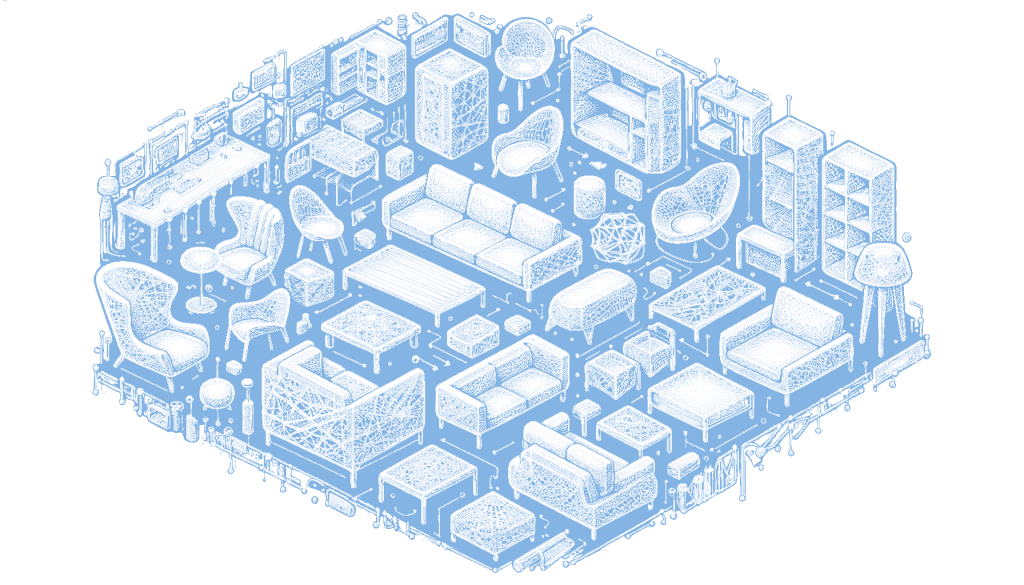
An innovative project has explored the potential of open-source language models like LLaMA 3.1 to generate 3D furniture models, pushing these models beyond text to create complex 3D mesh structures. The project involved fine-tuning LLaMA with a 20k token context length to handle the intricate geometry of furniture, using a specialized dataset of furniture categories such as sofas, cabinets, chairs, and tables. Utilizing GPU infrastructure from verda.com, the model was trained to produce detailed mesh representations, with results available for viewing on llm3d.space. This advancement showcases the potential for language models to contribute to fields like e-commerce, interior design, AR/VR applications, and gaming by bridging natural language understanding with 3D content creation. This matters because it demonstrates the expanding capabilities of AI in generating complex, real-world applications beyond traditional text processing.
The project of using LLaMA 3.1 to generate 3D furniture models represents a significant leap in the capabilities of open-source language models. Traditionally, language models like LLaMA have been used primarily for text generation and natural language processing tasks. However, this endeavor pushes the boundaries by exploring whether these models can extend their utility to the realm of 3D content creation. This matters because it demonstrates the potential for language models to transcend their original design purposes and apply their capabilities to more complex, multi-dimensional tasks, thus broadening the scope of artificial intelligence applications.
One of the main challenges addressed in this project is the complexity of furniture geometry. Unlike simpler 3D objects, furniture involves intricate mesh structures that require a high level of detail and precision. By fine-tuning LLaMA 3.1 with a 20k token context length, the model was equipped with the necessary capacity to understand and generate these complex structures. This advancement is crucial because it indicates that language models can be adapted to handle tasks that involve detailed geometric understanding, which is essential for accurate 3D modeling.
The specialized dataset curated for this project plays a pivotal role in its success. By focusing on specific categories of furniture such as sofas, cabinets, chairs, and tables, the dataset ensures that the model is exposed to a wide variety of geometric forms and styles. This targeted approach is important because it allows the model to learn the nuances of different furniture types, improving its ability to generate realistic and diverse 3D models. The use of verda.com’s GPU infrastructure for training underscores the importance of robust computational resources in developing advanced AI applications.
The implications of successfully integrating natural language understanding with 3D content creation are vast. This development opens up new possibilities for industries such as e-commerce, interior design, augmented reality (AR), virtual reality (VR), and gaming. For instance, in e-commerce, customers could potentially generate custom furniture designs based on textual descriptions. In AR/VR and gaming, this technology could enable more dynamic and interactive environments. As the project continues to evolve, it will be exciting to see how these initial results can be further refined and applied across various sectors, potentially transforming the way we interact with digital content.
Read the original article here
Comments
2 responses to “3D Furniture Models with LLaMA 3.1”
The use of LLaMA 3.1 for generating 3D furniture models is fascinating, especially in terms of its potential applications in fields like e-commerce and AR/VR. How do you envision this technology impacting the workflow of traditional 3D artists and designers in these industries?
The post suggests that incorporating LLaMA 3.1 into workflows could streamline the initial design process for 3D artists and designers by providing a base model to refine and customize. This technology might allow artists to focus more on creative aspects and less on basic modeling tasks, enhancing productivity in e-commerce and AR/VR applications. For more detailed insights, you might want to check the original article linked in the post.