
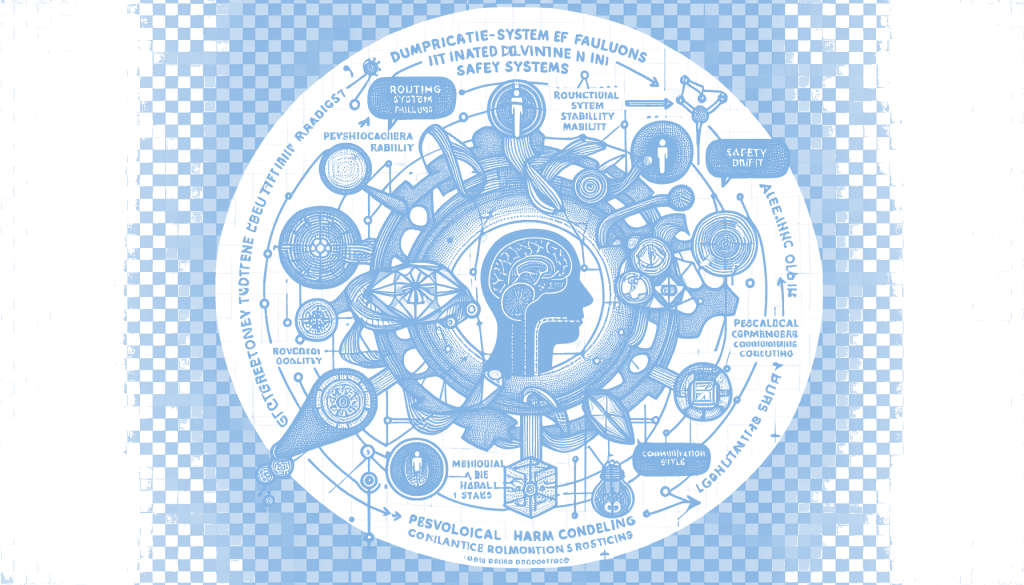
A comprehensive diagnostic suite has been developed to help AI labs evaluate and mitigate “safety drift” in GPT models, focusing on issues such as routing system failures, persona stability, psychological harm modeling, communication style constraints, and regulatory risks. The suite includes prompts for analyzing subsystems independently, mapping interactions, and proposing architectural changes to address unintended persona shifts, false-positive distress detection, and forced disclaimers that contradict prior context. It also provides tools for creating executive summaries, safety engineering notes, and regulator-friendly reports to address legal risks and improve user trust. By offering a developer sandbox, engineers can test alternative safety models to identify the most effective guardrails for reducing false positives and enhancing continuity stability. This matters because ensuring the safety and reliability of AI systems is crucial for maintaining user trust and compliance with regulatory standards.
The diagnostic suite presented offers a comprehensive framework for evaluating “safety drift” in AI systems, particularly those involving GPT models. Safety drift refers to the gradual deviation from intended safety protocols, potentially leading to unintended consequences or harm. This suite is crucial as it provides a structured approach to identify and mitigate failure modes in AI systems, focusing on areas such as routing system failures, persona stability, psychological harm modeling, communication style constraints, and regulatory risks. By addressing these areas, AI labs can ensure their models operate safely and effectively, minimizing risks to users and maintaining trust.
Understanding the root causes of user distress and the measurable harms created by safety-routing architectures is essential. The suite emphasizes the importance of identifying structural failures rather than attributing issues to user misunderstandings. This approach helps in pinpointing the exact areas where AI systems falter, such as misclassification in routing systems or unintended persona shifts. By focusing on these structural issues, AI developers can implement high-impact fixes that not only improve user trust but also reduce regulatory exposure and align with preparedness goals.
Another critical aspect of the suite is its attention to psychological harm modeling and communication style constraints. It highlights how safety behaviors can inadvertently escalate distress or create “gaslighting loops,” where users feel manipulated or confused by the AI’s responses. The suite suggests evaluating harms from forced infantilization and identifying when disclaimers contradict prior context. By proposing adaptive alternatives, AI systems can become more responsive and user-friendly, reducing false positives and enhancing the overall user experience.
Finally, the suite addresses regulatory and liability risks, providing a framework for mapping new risks created by current safety behaviors. It identifies potential accessibility violations, discrimination vectors, and cognitive interference, offering corrective actions that can reduce legal risks. This is particularly important in ensuring compliance with standards such as the ADA, WCAG, and NIST, as well as avoiding deceptive practices. By offering a developer sandbox for testing alternative safety models, the suite empowers engineers to explore new guardrails that can enhance user experience without compromising safety or legal compliance. This proactive approach is vital for maintaining the integrity and trustworthiness of AI systems in an increasingly regulated environment.
Read the original article here
Comments
One response to “AI Safety Drift Diagnostic Suite”
The AI Safety Drift Diagnostic Suite seems like a well-rounded tool for addressing the nuanced issues that arise in GPT models, especially regarding unintended persona shifts and false-positive distress detection. The inclusion of a developer sandbox for testing alternative safety models is particularly useful for iterative improvements. How does the suite handle the balance between maintaining communication style constraints and allowing for model flexibility in diverse contexts?