
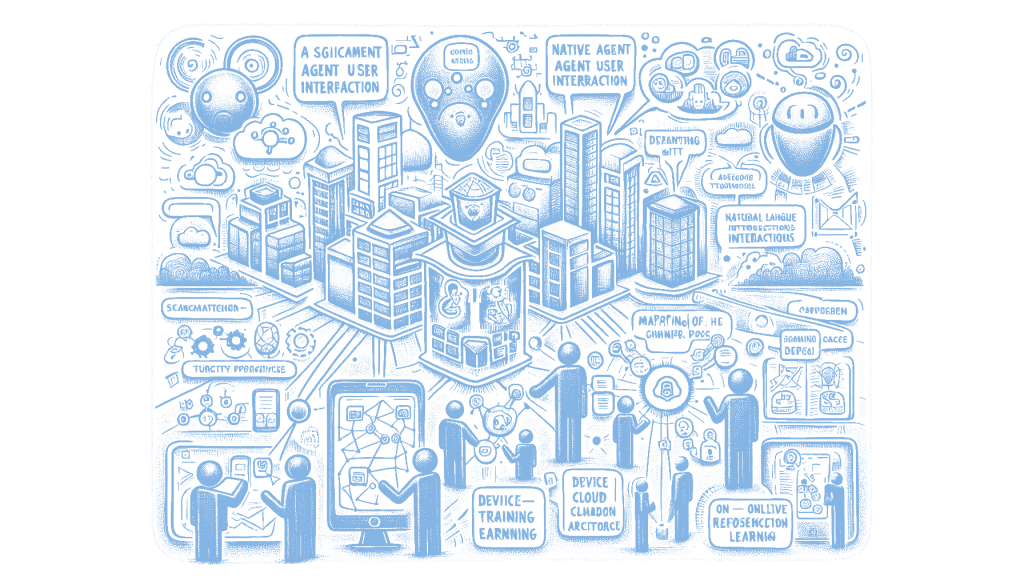
Alibaba Tongyi Lab’s MAI-UI is a groundbreaking family of GUI agents that excels in mobile GUI navigation and grounding, outperforming previous models like Gemini 2.5 Pro and Seed1.8. By integrating MCP tool use, agent-user interaction, and device-cloud collaboration, MAI-UI addresses gaps in earlier GUI agents, maintaining privacy while leveraging cloud models. Built on the Qwen3 VL framework, these agents process natural language and UI screenshots to perform actions in Android environments, achieving high accuracy on benchmarks such as ScreenSpot Pro and MMBench GUI L2. The system’s robust navigation capabilities are enhanced through a self-evolving data pipeline and an online reinforcement learning framework, demonstrating significant improvements in success rates on the AndroidWorld benchmark. This matters because it represents a significant advancement in the development of intelligent, interactive mobile applications that can seamlessly integrate with user needs and complex environments.
MAI-UI, developed by Alibaba Tongyi Lab, represents a significant advancement in the field of GUI agents for mobile applications. This family of agents is designed to address three specific challenges that earlier models struggled with: native agent user interaction, integration of MCP tools, and a device-cloud collaboration architecture. These enhancements allow MAI-UI to perform tasks more efficiently while maintaining user privacy by processing sensitive data on the device and utilizing cloud models when necessary. This matters because it provides a more robust and secure way to enhance mobile user interfaces, potentially transforming how users interact with their devices.
Grounding, a critical process for any GUI agent, involves mapping natural language instructions to the correct on-screen controls. MAI-UI employs a sophisticated UI grounding strategy that generates multiple perspectives for each UI element. This approach reduces the impact of flawed instructions by providing the model with various reasoning evidence, thereby improving accuracy. The results speak for themselves, as MAI-UI outperforms previous models like Gemini 3 Pro and Seed1.8 on several public GUI grounding benchmarks. This improvement is crucial for creating more intuitive and responsive interfaces, enhancing user experience across various applications.
Navigation, a more complex task than grounding, requires maintaining context across multiple steps and applications while interacting with users and tools. MAI-UI tackles this with a self-evolving data pipeline that generates diverse task scenarios, allowing the model to learn from a wide range of interactions. The use of human annotators and multiple agents to execute tasks ensures high-quality training data. This comprehensive approach results in MAI-UI achieving significant success on the MobileWorld benchmark, outperforming other models in tasks that involve pure GUI interactions, user-agent interactions, and MCP tool calls. Such advancements are vital for developing agents that can seamlessly navigate complex mobile environments.
MAI-UI’s use of an online reinforcement learning (RL) framework within containerized Android environments is another noteworthy feature. By scaling the number of parallel GUI environments and increasing the allowed environment steps, MAI-UI improves navigation success rates significantly. This scalability is essential for developing robust agents that can adapt to the dynamic nature of mobile apps. As mobile applications continue to evolve, having an adaptable and scalable framework ensures that GUI agents remain effective and efficient. Overall, MAI-UI’s advancements in GUI grounding, navigation, and RL frameworks highlight its potential to revolutionize mobile user interfaces, making them more intelligent and user-friendly.
Read the original article here
Comments
2 responses to “Alibaba’s MAI-UI: Leading GUI Agent Innovation”
MAI-UI’s integration of MCP tool use and device-cloud collaboration is a significant leap forward in GUI agent technology, especially in maintaining user privacy while using cloud models. The use of a self-evolving data pipeline and online reinforcement learning to enhance navigation capabilities is impressive, highlighting Alibaba’s innovative approach in this space. How does the Qwen3 VL framework specifically contribute to MAI-UI’s ability to process natural language and UI screenshots so effectively?
The Qwen3 VL framework plays a crucial role by enabling MAI-UI to effectively process natural language and UI screenshots through its advanced vision-language alignment capabilities. This allows for precise interpretation and execution of tasks in Android environments, enhancing the agent’s overall navigation and interaction efficiency. For more detailed insights, you might want to refer to the original article linked in the post.