
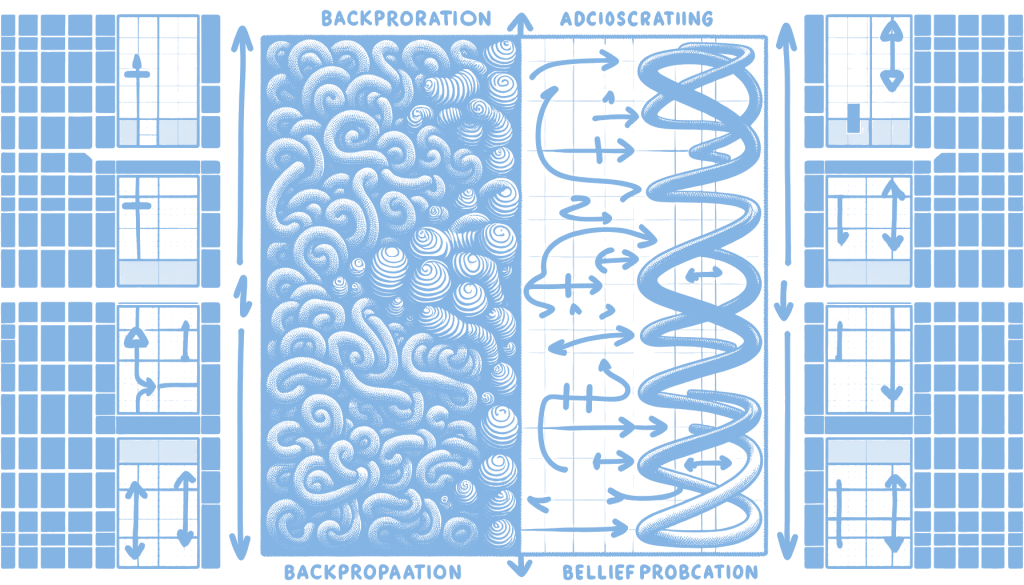
Belief Propagation is presented as an intriguing alternative to backpropagation for training reasoning models, particularly in the context of solving Sudoku puzzles. This approach, highlighted in the paper ‘Sinkhorn Solves Sudoku’, is based on Optimal Transport theory, offering a method akin to performing a softmax operation without relying on derivatives. This method provides a fresh perspective on model training, potentially enhancing the efficiency and effectiveness of reasoning models. Understanding alternative training methods like Belief Propagation could lead to advancements in machine learning applications.
Belief Propagation, as highlighted in the context of training reasoning models, offers an intriguing alternative to the widely used backpropagation method. This approach is particularly noteworthy in its application to solving Sudoku puzzles, which serve as a robust testbed for evaluating the efficacy of reasoning models. By leveraging concepts from Optimal Transport theory, Belief Propagation circumvents the need for derivatives, a staple in backpropagation, thereby presenting a novel methodology for model training. This distinction is not only theoretically fascinating but also potentially transformative for the development of AI systems capable of complex reasoning tasks.
The analogy to performing a softmax operation without derivatives is a key aspect of Belief Propagation’s appeal. In traditional neural networks, backpropagation relies heavily on gradient descent and the computation of derivatives to update model parameters. However, Belief Propagation’s derivative-free approach could simplify the training process, reduce computational overhead, and potentially lead to more efficient algorithms. This is particularly relevant in scenarios where derivative calculations are complex or computationally expensive, making Belief Propagation a valuable tool for researchers and practitioners seeking alternative training methodologies.
Understanding why this matters requires an appreciation of the broader implications for AI and machine learning. As models become increasingly sophisticated and are tasked with more complex reasoning, the limitations of current training methods become more apparent. Belief Propagation offers a glimpse into a future where alternative training techniques could unlock new levels of performance and capability in AI systems. By exploring such methods, researchers can push the boundaries of what is possible, leading to more intelligent and adaptable systems that can tackle a wider range of problems.
In conclusion, the exploration of Belief Propagation as an alternative to backpropagation is not just an academic exercise but a crucial step towards advancing the field of AI. By challenging the status quo and investigating new approaches rooted in different theoretical frameworks, the potential for innovation and breakthroughs in reasoning models is significantly enhanced. This matters because it opens up new avenues for research and development, encouraging a more diverse set of tools and techniques that can be applied to the ever-growing challenges faced by AI systems in the real world.
Read the original article here
Comments
2 responses to “Belief Propagation: An Alternative to Backpropagation”
The exploration of Belief Propagation as a substitute for backpropagation is fascinating, especially in its application to reasoning models like Sudoku. How does the efficiency and performance of models trained with Belief Propagation compare to those trained with traditional backpropagation in real-world scenarios?
The post suggests that Belief Propagation could potentially offer advantages in terms of efficiency and effectiveness for reasoning models, though its performance compared to backpropagation in real-world scenarios might vary depending on the specific application. For a detailed comparison and more insights, it would be best to refer to the original article linked in the post to explore the authors’ findings.