
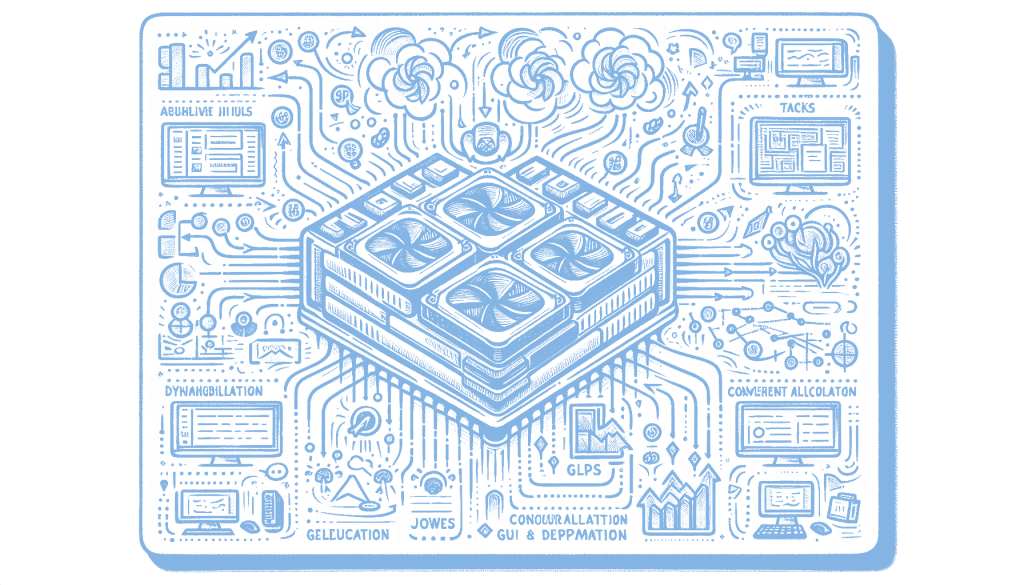
Traditional GPU job orchestration often leads to underutilization due to the one-job-per-GPU approach, which leaves GPU resources idle when not fully saturated. WoolyAI’s software stack addresses this by allowing multiple jobs to run concurrently on a single GPU with deterministic performance, dynamically managing the GPU’s streaming multiprocessors (SMs) to ensure full utilization. This approach not only maximizes GPU efficiency but also supports running machine learning jobs on CPU-only infrastructure by executing kernels remotely on a shared GPU pool. Additionally, it allows existing CUDA PyTorch jobs to run seamlessly on AMD hardware without modifications. This matters because it significantly increases GPU utilization and efficiency, potentially reducing costs and improving performance in computational tasks.
In the realm of GPU utilization, the conventional practice has been to allocate a single job per GPU to avoid performance unpredictability. This conservative approach often leads to underutilization, as the GPU’s resources like Streaming Multiprocessors (SMs) and VRAM may remain idle if the job doesn’t fully saturate them. This inefficiency is a significant concern, especially given the high costs associated with GPU resources. WoolyAI’s innovative software stack addresses this issue by enabling the co-location of multiple jobs on a single GPU while maintaining deterministic performance. This approach promises to significantly boost GPU utilization, potentially achieving a 2-3x increase.
The key to WoolyAI’s solution lies in its dynamic management of GPU resources. By orchestrating concurrent kernel executions, the software ensures that the GPU’s SMs are always engaged, minimizing idle time and maximizing resource utilization. This dynamic allocation is crucial because it allows multiple jobs to share the GPU without interfering with each other’s performance, which has traditionally been a challenge. By guaranteeing that no resources are left idle, WoolyAI can deliver consistent performance across all jobs, making it a compelling option for organizations looking to optimize their GPU investments.
Another notable feature of WoolyAI’s stack is its flexibility in deployment. Users can run machine learning jobs on CPU-only infrastructure while leveraging remote kernel execution on a shared GPU pool. This capability not only broadens access to GPU resources but also reduces the need for extensive hardware investments. Furthermore, the software supports existing CUDA PyTorch jobs without requiring any modifications, even on AMD hardware. This compatibility ensures that organizations can seamlessly integrate WoolyAI into their existing workflows, preserving their investments in current software and training pipelines.
Understanding the implications of WoolyAI’s advancements is crucial for industries reliant on heavy computational tasks, such as artificial intelligence and data analytics. By increasing GPU utilization and providing flexibility in resource allocation, organizations can achieve significant cost savings and improved performance. This approach could redefine how computational resources are managed, leading to more sustainable and efficient operations. As the demand for high-performance computing continues to grow, solutions like WoolyAI’s offer a promising path forward, ensuring that technological advancements translate into tangible benefits for businesses and researchers alike.
Read the original article here
Comments
2 responses to “Boosting GPU Utilization with WoolyAI’s Software Stack”
While WoolyAI’s approach to maximizing GPU utilization is innovative, it would be beneficial to consider the potential overhead introduced by managing multiple concurrent jobs on a single GPU, which could affect performance under certain workloads. Providing benchmarks or case studies comparing this solution to traditional methods in various real-world scenarios could strengthen the claim of increased efficiency. How does the software stack handle potential conflicts or resource contention when running diverse types of jobs concurrently on a single GPU?
The post acknowledges the potential overhead and suggests that WoolyAI’s software stack manages resource contention by dynamically allocating streaming multiprocessors (SMs) to balance workloads. While specific benchmarks aren’t detailed in the post, looking into the linked article might provide deeper insights or direct you to resources that compare this solution to traditional methods.