
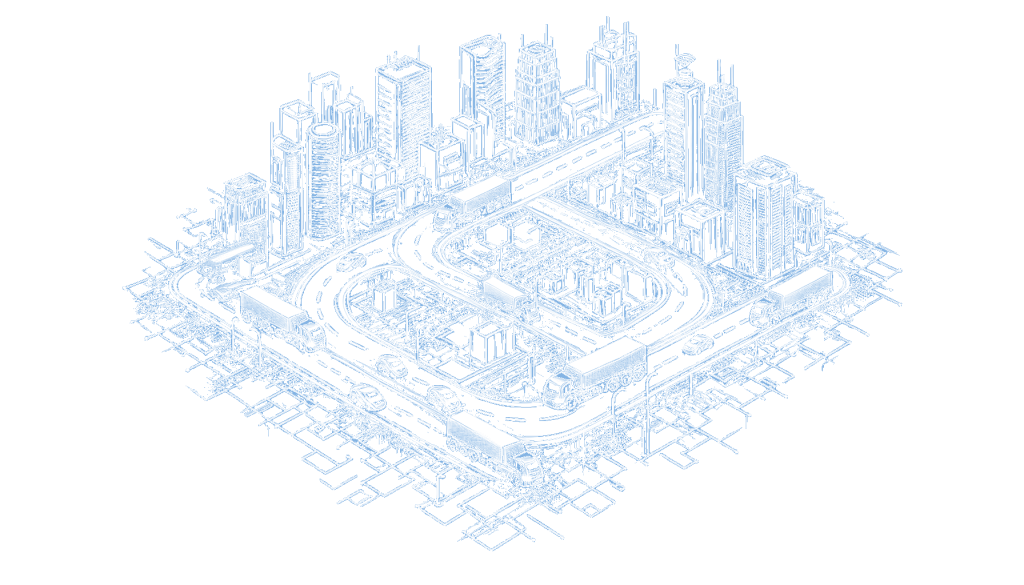
An advanced autonomous logistics simulation is developed where multiple smart delivery trucks operate within a dynamic city-wide road network. Each truck acts as an agent capable of bidding on delivery orders, planning optimal routes, managing battery levels, and seeking charging stations, all while aiming to maximize profit through self-interested decision-making. The simulation demonstrates how agentic behaviors emerge from simple rules, how competition influences order allocation, and how a graph-based world facilitates realistic movement, routing, and resource constraints.
The simulation’s core components include defining the AgenticTruck class, initializing key attributes like position, battery, balance, and state, and implementing decision-making logic for tasks such as calculating shortest paths, identifying charging stations, and evaluating order profitability. Trucks are designed to transition smoothly between states like moving, charging, and idling, while managing battery recharging, financial impacts of movement, fuel consumption, and order completion. The simulation orchestrates agent interactions by generating a graph-based city, spawning trucks with varying capacities, and producing new delivery orders, with agents bidding for tasks based on profitability and distance.
The simulation loop updates agent states, visualizes the network, displays active orders, and animates each truck’s movement, showcasing emergent coordination and competition within the multi-agent logistics ecosystem. This setup allows for observing dynamics that mirror real-world fleet behavior, providing a sandbox for experimenting with logistics intelligence. The project highlights the potential of autonomous systems in logistics, demonstrating how individual components like graph generation, routing, battery management, auctions, and visualization can form a cohesive, evolving system. This matters because it showcases the potential of AI and autonomous systems in transforming logistics and supply chain management, offering insights into optimizing efficiency and resource allocation.
The development of an autonomous multi-agent logistics system with route planning, dynamic auctions, and real-time visualization represents a significant leap in logistics technology. By simulating a network of smart delivery trucks operating within a dynamic city-wide road network, this system showcases the potential of artificial intelligence to optimize logistics operations. Each truck acts as an independent agent capable of making decisions based on simple rules, such as bidding on delivery orders, planning optimal routes, and managing resources like battery levels. This matters because it highlights how AI can be used to improve efficiency and profitability in logistics, a field that is crucial for global commerce and supply chain management.
The implementation of agentic behaviors in this logistics system demonstrates the power of competition and decision-making in shaping order allocation. Trucks compete for delivery orders based on potential profitability and feasibility, ensuring that resources are used efficiently. The use of a graph-based world allows for realistic movement and routing, taking into account constraints such as distance, fuel costs, and charging needs. This matters as it provides a blueprint for real-world applications where logistics companies can harness AI to reduce costs, improve delivery times, and enhance customer satisfaction by ensuring timely and efficient delivery of goods.
Visualizing the logistics swarm in real-time offers insights into the emergent dynamics of the system, which mirrors real-world fleet behavior. By observing how agents negotiate workloads, compete for opportunities, and respond to environmental pressures, stakeholders can gain a deeper understanding of logistics intelligence. This matters because it provides a testing ground for new strategies and technologies in logistics, allowing companies to experiment with different approaches in a controlled environment before implementing them in real-world scenarios. Ultimately, this simulation serves as a powerful tool for advancing logistics intelligence, paving the way for smarter, more autonomous logistics operations that can adapt to the ever-changing demands of the market.
Read the original article here