
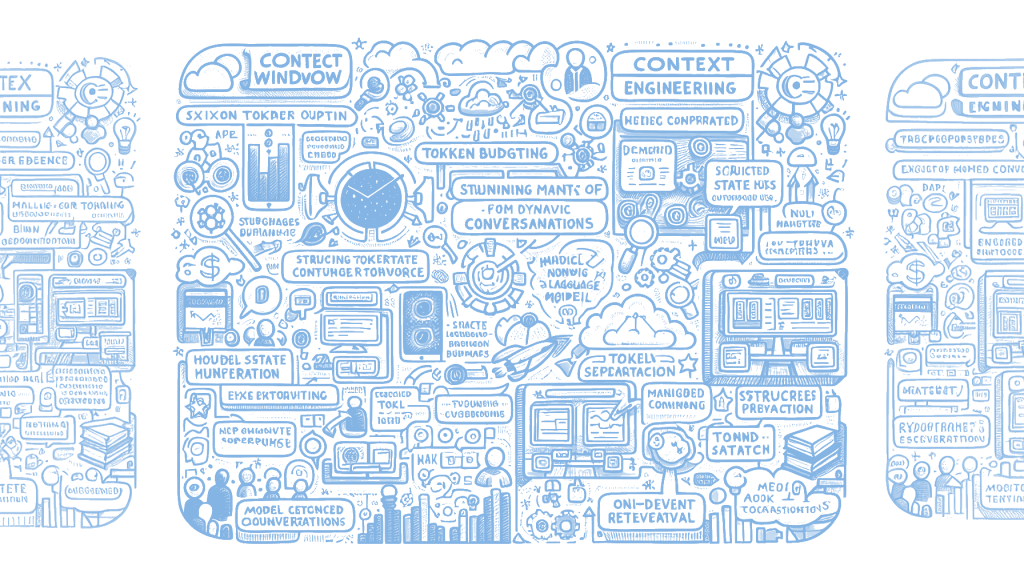
Context engineering is essential for managing the limitations of large language models (LLMs) that have fixed token budgets but need to handle vast amounts of dynamic information. By treating the context window as a managed resource, context engineering involves deciding what information enters the context, how long it stays, and what gets compressed or archived for retrieval. This approach ensures that LLM applications remain coherent and effective, even during complex, extended interactions. Implementing context engineering requires strategies like optimizing token usage, designing memory architectures, and employing advanced retrieval systems to maintain performance and prevent degradation. Effective context management prevents issues like hallucinations and forgotten details, ensuring reliable application performance. This matters because effective context management is crucial for maintaining the performance and reliability of AI applications using large language models, especially in complex and extended interactions.
Context engineering is a critical concept in the realm of large language models (LLMs), especially as these models face limitations due to fixed context windows. This limitation means that all relevant information for a task must fit within a certain number of tokens, which can be problematic when dealing with applications that generate vast amounts of data. Without proper management, important information can be lost, leading to degraded performance. Context engineering addresses this by treating the context window as a managed resource, enabling explicit allocation of information and ensuring that essential data is not randomly truncated or omitted.
Understanding the necessity of context engineering is the first step in optimizing LLMs for complex tasks. In applications where multiple data sources and interactions are involved, such as retrieval-augmented generation (RAG) or multi-step AI agents, the challenge is deciding which information should be prioritized and retained. Without explicit context management, LLMs may forget crucial details, hallucinate outputs, or degrade in quality over time. Context engineering involves continuously curating the information environment, deciding what enters the context, when it enters, and how long it stays, ensuring the model remains effective throughout its execution.
In practice, context engineering requires strategic management of the context window. This involves budgeting tokens, truncating conversations, managing tool outputs, and utilizing on-demand retrieval systems. By treating context as a dynamic resource rather than a static configuration, developers can optimize the use of tokens and ensure that the most relevant information is always available to the model. Techniques such as semantic compression, structured state separation, and the model context protocol (MCP) help in managing the flow of information, allowing the model to fetch data as needed rather than trying to fit everything into the context upfront.
Implementing context engineering at scale involves sophisticated memory architectures, compression strategies, and retrieval systems. By designing memory architectures that separate working, episodic, semantic, and procedural memory, developers can optimize the model’s immediate task needs while preserving important historical and factual data. Advanced compression techniques and retrieval systems ensure that only the most relevant information is retrieved, reducing token usage and improving performance. This approach not only enhances the model’s ability to handle complex, extended interactions but also ensures coherence and reliability, preventing issues like hallucination or information loss. Overall, context engineering is a crucial component in building effective and efficient LLM applications.
Read the original article here
Comments
2 responses to “Context Engineering: 3 Levels of Difficulty”
The concept of treating the context window as a managed resource is a game-changer for optimizing large language models, especially in maintaining coherence during extended interactions. Implementing memory architectures and advanced retrieval systems seems crucial for preventing issues like hallucinations and forgotten details. Could you elaborate on how these strategies might differ when applied to various industries, such as healthcare versus customer service?
The post suggests that in healthcare, context engineering might focus on ensuring patient data is accurately retained and retrievable, prioritizing privacy and compliance. In customer service, the emphasis could be on maintaining conversational continuity and personalizing interactions. Different industries will likely require tailored strategies to address their specific challenges and priorities. For more detailed insights, you might want to refer to the original article linked in the post.