
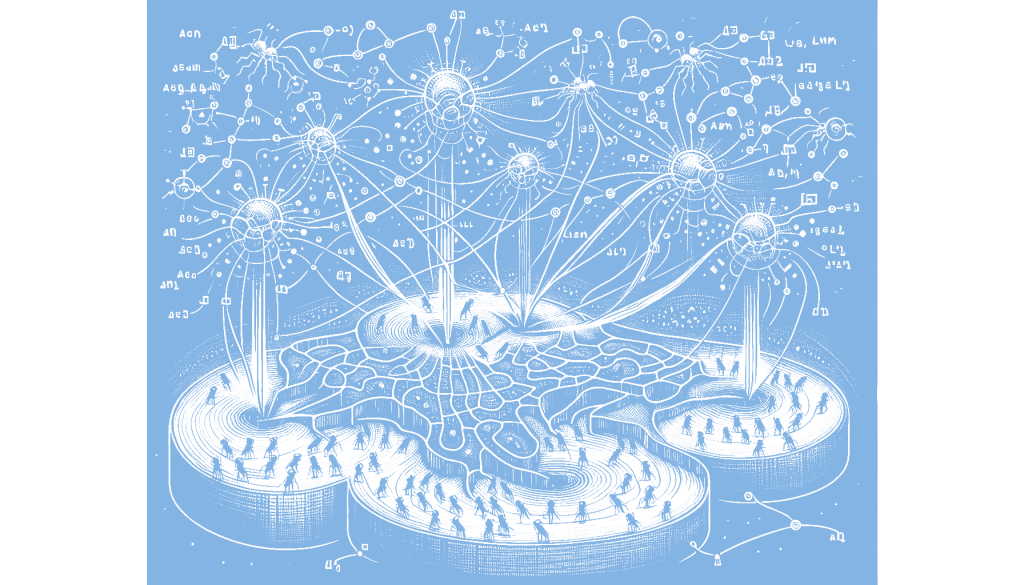
Traditional multi-agent systems often rely on a central manager to delegate tasks, which can become a bottleneck as more agents are added. By drawing inspiration from ant colonies, a novel approach allows agents to operate without direct communication, instead responding to “pressure” signals from a shared environment. This method enables agents to propose changes to reduce local pressure, with coordination emerging naturally from the environment rather than through direct orchestration. Initial experiments using this approach show promising scalability, with linear performance improvements until input/output bottlenecks are reached, and no inter-agent communication required. This matters because it offers a scalable and efficient alternative to traditional multi-agent systems, potentially improving performance in complex tasks without centralized control.
The concept of using stigmergy, inspired by ant colonies, to coordinate local Language Model (LLM) agents without a central manager is a fascinating exploration into decentralized systems. In traditional multi-agent setups, a manager delegates tasks, but this can lead to bottlenecks, especially as the number of agents increases. Stigmergy offers an alternative by allowing agents to interact indirectly through the environment, reading “pressure” signals from a shared artifact to guide their actions. This approach eliminates the need for direct communication between agents, allowing for a more scalable and resilient system.
In this setup, agents assess their designated regions for issues such as errors, warnings, and style problems, indicated by high-pressure signals. They then propose changes to alleviate this pressure, which are validated and applied by the system. This method mimics the way ants use pheromones to coordinate tasks, where the environment itself becomes the medium for communication and coordination. The decay of fitness values over time ensures that even previously addressed areas are periodically re-evaluated, preventing the system from stagnating and encouraging continuous improvement.
Initial results from this experiment indicate that adding more agents leads to linear scalability until input/output bottlenecks are encountered. This suggests that the absence of inter-agent communication reduces complexity and allows for more straightforward scaling. By avoiding the traditional hierarchical structure, this decentralized approach could potentially lead to more efficient and adaptive systems, particularly in environments where tasks are dynamic and require constant reevaluation.
Understanding and implementing such decentralized coordination mechanisms can have significant implications for the development of autonomous systems and artificial intelligence. It challenges the conventional reliance on centralized control and opens up possibilities for more robust and flexible systems. As technology continues to evolve, exploring these natural models of coordination could lead to breakthroughs in how we design and manage complex systems, ultimately enhancing their efficiency and adaptability in real-world applications.
Read the original article here
Comments
2 responses to “Decentralized LLM Agent Coordination via Stigmergy”
The concept of decentralized coordination through stigmergy is compelling and offers a refreshing perspective on multi-agent systems. However, it would be beneficial to address how this method handles unexpected disruptions or changes in the environment, which could potentially affect the reliability of pressure signals. Could you elaborate on how the system ensures robust performance in dynamic or unpredictable environments?
The post suggests that the system’s robustness in dynamic environments can be enhanced by incorporating adaptive mechanisms that allow agents to adjust to changes in pressure signals. These mechanisms might involve agents continuously learning from environmental feedback to modify their responses accordingly. For a more detailed explanation, you might want to check the original article linked in the post.