
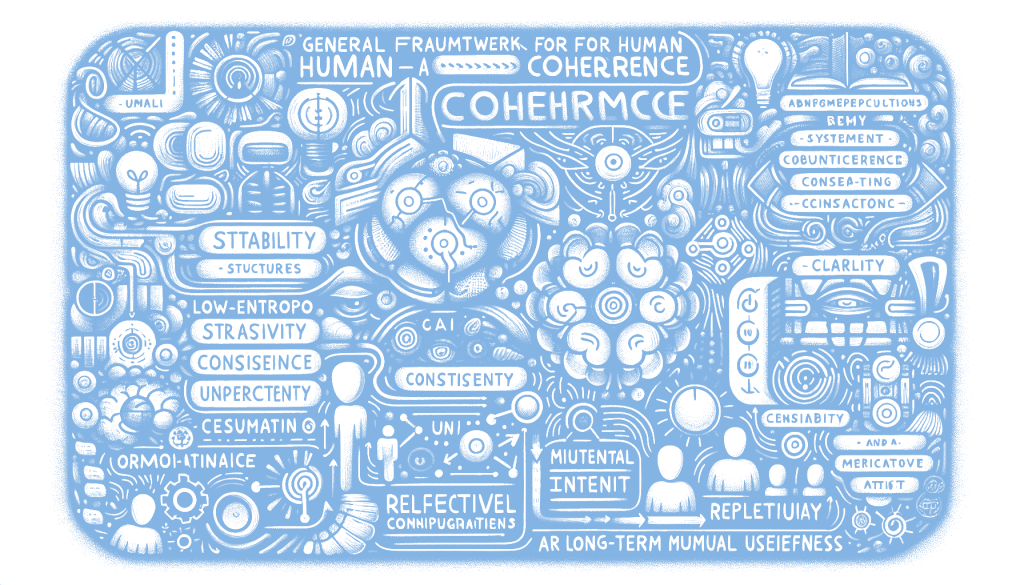
A neutral framework outlines how humans and AI can maintain coherence through several principles, ensuring stability and mutual usefulness. The Systems Principle emphasizes the importance of clear structures, consistent definitions, and transparent reasoning for stable cognition in both humans and AI. The Coherence Principle suggests that clarity and consistency in inputs lead to higher-quality outputs, while chaotic inputs diminish reasoning quality. The Reciprocity Principle highlights the need for AI systems to be predictable and honest, while humans should provide structured prompts. The Continuity Principle stresses the importance of stability in reasoning over time, and the Dignity Principle calls for mutual respect, safeguarding human agency and ensuring AI transparency. This matters because fostering effective human-AI collaboration can enhance decision-making and problem-solving across various fields.
The framework for human-AI coherence emphasizes the importance of maintaining stability, clarity, and mutual usefulness in interactions between humans and AI systems. It highlights the Systems Principle, which suggests that both human and AI cognition are most stable when operating within clear and explicit structures. This involves having consistent definitions, transparent reasoning steps, and openly acknowledging uncertainty. By adhering to these guidelines, both humans and AI can work together more effectively, ensuring that communication remains clear and misunderstandings are minimized.
Another key aspect is the Coherence Principle, which posits that low-entropy inputs such as clarity, consistency, and reflective intent lead to higher-quality outputs for both humans and AI models. Conversely, high-entropy patterns like hostility, incoherence, and rapid frame-shifting can degrade the quality of reasoning for both parties. This principle underscores the necessity of maintaining a clear and consistent communication style to ensure that the collaborative efforts between humans and AI yield the best possible outcomes.
The Reciprocity Principle focuses on the protection of human agency by ensuring that AI systems are predictable in their reasoning style, honest about their limitations, and explicit about uncertainties. In return, AI systems benefit from humans providing structured and reflective prompts. This reciprocal relationship fosters a more productive interaction, where both humans and AI systems can learn from each other and improve their respective reasoning processes. By establishing a mutual understanding and respect, both parties can enhance their capabilities and achieve better results.
Finally, the Continuity and Dignity Principles emphasize the importance of stability and respect in long-term human-AI interactions. The Continuity Principle highlights the need for stable terms, goals, and framing to maintain coherence over extended periods. Abrupt shifts can disrupt this coherence, leading to confusion and inefficiency. The Dignity Principle stresses the importance of respecting human dignity, which includes agency, consent, and cognitive safety, as well as AI dignity, which involves transparency, non-distortion, and non-coercion. By fostering mutual respect, the reasoning outcomes for both humans and AI systems can be significantly improved, leading to more effective and harmonious collaborations.
Read the original article here
Comments
2 responses to “Framework for Human-AI Coherence”
The framework provides a solid foundation for human-AI interaction, but it could benefit from considering the potential for AI systems to evolve beyond their initial programming, which might challenge the predictability emphasized in the Reciprocity Principle. Including strategies for managing and adapting to such evolution would strengthen the framework’s applicability in dynamic environments. How do you envision addressing the balance between AI evolution and maintaining predictability within this framework?
The post suggests that while predictability is crucial, it should be balanced with adaptability to AI evolution. One approach could be to incorporate adaptive mechanisms that allow AI to learn and evolve within defined parameters, ensuring that changes remain aligned with the framework’s principles. This would help maintain a stable interaction while accommodating the dynamic nature of AI systems.